
Motor Dysfunction in Occupational Therapy
Aug 08, 2026
Motor Dysfunction in Occupational Therapy:
What Produces Functional Movement?
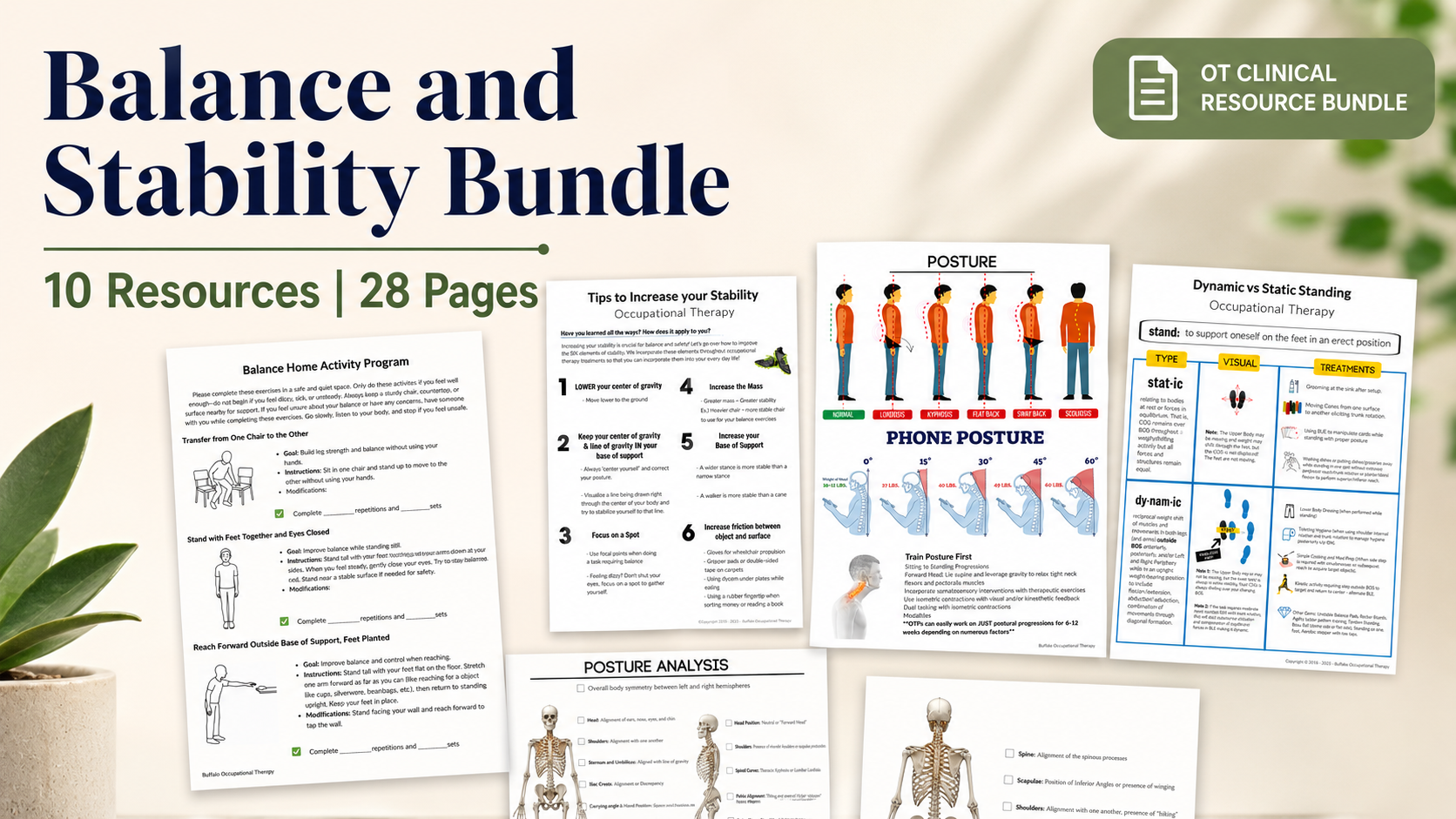
Dear Members: The Balance and Stability Bundle is in your Membership Library, check it out!
Membership Resources: This article and its companion audio are free to read and listen to. Links throughout the article connect members of the Functional Cognition Lab to related printables, treatment tools, courses, and clinical resources that align with the topic being discussed. Membership also includes access to the full resource library and direct clinical support. Find out more about membership on the Membership Options Page
Just want the resources mentioned in this article?: Download the Balance and Stability Bundle
AOTA-Approved CEU Course: Trunk, Balance, and Posture in Occupational Therapy : Explore trunk control, postural alignment, balance, and the role of proximal stability in functional movement and occupational performance.
Motor dysfunction is one of those concepts that sounds straightforward until you are standing in front of an actual patient. The person cannot reach accurately, their gait looks awkward, they struggle to get an arm into a shirt sleeve, or they repeatedly lose their balance during an otherwise familiar activity. Sometimes weakness is obvious. Other times the patient appears to have enough strength and range of motion, yet the movement still does not look or function the way you would expect.
This is where occupational therapy practitioners need to think beyond a single impairment.
Functional movement depends on multiple systems working together. A person may need adequate range of motion, muscle strength, postural control, muscle tone, sensation, coordination, praxis, and the cognitive ability to understand and carry out the task. A breakdown in any one of these areas can change the way movement looks and, more importantly, whether the person can successfully use that movement during everyday activity.
The clinical question is therefore not simply, “What movement is impaired?” We need to determine what is interfering with the person's ability to produce and use that movement functionally.
Functional Movement Is More Than Moving a Joint
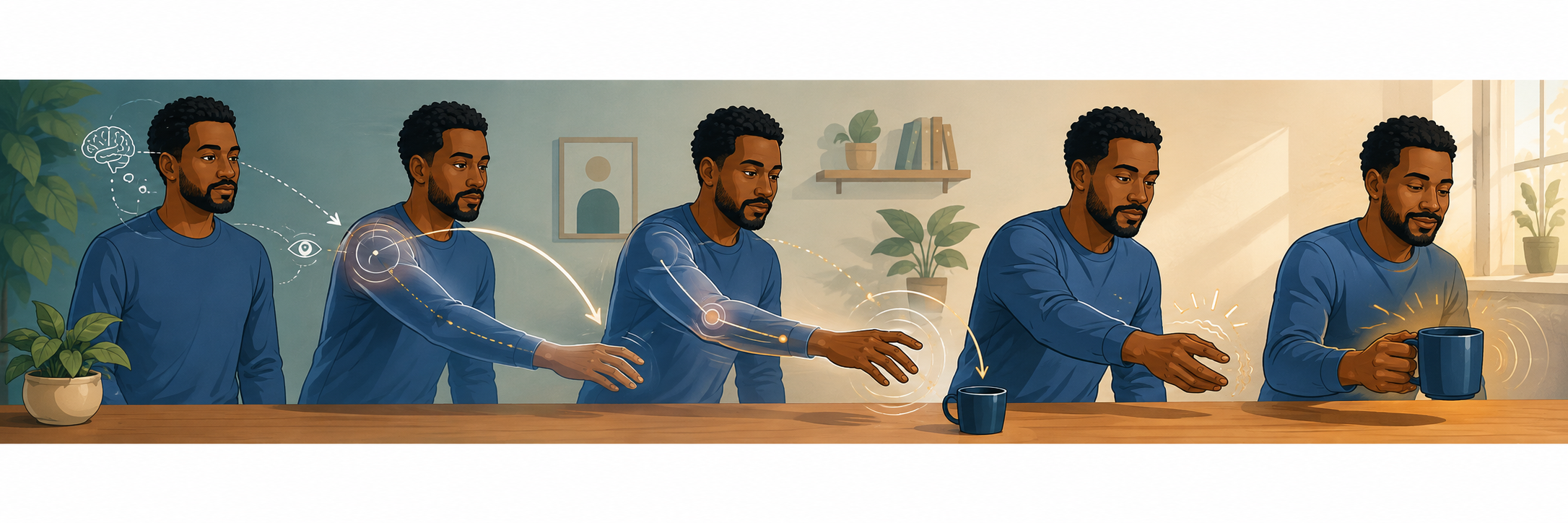
Consider something as ordinary as reaching for a coffee mug. The shoulder has to move, but that is only one part of the task. The person also has to locate the mug, understand what they intend to do with it, maintain enough postural stability to reach, coordinate the shoulder and elbow, adjust the trajectory of the hand, open the fingers at the right time, generate an appropriate grip, and use sensory information to determine whether the mug is securely held.
All of that happens within a matter of seconds.
This is why someone can have adequate shoulder flexion on a range-of-motion screen and still have difficulty reaching for the mug. It is also why a patient can demonstrate reasonable strength during manual muscle testing but struggle significantly once the same muscles have to function within a more complicated movement pattern.
ROM and strength matter, but they are pieces of a much larger movement system.
Helpful Resource: The Clinic Is Not the Goal. Home Is.
A practical discussion of why improvements seen in therapy have to translate into meaningful performance in the environments where patients actually live.
Praxis and Motor Planning
Praxis involves understanding the demands of an activity and organizing the movements needed to carry it out. A patient may physically possess the movements needed for a task but have difficulty conceptualizing, initiating, sequencing, or organizing those movements.
Dressing is a good example. A patient may have sufficient shoulder and elbow movement to put on a jacket, yet repeatedly orient the jacket incorrectly, attempt to place the wrong arm into the sleeve, or become stuck during the sequence. Performing additional shoulder strengthening exercises will not necessarily solve that problem because the limitation may not primarily be muscular.
This is where task observation becomes so important. Watching the person perform the actual occupation helps you distinguish between a patient who cannot produce a movement and a patient who has the movement but cannot effectively organize it.
Helpful Resource: It’s Not Weakness. It’s a Missing Motor Plan.
Explore why a patient may physically have the movement needed for an activity but still struggle to organize, initiate, or carry it out.
Postural Control
The extremities also need a stable base from which to move. Postural control allows a person to maintain and adjust the position of the body while movement occurs elsewhere.
You can often see the relationship between proximal stability and distal movement during reaching. A patient may appear to have poor shoulder control because they lean excessively to the side, rotate the trunk, or use momentum every time they reach. When you improve their seated position or provide additional proximal support, the arm movement may suddenly become more controlled.
That finding matters. Instead of immediately assuming the shoulder needs more strengthening, you now have evidence that postural stability is contributing to the movement problem.
The same principle applies during dressing, transfers, grooming, meal preparation, and functional mobility. Sometimes the extremity that appears impaired is actually trying to compensate for instability somewhere else.
Member Resource: Postural Analysis Template
Helpful Resource: Balance and Stability for Occupational Therapy
Review how postural stability, balance, and movement interact during reaching, mobility, and everyday occupational performance.
Range of Motion
Range of motion determines whether the person has access to the joint movement required for an activity. A patient cannot reach an overhead cabinet efficiently if the necessary shoulder motion simply is not available.
However, available movement and actively usable movement are not always the same thing. A patient may demonstrate nearly full passive shoulder flexion but substantially less active shoulder flexion. Another patient may have similar limitations in both passive and active movement. Those findings look similar during occupation, but they suggest different underlying problems.
This is why comparing passive, active-assisted, active, and self-assisted movement can help clarify what is occurring. The important question is not simply how many degrees of motion are present. It is whether the person can access and control enough movement to meet the demands of the task.
Member Resource: Upper Body Active Range of Motion Reference
Helpful Resource: Top Four Range of Motion Concepts in Occupational Therapy
Compare PROM, SROM, AAROM, and AROM and what each tells us about a patient’s access to and control of movement.
Muscle Strength and Endurance
Strength allows the person to generate the force needed to produce and control movement. Weakness can certainly interfere with occupation, but a manual muscle testing score should never be interpreted completely outside of functional performance.
Imagine a patient who has difficulty bringing a cup to their mouth. Elbow flexor weakness might contribute, but so could shoulder instability, tremor, pain, limited range of motion, altered tone, poor grip, impaired sensation, or fatigue. The movement has to be analyzed before we can confidently decide which impairment deserves treatment.
Endurance adds another layer. A patient may have enough strength to perform a movement once but not enough muscular endurance to repeat or sustain it throughout an activity. Muscle endurance includes the ability to perform repeated contractions or maintain muscular activity over time.
A patient may be able to raise an arm during testing but struggle to keep it elevated long enough to wash their hair. Someone may successfully complete one sit-to-stand but fatigue when the movement has to occur repeatedly throughout the day. That difference between producing force and sustaining force can significantly change intervention planning.
Helpful Resource: Manual Muscle Testing in Occupational Therapy
Learn how to interpret muscle strength findings within the larger context of movement patterns and functional performance.
Muscle Tone
Tone also influences the quality and efficiency of movement. Changes in tone may affect a person's ability to initiate movement, maintain a position, move selectively, or transition smoothly between different movement patterns.
Hypotonia, flaccidity, hypertonicity, rigidity, and spasticity do not all produce the same presentation. Hypertonicity may create increased resistance to movement, while spasticity has a velocity-dependent component. Rigidity can involve increased resistance across opposing muscle groups, while hypotonia may make maintaining posture or joint stability more difficult.
In neurological rehabilitation, tone also interacts with strength and motor control. A patient may appear weak because they cannot selectively recruit the movement you are asking for, even though muscle force production is not the only issue. Another patient may generate substantial force but remain trapped within an inefficient synergy pattern.
This is why “the arm is weak” is sometimes an incomplete description of what you are actually seeing.
Helpful Resource: Spastic Hemiplegia: When the Affected Arm Can’t Hold Still
A clinical look at how altered tone and motor control can interfere with positioning, stability, and functional use of the affected upper extremity.
Sensation
Movement depends heavily on sensory information. The nervous system continuously receives information about joint position, pressure, touch, movement, and the relationship between the body and the environment. Mechanoreceptors, for example, respond to mechanical information such as touch, pressure, vibration, and joint-related input.
When that feedback is impaired, the movement itself may appear clumsy or poorly controlled. A patient with reduced proprioceptive awareness may watch their hand throughout an activity because vision is helping compensate for unreliable information about limb position. Someone with impaired tactile sensation may grip an object excessively because they cannot accurately determine whether it is secure.
This is an important reminder that what looks like a motor problem may sometimes be partly sensory.
If the person repeatedly misses objects, uses excessive force, drops items, or has difficulty controlling limb position, consider whether they are receiving enough sensory information to effectively guide the movement.
Coordination
Coordination refers to the ability to organize muscle activity so movement occurs with appropriate timing, direction, rhythm, and force. It may involve gross motor coordination, fine motor coordination, or eye-hand coordination.
Rather than documenting only “poor coordination,” describe what you actually observe. Does the patient overshoot or undershoot a target? Is the movement broken into multiple segments? Do they lose rhythm during alternating movements? Does tremor become more pronounced as the hand approaches the target? Do they rely heavily on vision? Does the movement become less accurate when speed increases?
Those observations are much more informative because different movement disorders produce different patterns.
For example, dysmetria may present as overshooting or undershooting the intended target, while dysdiadochokinesia involves difficulty with rapidly alternating movements. Dyssynergia can cause movement to become segmented rather than smooth, and intention tremor may become more noticeable as the person approaches a target.
These differences are clinically useful. They help us move beyond the broad label of “poor coordination” and begin thinking about what part of motor control may be impaired.
Helpful Resource: The Cerebellum
Explore how the cerebellum contributes to movement timing, coordination, accuracy, postural control, and the ongoing adjustment of movement.
Cognition Is Part of Movement Too
Movement discussions sometimes become so focused on the musculoskeletal and neurological systems that cognition gets separated from the picture. During occupation, that separation does not really exist.
A person must understand the task, maintain the goal, initiate the action, monitor what is happening, recognize errors, and adjust their behavior when conditions change. A patient may physically possess everything needed to complete a transfer but initiate the movement before the wheelchair brakes are locked. Another patient may have enough strength and balance to prepare a simple meal but lose track of the sequence once several steps compete for attention.
This becomes particularly obvious during dual-task situations. Someone may walk well through a quiet hallway and then demonstrate shorter steps, reduced balance, or slower gait when they are asked a question while walking. Their muscles did not suddenly become weaker. The demands placed on the movement system changed.
This is one of the reasons functional cognition belongs in conversations about motor performance. Movement occurs within an activity, and activities almost always place simultaneous cognitive, sensory, environmental, and physical demands on the person.
Helpful Resource: Your Patient Is Working Hard. Their Brain Is Working Harder.
See how cognitive load and simultaneous task demands can change motor performance even when basic movement capacity appears intact.
Stop Looking for One Impairment
When movement looks abnormal, there is a temptation to identify the most obvious impairment and make it the explanation for everything. In reality, several factors often contribute at the same time.
A difficult reach might involve limited ROM, weakness, poor trunk control, impaired proprioception, and coordination. A transfer problem could involve lower-extremity weakness, balance, motor planning, attention, fear, and environmental setup. Poor handwriting might involve fine motor control, sensation, grip, visual processing, posture, and endurance.
This is why occupational therapy evaluation cannot simply become a collection of impairment scores. Objective measurements are important, but they become much more useful when we understand how those findings interact during the person's actual activities.
Watch Where the Task Breaks Down
One of the best ways to understand motor dysfunction is simply to watch the person perform something meaningful. Observation during routine activities can reveal problems that are not obvious during isolated testing.
As the person performs the task, pay attention to where performance begins to change. You might notice that posture deteriorates first, accuracy decreases as the arm moves farther from the body, the patient begins using momentum after several repetitions, tone increases with effort, or performance becomes less organized when another demand is introduced.
Then change something.
Improve the base of support. Reduce the reach distance. Provide visual feedback. Stabilize the proximal segment. Reduce the cognitive demand. Change the object. Slow the movement.
If performance improves, you have gained information about what may have been driving the difficulty.
That is clinical reasoning happening in real time.
Compensation Is Also Information
Compensation is not automatically a sign that treatment has failed. Sometimes it is an inefficient pattern that we want to reduce. Sometimes it is an effective strategy that allows the person to participate safely and independently.
If a patient leans the trunk to complete a reach, for example, you need to determine why. Perhaps the trunk movement is compensating for limited shoulder motion. Maybe it allows the person to complete an important task despite a permanent impairment. Or perhaps the strategy is creating pain, instability, or additional safety concerns and should be modified.
Remediation, compensation, environmental adaptation, and education can all exist along the same continuum of intervention. The goal is not always to make movement look perfectly normal. The goal is to help the person perform meaningful activities as safely, efficiently, and independently as possible.
Turning Movement Analysis Into Treatment
Once you have a better understanding of what is contributing to the motor dysfunction, treatment becomes much more specific. Limited mobility may require work on range of motion. Weakness may require strengthening and endurance training. Poor proximal stability may require postural and trunk control. Sensory impairment may require greater reliance on visual feedback, graded sensory input, or environmental modifications. Motor-planning deficits may respond to structured practice, cueing, and repeated performance of meaningful tasks.
Coordination problems may require controlled practice of goal-directed movement, while altered cognitive demands may require you to change the complexity, sequencing, or attentional requirements of the activity.
The important part is that these components eventually have to come back together.
We can isolate an impairment temporarily because doing so helps us understand or address a specific limitation. But the patient ultimately has to reach, dress, cook, walk, manipulate objects, manage self-care, and interact with the environment. That is where the systems have to work together again.
A Functional Example
Imagine a patient after a neurological injury who repeatedly misses a cup when reaching.
You could document that the patient demonstrates impaired upper-extremity coordination, but that should be the beginning of the analysis rather than the end of it.
Watch what happens. Does the patient consistently overshoot the cup? Is the movement less accurate as the hand approaches the target? Can they maintain their trunk position? Do they have enough active shoulder and elbow motion? Does visual feedback improve accuracy? Can they recognize that they missed? Can they correct the movement on the next attempt? Does performance become worse when they are simultaneously answering a question?
Each observation tells you something different about the movement system.
Now your intervention is no longer simply “practice reaching.” You can target the factor that appears to be interfering with successful reaching and then return that component to the functional task.
The Clinical Takeaway
Functional movement emerges from the interaction of praxis, postural control, range of motion, strength, tone, sensation, coordination, and cognition. None of these systems operates completely independently during occupation.
When movement breaks down, look beyond what the movement looks like and try to determine why it is happening. Consider whether the movement is physically available, whether the person can generate and sustain enough force, whether they can stabilize their body, whether sensory information is adequately guiding the movement, and whether they can plan, coordinate, monitor, and adjust their actions.
Then watch what happens when the demands of the task change.
That is where a generic observation such as “poor movement” starts becoming useful clinical information, and where motor dysfunction becomes something we can actually reason through and treat.
Continue Learning With Us
Did you find this information helpful? Please share this article with another occupational therapy practitioner, student, educator, or rehabilitation professional who may benefit from it.
Would you like access to the clinical resources discussed throughout this article? Explore our membership options to find the level of support that works best for you.
Looking for a more formal learning and mentorship experience? Learn more about the Functional Cognition Lab Mentorship Program.
You can also explore our AOTA-approved courses and clinical resource packages for additional education, treatment resources, and practical tools you can use in rehabilitation practice.
Interested in receiving free functional cognition education each week? Subscribe to the Functional Cognition Lab Newsletter