
Top Four Range of Motion Concepts in Occupational Therapy
Aug 07, 2026
Range of Motion in Occupational Therapy:
PROM, AAROM, AROM, and SROM Explained
Membership Resources: This article and its companion audio are free to read and listen to. Links throughout the article connect members of the Functional Cognition Lab to related printables, treatment tools, courses, and clinical resources that align with the topic being discussed. Membership also includes access to the full resource library and direct clinical support. Find out more about membership on the Membership Options Page
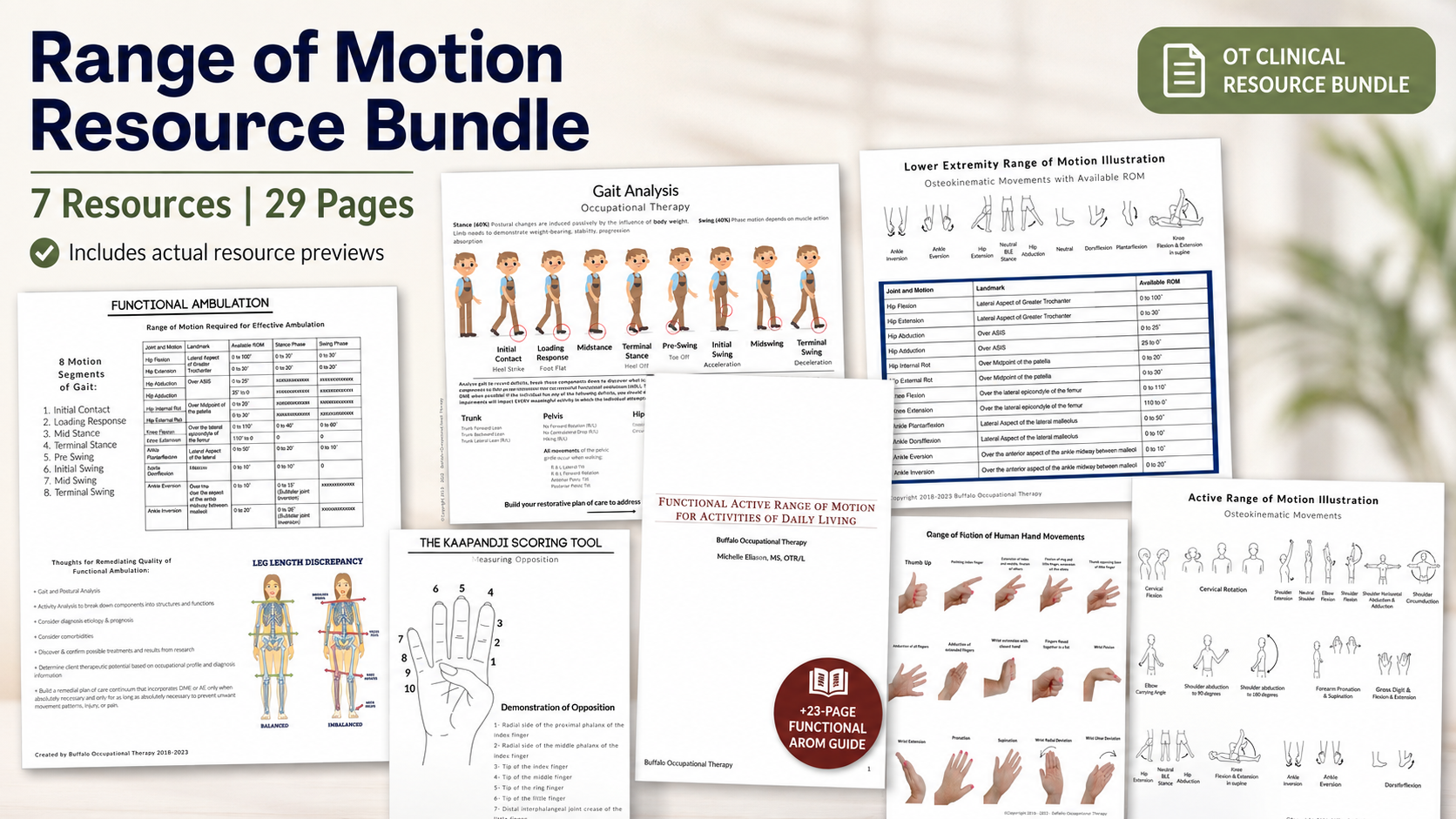
Just want the resources mentioned in this article?: Download the Range of Motion Bundle
Range of motion is one of those concepts that seems incredibly straightforward when you first learn it.
A joint moves through a certain number of degrees. We measure it. We determine whether movement is limited. Then, if needed, we work on improving it.
Clinical practice is rarely that simple.
A patient may have full passive range of motion but still be unable to actively reach into a cabinet. Another person may have limited shoulder motion but successfully complete dressing because they have developed an effective movement strategy. Someone else may technically have enough range but cannot access it because of weakness, pain, impaired motor control, spasticity, poor postural stability, or difficulty initiating the movement.
So when you evaluate range of motion in occupational therapy, try not to stop at: How many degrees does this joint move? Instead, Ask: Does this person have access to the movement they need to perform the occupation?
Practitioners who need a refresher on the anatomy and movement of the upper extremity can also review the AOTA-approved CEU course: Overview of the Upper Extremity in Occupational Therapy.
What Is Range of Motion?
Range of motion, or ROM, describes the movement available at a joint.
In occupational therapy, ROM may help us understand why someone is having difficulty reaching, dressing, bathing, grooming, toileting, feeding, cooking, completing household tasks, working, transferring, or participating in other meaningful activities...but range of motion rarely functions independently!
Functional movement depends on multiple systems working together, including:
- joint mobility
- muscle strength
- postural control
- muscle tone
- sensation
- coordination
- motor planning
- pain
- endurance
- cognition
All of these contribute to whether someone can actually produce a useful movement during an occupation, which is why two people with identical shoulder-flexion measurements can function completely differently.
- One may have pain.
- One may have significant weakness.
- One may demonstrate poor scapular control.
- One may compensate effectively with another movement pattern.
- One may have enough available motion but struggle to organize the movement neurologically.
The ROM measurement is information. Your clinical reasoning determines what that information means.
Passive Range of Motion: PROM
Passive range of motion means the movement is produced by an outside force rather than by the patient's own muscular effort.
The therapist may move the extremity, or another external source may assist in producing the motion.
PROM is useful when you need to understand how much movement is available at the joint independent of the person's ability to actively produce it.
It may also be incorporated when active muscular contraction is not currently possible or appropriate.
One important distinction is that PROM is not strengthening. The patient's muscles are not generating the movement, so passive movement should not be treated as though it is strengthening an inactive muscle.
Imagine a patient after a neurological injury who cannot actively extend their elbow.
You move the elbow passively and discover that almost full extension is available which tells you that the joint can physically reach that position.
The problem is that the patient cannot currently produce or control the movement independently.
Now you need to ask why.
- Is the limitation related to weakness?
- Altered tone?
- Motor control?
- Pain?
- Fear?
- Motor initiation?
- Several of these at once?
That is the point of comparing passive and active movement.
Self Range of Motion: SROM
Self range of motion allows the patient to use another part of their own body to assist the movement.
A common example is using the stronger upper extremity to help move an affected arm.
I like SROM because the patient becomes part of the process.
Instead of the therapist doing all of the movement, the person learns how to position, support, and move their own extremity. This can also make SROM useful as part of an appropriate home program.
But do not simply hand someone a sheet of exercises and tell them to complete twenty repetitions.
Teach them what they are doing.
They should understand how far to move, what discomfort is acceptable, what symptoms should make them stop, how to protect vulnerable joints, and why maintaining or improving that particular movement matters.
The goal is not completing repetitions.
The goal is increasing the person's ability to safely participate in managing their own movement.
Active-Assisted Range of Motion: AAROM
Active-assisted range of motion occurs when the patient actively contributes to the movement but receives assistance to complete it.
That assistance might come from:
- the therapist
- the opposite extremity
- a cane or dowel
- a table surface
- gravity-reduced positioning
- another external support
AAROM is a combined effort between the person's own muscular activation and an outside source.
This can be especially useful when someone can initiate movement but cannot complete the entire range independently.
Think about a patient who begins shoulder flexion successfully but reaches a point where the arm starts to drop.
You could simply lift the arm for them.
Or you could provide just enough assistance for the patient to continue participating in the movement.
That distinction matters.
In the second situation, the patient continues producing and controlling as much of the movement as possible while you fill in what they cannot yet accomplish independently.
Active Range of Motion: AROM
Active range of motion means the patient produces the movement through their own muscular effort.
This gives us different information than PROM.
Suppose your patient has nearly full passive shoulder flexion but only 70 degrees of active shoulder flexion.
The joint has considerably more available motion than the patient can currently access independently.
That should immediately make you think beyond joint restriction.
Consider:
- weakness
- pain
- fatigue
- motor activation
- coordination
- neuromuscular control
- altered tone
- postural stability
Now imagine another patient has approximately 70 degrees of both passive and active shoulder flexion.
That is a different presentation because passive mobility itself is also limited.
Those two patients should not automatically receive identical treatment, and once you understand what is limiting the active movement, the next question becomes how to help the patient actually use that movement.
As active movement improves, begin moving away from isolated motion and toward meaningful movement patterns. Your patient eventually needs to use that shoulder, elbow, wrist, and hand to interact with the environment.
For example, maybe they need to reach for clothing, wash their hair, retrieve a plate, carry groceries, reach into a cabinet, or manage bathing supplies. Building movement in strength is one thing, pointing toward an occupation is quite another.
This is where understanding the movement requirements of ADLs and IADLs becomes important.
Need tips for improving AROM with spasticity? Check out Managing and Inhibiting Spasticity article.
PROM vs. AAROM vs. AROM vs. SROM
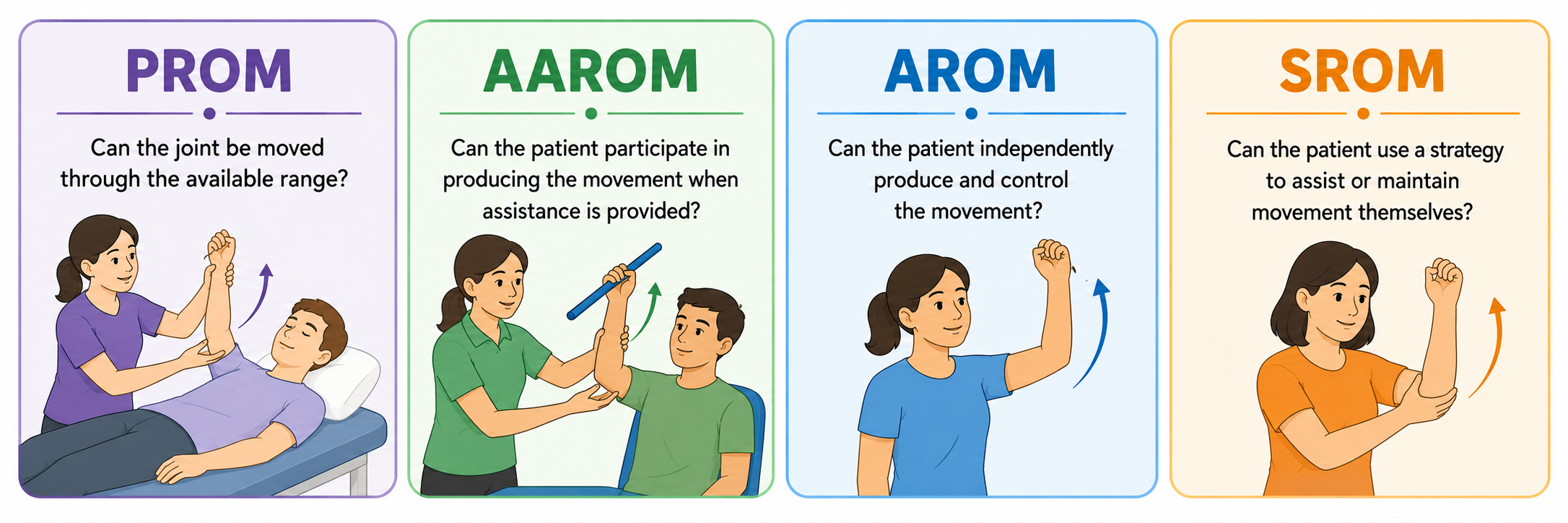
A simple way to organize the four concepts is to think about the question each one helps answer.
PROM: Can the joint be moved through the available range?
AAROM: Can the patient participate in producing the movement when assistance is provided?
AROM: Can the patient independently produce and control the movement?
SROM: Can the patient use a strategy to assist or maintain movement themselves?
Now the abbreviations mean something clinically.
They help you determine the difference between movement that exists and movement the person can actually access.
Range of Motion Should Connect to Occupation
Member Resource:
- Functional Active Range of Motion for Activities of Daily Living (23 pages of range of motion -> functional task conversions)
- Activity Analysis illustration
A limitation in range of motion matters because of what it prevents someone from doing.
- Shoulder flexion may matter because the person cannot reach a cabinet.
- Shoulder external rotation may matter because they cannot wash or style their hair.
- Elbow extension may matter because they cannot reach an object away from their body.
- Forearm supination may affect feeding, carrying, or manipulating objects.
- Wrist extension may influence functional grasp.
- Lower-extremity range can affect dressing, transfers, toileting, and mobility.
This is why activity analysis matters.
Ask:
Where does this movement occur in the person's life?
You may also discover that the person does not need textbook-normal range to successfully perform the occupation. They may need enough movement, combined with appropriate strength, stability, coordination, equipment, environmental support, and strategy.
The value proposition of an OT practitioner is that we start with the end activity in mind and builds the goal to the person and in s doing, we establish a difference between treating a measurement and treating occupational performance.
When writing goals, the same reasoning applies. A ROM goal becomes stronger when the movement is connected with why it matters. See examples in Occupational Therapy Goals for ADLs and IADLs and Occupational Therapy Goals for Functional Mobility.
When Should You Be Cautious With Range of Motion?
Range of motion is basic, but that does not mean it is automatically harmless. Before applying force to a joint, know the medical situation.
Conditions requiring avoidance or additional caution may include recent fractures or dislocations, acute soft-tissue injury, joint inflammation or infection, osteoporosis, hypermobility, subluxation, hematoma, heterotopic ossification, and other situations in which tissue or joint integrity may be compromised.
Do not walk into a room, see a stiff shoulder, and immediately start pushing it farther. Instead, ask what happened, review precautions, know whether surgery occurred recently or historically, consider tissue healing, assess pain, understand the diagnosis, and if the presentation does not make sense, investigate before adding force.
Limited Movement Does Not Automatically Mean “Do ROM”
This is where clinical reasoning gets interesting.
Your patient cannot reach overhead.
Is the problem actually range of motion?
Maybe.
But it could also be:
- weakness
- pain
- poor scapular control
- altered muscle tone
- impaired trunk stability
- decreased motor planning
- sensory impairment
- fear of movement
- reduced endurance
Sometimes several of these are occurring together.
This is why observation during actual activity is so valuable.
Watch the person reach for a cup.
Watch them put on a jacket.
Watch them retrieve something from a shelf.
Watch the trunk.
Watch the scapula.
Watch whether they avoid using the arm.
Watch what happens when the object moves farther away.
Observation of normal movement during everyday activity can supplement isolated ROM and strength testing and help clarify how an impairment is influencing function.
Postural control can also completely change what the upper extremity is capable of doing. When that appears to be part of the problem, consider how balance and stability are affecting movement.
Turning Range of Motion Into Treatment
Think of intervention as a progression rather than a collection of exercises.
A patient may initially require passive movement.
Then active-assisted movement.
Then active movement.
Then strengthening.
Then reaching.
Then reaching while maintaining trunk control.
Then reaching while standing.
Then reaching while manipulating another object.
Then performing the occupation.
That progression will look different for every patient, and the act of choosing where your patient is in this continuum is called activity grading.
You are changing the motor, cognitive, environmental, and physical demands as the person's abilities change. The principles behind the just-right challenge are particularly useful here.
And remember that remediation and compensation can exist on the same continuum.
Sometimes we restore movement.
Sometimes we modify the environment.
Sometimes we teach another strategy.
Often, we do several of those things at the same time.
The right decision depends on the person's diagnosis, prognosis, goals, safety, environment, recovery potential, and occupational needs.
Document More Than “ROM Exercises”
Documenting “Patient completed BUE ROM exercises.” does not tell us very much at all. Instead, describe what you were trying to change, what the patient did, what assistance was required, and then connect the movement to function.
For example:
Patient completed active-assisted shoulder flexion during functional reaching with proximal support to increase access to overhead grooming supplies.
Now we know what movement was addressed, the type of assistance provided, how it was practiced, and why it mattered.
Other useful variables may include:
- available ROM
- pain
- assistance required
- compensatory movement
- repetitions
- movement quality
- fatigue
- changes across trials
- functional carryover
The Goals and Objective Measures and Documentation and Billing sections of BOT Portal provide additional support for translating those findings into measurable goals and defensible documentation.
The Clinical Takeaway
Range of motion is not simply a number from a goniometer; It gives us, as practitioners information about movement access.
PROM tells us what movement is available when an outside force produces it.
AAROM tells us what the patient can contribute when assistance fills the gap.
AROM tells us what movement the person can independently produce and control.
SROM gives the patient another way to participate in maintaining or accessing movement.
But none of those measurements become especially meaningful until we connect them to occupation.
So, when you see that your patient's shoulder flexion is 90 degrees.
Immediately, begin asking yourself:
- Why is it limited?
- What happens passively compared with actively?
- What other systems are influencing the movement?
- What does this prevent the person from doing?
- How much movement does the occupation actually require?
- And what is the most appropriate way to help this particular person get there?
Continue Learning With Us
Did you find this information helpful? Please share this article with another occupational therapy practitioner, student, educator, or rehabilitation professional who may benefit from it.
Would you like access to the clinical resources discussed throughout this article? Explore our membership options to find the level of support that works best for you.
Looking for a more formal learning and mentorship experience? Learn more about the Functional Cognition Lab Mentorship Program.
You can also explore our AOTA-approved courses and clinical resource packages for additional education, treatment resources, and practical tools you can use in rehabilitation practice.
Interested in receiving free functional cognition education each week? Subscribe to the Functional Cognition Lab Newsletter.
Hosted by Michelle Eliason, MS, OTR/L