
Balance and Stability for Occupational Therapy
Jun 27, 2024
Understanding Balance and Stability in Occupational Therapy
by Michelle C. Eliason, MS, OTR/L
Dear Members, check out your Membership Library where you have access to the Resource Bundles with your membership. I would also like to encourage you to leave a Marco Polo message for asynchronous discussion about how this content may currently relate to your clinical practice or education!
Membership Resources: This article and its companion audio are free to read and listen to. Links throughout the article connect members of the Functional Cognition Lab to related printables, treatment tools, courses, and clinical resources that align with the topic being discussed. Membership also includes access to the full resource library and direct clinical support. Find out more about membership on the Membership Options Page
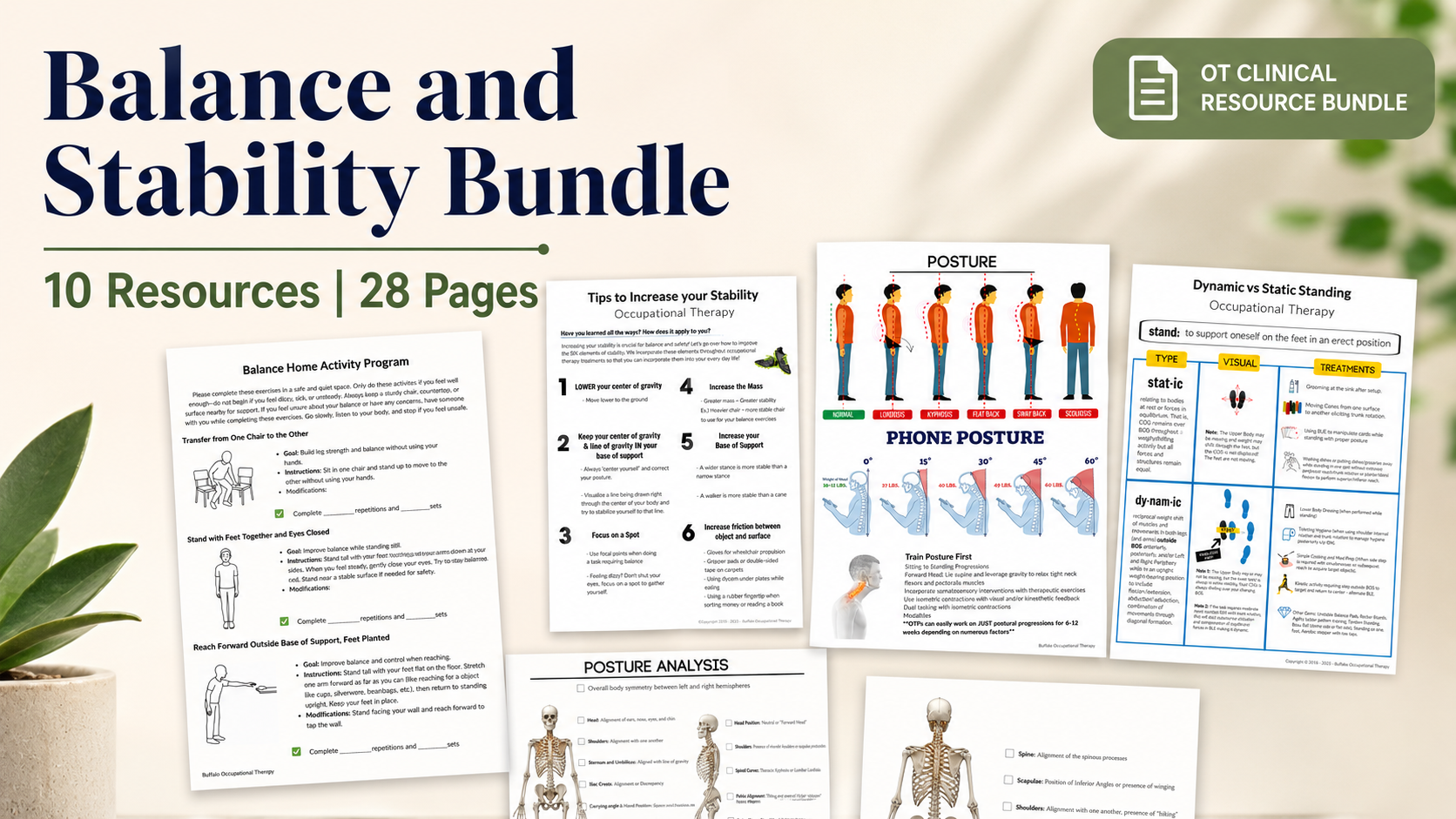
Just want the resources mentioned in this article?: Download the Balance and Stability Bundle
- Occupational Therapy Intervention Dashboard
- Balance and Stability Goals for Neuromuscular Re-Education
- Balance and Stability in Occupational Therapy
- How to Write Occupational Therapy Goals for Balance and Stability
Balance
Balance is the ability to control the body’s position in relation to gravity and the surrounding environment.
It requires the nervous system to continuously manage the relationship between the body’s center of mass and its base of support.
Balance can be static or dynamic.
Static balance allows a person to maintain a position, such as sitting upright or standing still.
Dynamic balance allows a person to maintain control while reaching, turning, stepping, walking, transferring, or changing positions.
Member Resource: Functional Ambulation in Occupational Performance Handout
Balance is not simply about avoiding a fall. It also allows a person to move efficiently, adjust to the environment, and participate safely in everyday activities.
Stability
Stability is the body’s ability to maintain or regain control when balance is challenged.
A person demonstrates stability when they can remain upright during a reach, recover after being bumped, control their body during a transfer, or adjust safely when walking across an uneven surface.
Balance and stability are closely connected.
Balance describes the overall control of body position. Stability describes how well that control is maintained or recovered when movement, force, or an unexpected disturbance occurs.
The Importance of Balance and Stability in Occupational Therapy
Understanding balance and stability is important because both affect occupational performance.
A person may have difficulty sitting upright long enough to get dressed. Another person may stand safely but lose control when reaching into a cabinet. Someone else may walk well in a quiet hallway but become unstable when carrying an object, turning quickly, or talking at the same time.
Occupational therapy practitioners evaluate which part of postural control is breaking down.
Helpful Member Resource: Standing Balance and Posture
The person may have difficulty:
-
Maintaining a position
-
Moving within the base of support
-
Preparing the body before movement
-
Responding to an unexpected disturbance
-
Using sensory information
-
Coordinating movement
-
Dividing attention during mobility
-
Adapting to different environments
Treatment should address the specific problem while remaining connected to meaningful daily activities.
For example, if a patient cannot sit upright without support, therapy may begin with trunk control, alignment, and static sitting. As control improves, the therapist may add reaching, turning, object manipulation, or changes in the supporting surface.
If the person can maintain a position but loses control during movement, therapy may focus more heavily on coordination, weight shifting, stepping, transfers, agility, and reactive postural control.
The Sensory Systems That Support Balance
Balance depends on information from three major sensory systems.
Vision
Vision provides information about the body’s position in relation to the environment.
Visual information helps a person identify obstacles, judge distance, maintain orientation, and plan movement.
Vestibular System
The vestibular system is located in the inner ear.
It provides information about head position, movement, speed, and direction. It helps the body remain oriented when the head moves or when visual information is limited.
Somatosensory and Proprioceptive Systems
Somatosensory and proprioceptive input comes from the skin, muscles, joints, and supporting surfaces.
This information helps the brain understand where the body is positioned and how much pressure is being placed through the feet, hands, or other body parts.
The nervous system constantly combines information from all three systems.
When one source of information becomes unreliable, the brain must rely more heavily on the others.
For example, a person may appear stable in a bright room but become unsteady in dim lighting because they depend too heavily on vision.
Anticipatory Postural Control
Anticipatory postural adjustments occur before movement begins.
Before a person reaches, stands, lifts an object, or takes a step, the body activates muscles to prepare for the expected change in balance.
These adjustments help prevent the intended movement from causing a loss of control.
A person with impaired anticipatory postural control may hesitate before moving, use excessive effort, lose balance during reaching, or struggle to begin walking.
Reactive Postural Control
Reactive postural control occurs after something unexpected challenges balance.
This may happen when a person slips, trips, gets bumped, steps onto an uneven surface, or experiences a sudden movement of the supporting surface.
The body may respond with:
-
An ankle strategy
-
A hip strategy
-
A stepping response
-
A reaching response
-
Grasping for support
A person may appear stable during predictable activities but still have poor reactive balance.
This is one reason that standing still during an assessment does not always reflect safety during real life.
Limits of Stability
Limits of stability describe how far a person can intentionally move their center of mass within the base of support without stepping, falling, or reaching for support.
This ability is used during many daily activities, including:
-
Reaching into cabinets
-
Pulling up clothing
-
Bathing
-
Preparing meals
-
Picking up objects
-
Transferring
-
Opening doors
-
Moving through crowded environments
A person with reduced limits of stability may avoid reaching, move very slowly, or rely heavily on furniture and other supports.
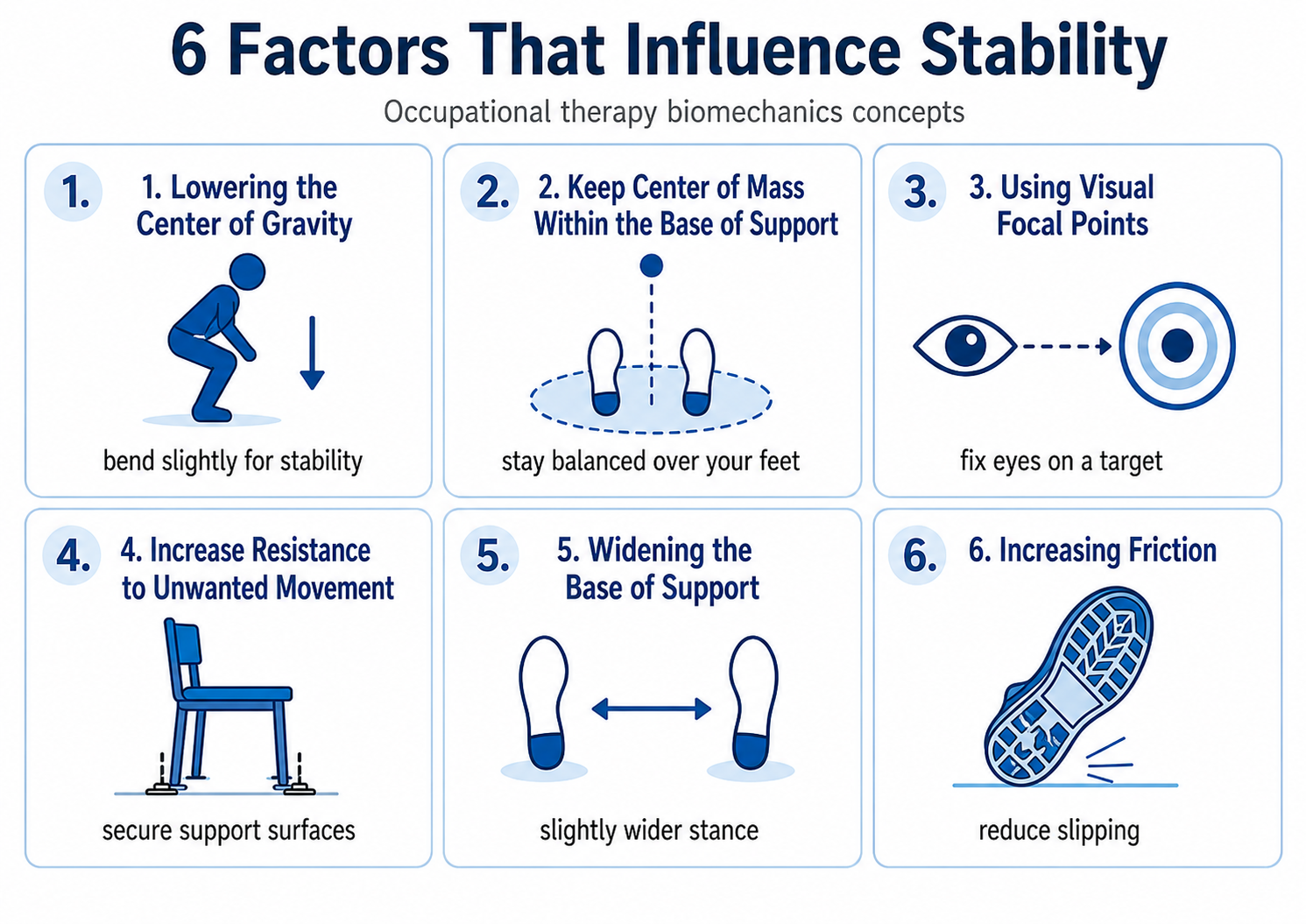
Six Factors That Influence Stability
Several biomechanical factors can affect how stable a person or object is.
These principles can be used during occupational therapy to improve safety, positioning, movement, and functional performance.
1. Lowering the Center of Gravity
Lowering the center of gravity generally increases stability.
People often do this naturally when they feel unsteady. They may bend their hips and knees or lower their body closer to the ground.
A slight bend at the hips and knees may help a person prepare for lifting, reaching, or responding to an expected challenge.
However, this strategy must be individualized.
Excessive crouching or forward flexion may make walking, transfers, and movement initiation more difficult for some people.
The goal is not simply to get lower. The goal is to find a position that provides control while still allowing efficient movement.
2. Keeping the Center of Mass Within the Base of Support
The base of support is the area beneath and between the parts of the body that are touching the supporting surface.
During standing, the base of support is generally the area beneath and between the feet.
The center of mass is the point where the body’s mass is considered to be concentrated.
The line of gravity is the vertical projection of the center of mass toward the supporting surface.
A person is generally more stable when the line of gravity remains within the base of support and away from its outer edges.
However, movement often requires the center of mass to shift.
During walking, the body repeatedly moves forward and creates a new base of support with each step.
Occupational therapy interventions may help patients improve their awareness and control of these shifts during reaching, transfers, mobility, and daily activities.
3. Using Visual Focal Points
A fixed visual target can provide an external reference for posture and movement.
Member Resource: Postural Analysis Checklist
Visual fixation may help a person maintain orientation, reduce unnecessary head movement, and improve control during standing or walking.
This can be helpful during:
-
Gait training
-
Transfers
-
Reaching
-
Turning
-
Balance exercises
-
Movement initiation
Visual cues may also help some people with Parkinson’s disease improve posture, step length, or movement initiation.
However, vision should not become the person’s only balance strategy.
Therapy should also challenge the vestibular and somatosensory systems when appropriate so the person can remain safe in different environments.
4. Increasing Resistance to Unwanted Movement
Objects that are heavier or more securely positioned may resist sliding or tipping.
This principle can be useful when selecting furniture, adaptive equipment, or environmental supports.
However, heavier equipment is not automatically safer.
For example, a four-wheeled walker may be heavier than another device, but it may also move more freely and require effective braking, coordination, cognition, and control.
Equipment should be selected based on:
-
The person’s strength
-
Balance reactions
-
Cognition
-
Coordination
-
Movement pattern
-
Environment
-
Ability to control the device
-
Functional goals
The safest device is the one that best matches the individual, not simply the one with the greatest mass.
5. Widening the Base of Support
A wider base of support generally provides more room for the center of mass to move without crossing the outer boundaries.
For example, standing with the feet slightly farther apart may improve stability during selected tasks.
Mobility aids also increase the base of support.
A walker generally provides a larger base of support than a cane.
However, wider is not always better.
An excessively wide stance may interfere with stepping, transfers, turning, or efficient movement.
The goal is to create an appropriate and controllable base of support for the task.
6. Increasing Friction
Friction helps prevent unwanted sliding.
Examples include:
-
Rubber soles on shoes
-
Non-slip bathroom surfaces
-
Dycem beneath a plate
-
Wheelchair gloves
-
Grip material on handles
-
Non-slip mats under equipment
Increasing friction can improve control and safety.
However, too much friction may also create problems.
A shoe that grips the floor too strongly may interfere with pivoting. Excessive friction may also contribute to skin shear or make repositioning more difficult.
The goal is to create enough friction for control without preventing necessary movement.
Practical Applications in Occupational Therapy
Teaching Stability Strategies
Education can help patients and caregivers understand why certain positions or strategies improve safety.
A therapist may teach a patient to:
-
Widen the base of support before reaching
-
Move closer to an object before lifting it
-
Use a fixed visual target
-
Bend slightly at the hips and knees
-
Slow down before turning
-
Use stable supports
-
Avoid slippery footwear
-
Pause before beginning a transfer
-
Reduce distractions during mobility
These strategies should be practiced during the activities where the person actually needs them.
Static and Dynamic Balance Training
Therapy may begin with maintaining a stable position.
This may include:
-
Unsupported sitting
-
Standing with support
-
Standing without support
-
Maintaining alignment
-
Holding a position while completing a simple task
Dynamic balance training may include:
-
Reaching
-
Turning
-
Weight shifting
-
Stepping
-
Carrying objects
-
Changing directions
-
Moving between surfaces
-
Responding to environmental changes
The activity should be progressed based on the person’s abilities and goals.
Functional Mobility Training
Functional mobility training connects balance and stability directly to daily life.
This may include:
-
Bed mobility
-
Toilet transfers
-
Shower transfers
-
Moving through the kitchen
-
Getting in and out of a vehicle
-
Navigating stairs
-
Walking while carrying objects
-
Moving through crowded environments
-
Reaching during standing activities
Mobility should not be practiced in isolation when the person’s real goal is occupational performance.
Using Balance Equipment
Balance boards, foam surfaces, Dynadisks, stability balls, and other equipment can be used to challenge postural control.
These tools may alter the supporting surface, increase sensory demands, or require faster postural reactions.
However, equipment should not be used simply because it looks challenging.
The therapist should understand what system is being targeted and how the activity connects to function.
Adding Cognitive Demands
Helpful Resources:
Many falls and losses of balance happen when a person is doing more than one thing at a time.
A person may walk safely in a quiet environment but become unstable when:
-
Talking
-
Carrying an object
-
Looking for a room number
-
Following directions
-
Making a decision
-
Navigating obstacles
-
Responding to another person
Dual-task training can help identify whether cognitive demands interfere with balance and stability.
These challenges should be added gradually and safely.
Learn more about making your sessions multi-modal for cognitive conditioning
Tailoring Training to Individual Needs
Every person presents differently.
A patient with poor static sitting control may need trunk support, alignment, and gradual reaching activities.
A patient with good standing balance but poor reactive control may need stepping, reaching, and perturbation-based activities.
A patient who relies heavily on vision may need practice under changing visual conditions.
A patient with poor coordination may benefit from controlled stepping, direction changes, and agility-based activities.
A patient with cognitive impairment may require simplified instructions, visual cues, repetition, and environmental modification.
The intervention should be based on the specific breakdown rather than a general label of “poor balance.”
Final Thoughts
Balance and stability are not exactly the same, but they are closely connected.
Balance is the ability to control the body’s position during both stillness and movement.
Stability is the ability to maintain or regain that control when movement, force, or an unexpected disturbance creates a challenge.
Both depend on the interaction of strength, coordination, sensory processing, cognition, vision, the vestibular system, proprioception, the environment, and the demands of the activity.
Occupational therapy practitioners should evaluate more than whether a person can sit or stand without falling.
We need to understand whether the person can prepare for movement, shift weight, respond to a disturbance, divide attention, adapt to the environment, and remain safe while completing meaningful daily activities.
The goal is not simply better balance.
The goal is safer and more confident occupational performance.
For a larger collection of occupational therapy goal prompts across cognition, functional mobility, neurological rehabilitation, ADLs and IADLs, safety, pain, low vision, and other practice areas, see the Occupational Therapy Goals for Everything resource.
About the Author
Michelle Eliason, MS, OTR/L is an occupational therapist, rehabilitation researcher, educator, and founder of BOT Portal and Buffalo Occupational Therapy. Her clinical and scholarly work focuses on neurological rehabilitation, functional cognition, cognitive-motor performance, aging, and the translation of rehabilitation science into practical occupational therapy evaluation, intervention, and clinical reasoning.
Learn more about : Michelle C. Eliason, MS, OTR/L
Continue Learning With Us
Did you find this information helpful? Please share this article with another occupational therapy practitioner, student, educator, or rehabilitation professional who may benefit from it.
Would you like access to the clinical resources discussed throughout this article? Explore our membership options to find the level of support that works best for you.
Looking for a more formal learning and mentorship experience? Learn more about the Functional Cognition Lab Mentorship Program.
You can also explore our AOTA-approved courses and clinical resource packages for additional education, treatment resources, and practical tools you can use in rehabilitation practice.
Interested in receiving free functional cognition education each week? Subscribe to the Functional Cognition Lab Newsletter.