Manual Muscle Testing in Occupational Therapy
Aug 07, 2026
Manual Muscle Testing in Occupational Therapy:
The connection between strength scores and everyday performance.
Membership Resources: This article and its companion audio are free to read and listen to. Links throughout the article connect members of the Functional Cognition Lab to related printables, treatment tools, courses, and clinical resources that align with the topic being discussed. Membership also includes access to the full resource library and direct clinical support. Find out more about membership on the Membership Options Page
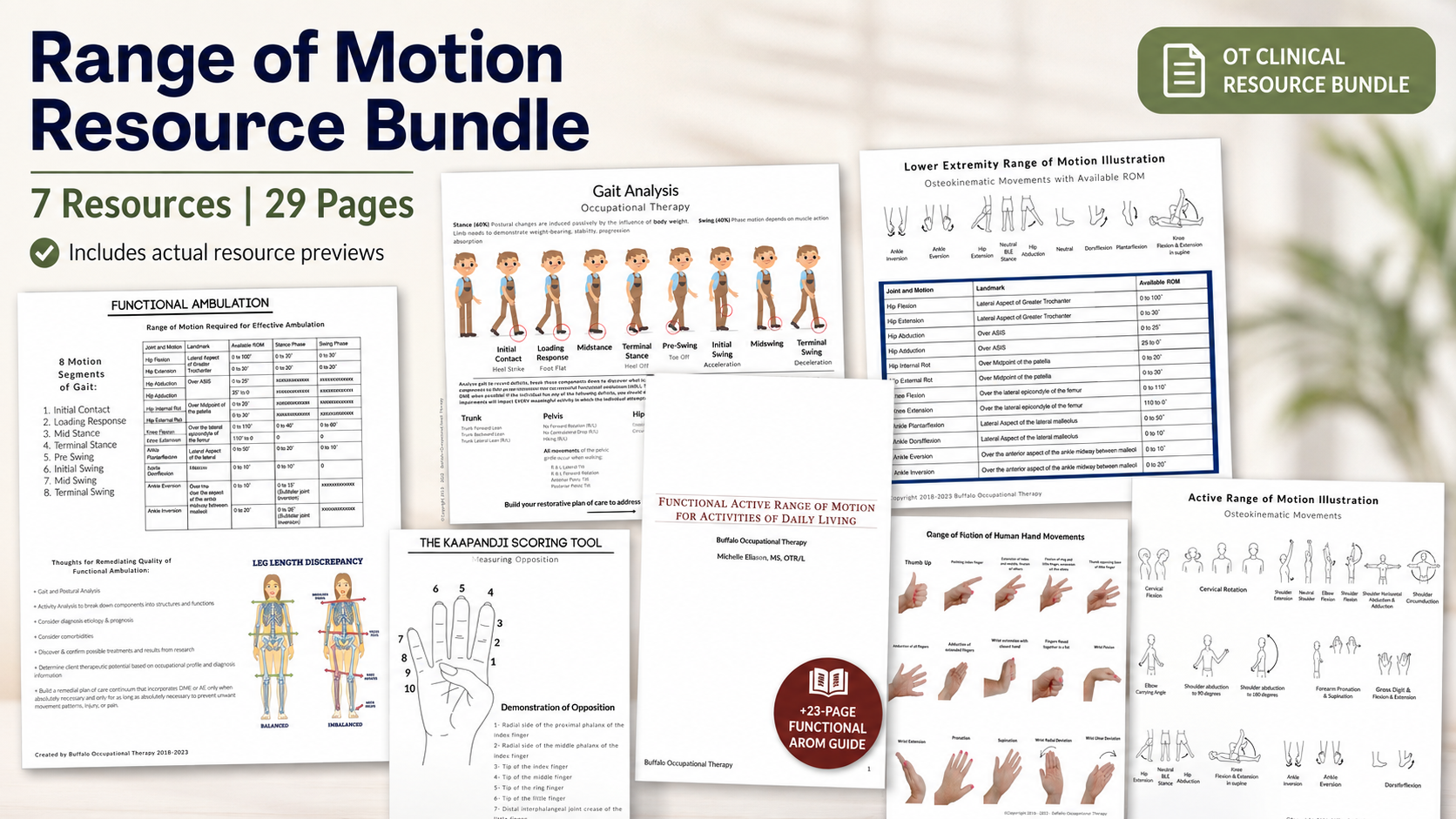
Just want the resources mentioned in this article?: Download the Range of Motion Bundle
Manual muscle testing is another one of those skills that can become very mechanical when you first learn it.
Position the patient. Stabilize. Apply resistance. Assign a score.
Done.
Except...the score isn't really the interesting part. For the occupational therapy practitioner, we ask a different question:
What does this amount of muscle strength allow the person to do, and what does it prevent them from doing?
That is where manual muscle testing, or MMT, becomes clinically useful.
A patient can have measurable weakness and still complete an activity independently. Another patient may have what looks like relatively good strength during isolated testing but struggle significantly once the movement has to occur repeatedly, against gravity, while maintaining posture, or during a multistep occupation.
So just like we discussed with range of motion, do not let the measurement become the treatment plan.
MMT gives you information, but your job is to figure out what that information means.
AOTA-Approved CEU Course: If upper-extremity anatomy or movement terminology feels rusty, the Overview of the Upper Extremity in Occupational Therapy can provide a refresher before you begin interpreting strength findings. For lower-body movement, you can also review the Overview of the Lower Extremity.
What Is Manual Muscle Testing Actually Telling You?
The purpose of manual muscle testing is not simply to assign a number to a muscle.
MMT can help you:
- determine how much muscle force appears to be available
- identify whether weakness may be limiting functional performance
- establish a baseline
- monitor change
- determine whether assistive or compensatory strategies may be necessary
- select activities that appropriately match the person's current abilities
Those purposes are reflected in the original teaching material.
The important word here is interpretation.
Suppose you determine that a patient has weakness in shoulder flexion.
Okay.
Now what?
- Can they bring their hand to their head?
- Can they place a lightweight object onto a shelf?
- Can they maintain the arm in space long enough to wash their hair?
- Can they repeatedly reach into a closet?
- Can they carry something while walking?
Perhaps...Before You Test Strength, Watch the Person Move
Before you isolate a muscle group, observe how the patient moves naturally.
Review the medical record and watch movement during normal situations such as bed mobility, meals, wheelchair use, walking through the environment, and interactions during everyday activity. You may also find comparing bilateral upper-extremity ROM and strength helpful, when appropriate.
Remember that the silent observation of your patient sometimes tell you what is wrong before you ever begin formal testing.
Watch them stand from a chair.
- Do they push heavily through both arms?
Watch them reach for a mug.
- Does the shoulder elevate?
- Does the trunk lean?
- Do they use momentum?
Watch them carry something.
- Does performance deteriorate after several repetitions?
Watch them during dressing.
- Can they generate the movement once but not sustain it throughout the task?
Now your MMT findings have context.
Strength Is Not the Same Thing as Functional Performance
Muscle strength is a client factor.
Occupational performance is the result of many systems working together.
A person may need adequate strength, but they also need sufficient ROM, coordination, sensation, postural stability, endurance, motor planning, attention, and environmental support.
This is why I do not want you seeing weakness and immediately prescribing strengthening exercises without asking whether weakness is actually the primary barrier.
Think about someone who struggles to bring a cup to their mouth.
The problem could be elbow-flexor weakness.
But it could also be pain.
Or tremor.
Or poor wrist stability.
Or inadequate shoulder control.
Or fatigue.
Or ataxia.
Or difficulty maintaining seated postural control.
Or several of those at once.
This is why the ADLs and IADLs Resource Page is useful when you are trying to connect isolated findings with the actual performance demands of everyday activity.
Ask Yourself: Is the Weakness Generalized or Specific?
One of the first questions after an MMT screen should be:
Is this weakness generalized, or is it isolated to a particular movement or muscle group?
That distinction can completely change your reasoning.
Imagine one patient demonstrates reduced strength throughout both upper extremities.
Now imagine another patient demonstrates relatively good strength everywhere except elbow extension on one side.
Those are not the same clinical presentation.
Generalized weakness may make you think about deconditioning, systemic disease, prolonged hospitalization, fatigue, or another broader contributor.
A focal weakness may make you think more specifically about the involved nerve, muscle group, joint, injury, or neurological pathway.
You are beginning to ask: Why does this pattern look the way it does?
Look at the Relationship Between Agonists and Antagonists
Another question to ask when interpreting strength is whether there is a meaningful imbalance between the muscles contributing to and controlling the movement.
Think about the movement rather than getting caught up in memorizing terminology.
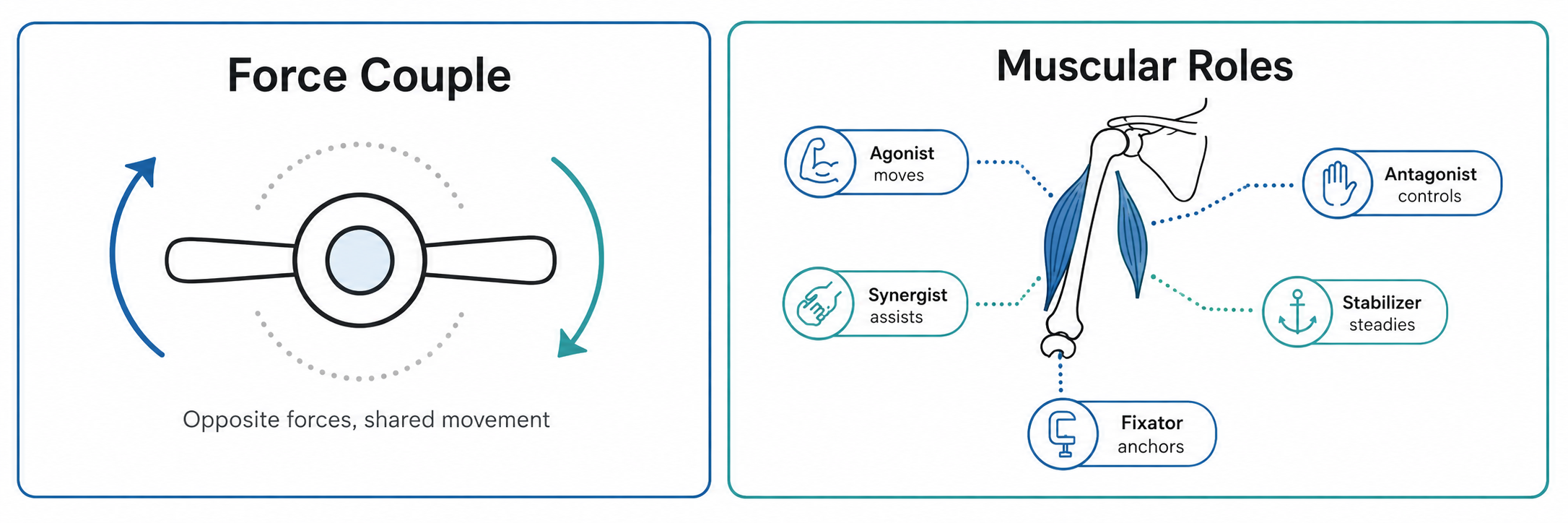
The agonist is a primary contributor to the desired movement. The antagonist produces an opposing action and can also help control or decelerate that movement.
But functional movement rarely depends on only those two muscles.
This is where the concept of a force couple becomes helpful.
A force couple occurs when two or more muscles generate forces in different directions that work together to produce or control a movement. In other words, muscles do not have to pull in the same direction to contribute to the same functional outcome.
That means we also need to think about the other muscular roles supporting movement:
- Agonist: primarily produces the desired movement
- Antagonist: opposes, controls, or decelerates the movement
- Synergist: assists the movement or helps limit unwanted motion
- Stabilizer: provides stability so another segment can move efficiently
- Fixator: helps hold a body segment or attachment point relatively stable during movement
This matters when we interpret manual muscle testing because MMT isolates a movement for testing, but functional movement does not occur in isolation.
For example, suppose you test shoulder flexion and your patient scores 4/5.
That is useful information, but now watch them reach into an overhead cabinet.
That seemingly simple reach also requires coordinated scapular movement, trunk and postural stability, elbow control, hand function, and appropriate muscular activity throughout the movement.
So the clinical question becomes, "Does this patient simply need a stronger shoulder flexor, or is the larger movement pattern inefficient?"
The same reasoning applies when you see an apparent imbalance between opposing muscle groups. Suppose a patient can generate elbow flexion relatively well but demonstrates substantially less control of elbow extension. That difference may affect more than an isolated MMT score. It may influence reaching away from the body, controlled placement of an object, weight bearing through the upper extremity, and the person's ability to smoothly transition between movements.
And remember that muscular roles can change depending on the task and the phase of movement. A muscle that contributes strongly to producing one part of an activity may play more of a stabilizing or controlling role during another.
This becomes even more important in neurological populations, where weakness may interact with altered tone, synergy patterns, impaired selective motor control, and changes in muscle recruitment.
That is why a strength score should never be interpreted completely outside of the movement pattern and the occupation in which that movement occurs.
If spasticity is contributing to the presentation, the Managing and Inhibiting Spasticity discussion may help you separate weakness from altered tone and motor-control problems.
Muscle Endurance Matters Too
Strength and endurance are related, but they are not interchangeable. Muscle endurance refers to the ability to perform repeated contractions or maintain a muscular contraction over time. A patient may be able to lift an arm once during testing, but can they maintain it long enough to shampoo their hair?
They may be able to stand from a chair once, but can they repeatedly stand throughout the day?
They may be able to hold a grocery bag for five seconds, but can they carry it from the car into the kitchen?
You may discover that maximum force production is not the primary issue. The patient simply cannot sustain the force required by the occupation. That shapes your treatment.
Muscle Contraction Type Matters Too
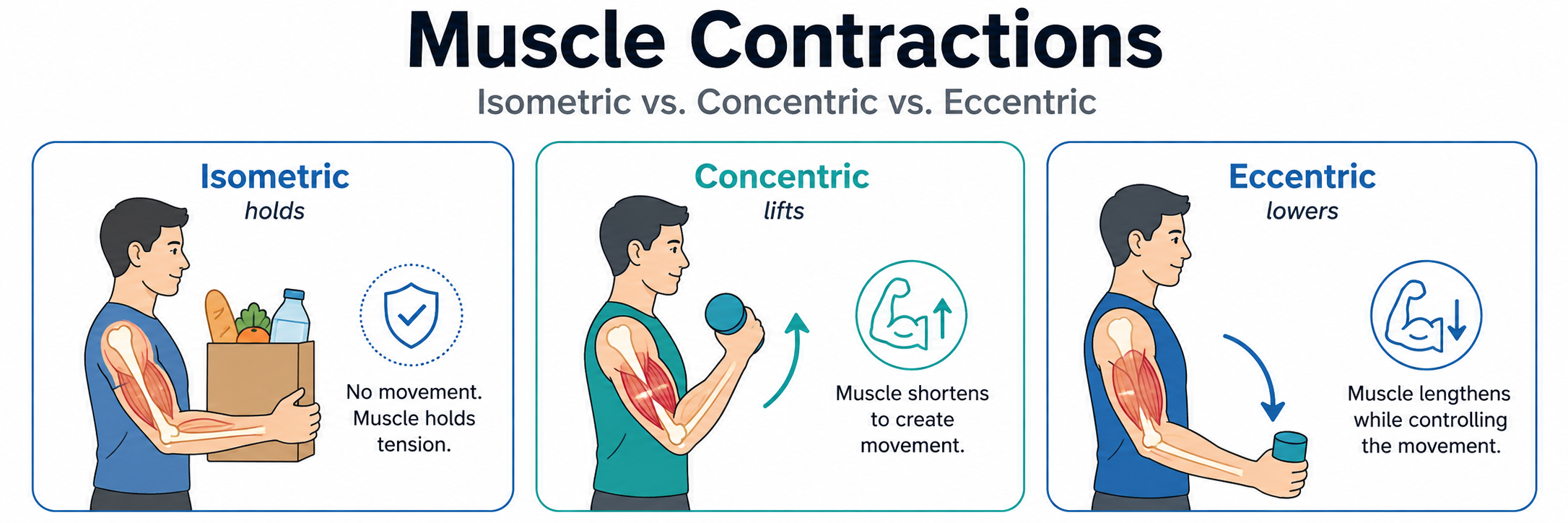
Muscle performance is not only about how much force someone can generate or how long they can sustain it. We also need to consider how the muscle is producing or controlling force during the activity.
Think about carrying a grocery bag.
Holding the bag relatively still requires isometric muscle activity.
Lifting the bag onto the counter requires concentric muscle activity as muscles shorten to produce the movement.
Lowering the bag back toward the floor requires eccentric muscle activity as muscles lengthen while controlling the descent.
Most everyday movements require us to produce force, maintain positions, and control movement as the body interacts with gravity, objects, and the environment.
Coordination Can Make a Strong Muscle Look Functionally Weak
Coordination involves producing smooth, appropriately timed interactions among muscles, which may be disrupted by conditions involving tremor or ataxia. This is another reason isolated strength testing can mislead you. Someone may generate adequate force but still be unable to control the limb accurately.
Think about a patient with cerebellar dysfunction. They may have enough strength to reach for the cup, but they overshoot it. Or their movement decomposes into several jerky segments, or an intention tremor becomes more pronounced as they approach the target. The functional problem is not simply that the arm needs to become stronger.
If balance, postural control, or coordination is contributing to performance, review the AOTA-Approved CEU Course: Balance and Stability for Occupational Therapy
What Can Cause Muscle Weakness?
Your differential thinking matters here.
There are several broad sources of weakness, including lower motor neuron conditions, primary muscle disease, neurological conditions, and weakness associated with disuse or immobilization. That means “weakness” is a finding....but It is not a diagnosis.
A patient who became weak after six weeks of immobilization is not automatically treated the same way as a patient whose weakness results from an actively progressive neurological disease.
Diagnosis, prognosis, tissue integrity, fatigue, recovery potential, and the person's goals all matter.
This is exactly why occupational therapy cannot become a protocol where every patient with reduced strength gets the same three exercises.
When Should You Be Cautious With MMT?
Manual muscle testing requires the patient to generate force, sometimes against external resistance. That means there are situations where resistance may be inappropriate or require modification.
Some of the scenarios you should be cautious: pain or inflammation in the region being tested, recent surgery, fracture or dislocation, myositis ossificans, bone carcinoma, fragile bone conditions, osteoporosis, hypermobility or subluxation, bleeding disorders, cardiovascular concerns, abdominal surgery or hernia, and fatigue that may exacerbate the person's condition.
Know whether the patient is medically stable.
And if pain substantially alters the person's ability to generate force, recognize that the test may be measuring more than muscular capacity.
Strengthening Should Have a Reason
Once you determine that strength is actually limiting occupational performance, strengthening may absolutely be appropriate.
You can provide strengthening through various modalities like active-assisted exercise, active exercise, resistive exercise, progressive resistive exercise, and the overload principle. But, I want you to keep asking:
What are we strengthening this person to do?
If shoulder and elbow weakness prevent someone from putting away dishes, strengthening needs to eventually contribute to reaching and object placement.
If grip weakness prevents opening containers, carrying bags, or managing grooming items, eventually the hand needs to interact with those objects.
If lower-extremity weakness is affecting dressing, transfers, or household mobility, your intervention should eventually reflect those demands.
For hand-specific intervention ideas, see 6 Fine Motor and Hand Strengthening Activities for Occupational Therapy and 10 Advanced Fine Motor Interventions for Occupational Therapy.
Moving From Isolated Strengthening to Functional Strength
Suppose your patient has reduced shoulder strength affecting overhead reaching. You might begin in a supported position.
Then progress to active movement against gravity.
Then controlled resistance.
Then reaching to progressively higher targets.
Then reaching while manipulating an object.
Then retrieving and placing objects repeatedly.
Then performing the actual household or self-care activity.
Notice what happened.
We moved from muscle performance to movement to task performance to occupation. That is the progression I want you thinking about as you build your plans of care.
The How to Grade Occupational Therapy Activities for the Just-Right Challenge discussion can help when deciding how quickly to increase resistance, repetitions, reach distance, task complexity, or environmental demands.
MMT Can Be a Baseline, But the Outcome Should Still Matter
One of the legitimate uses of MMT is establishing a baseline and monitoring change over time. No doubt that if strength improves, then a objective number for that is useful information. But..... we also need to ask whether the improvement changed function.
A patient may improve an isolated strength score while continuing to struggle with dressing. That tells that maybe strength was not the only barrier. Maybe the task also requires ROM, endurance, balance, motor planning, or adaptation. Your goal should not simply be: “Make the number better.” It should be to determine whether improved muscle performance gives the person greater access to the activity they are trying to perform.
This perspective also makes your goals and documentation stronger. The Goals and Objective Measures section can help connect measurable impairment findings with functional outcomes.
Document More Than the Strength Score
A strength score by itself is objective, but it does not necessarily explain medical necessity. Consider the difference between 'BUE strength 3+/5' and 'Reduced shoulder and elbow strength limited sustained overhead reach during upper-body dressing and grooming, with patient requiring intermittent rest and compensatory trunk movement to complete the task'. The second allows us to understand why the finding actually matters.
Your documentation can include:
- the movement tested
- side-to-side differences
- generalized versus focal weakness
- pain during testing
- fatigue
- compensatory movement
- endurance
- response to resistance
- changes over time
- how the weakness affects occupational performance
For additional support translating objective findings into skilled documentation, see Documentation and Billing.
The Clinical Takeaway
Manual muscle testing helps you answer a much larger question: Does this person have enough muscular capacity to perform the movements required by their everyday life?
When you find weakness, ask:
- How significant is the weakness?
- Is it generalized or specific?
- Is there an imbalance within the movement pattern?
- What is causing it?
- Does the person fatigue with repetition?
- Is the problem actually strength, or is coordination, pain, tone, ROM, or postural control influencing performance?
- What occupation is being affected?
And finally:
- If I improve the strength, what should the person be able to do that they cannot do right now?
Continue Learning With Us
Did you find this information helpful? Please share this article with another occupational therapy practitioner, student, educator, or rehabilitation professional who may benefit from it.
Would you like access to the clinical resources discussed throughout this article? Explore our membership options to find the level of support that works best for you.
Looking for a more formal learning and mentorship experience? Learn more about the Functional Cognition Lab Mentorship Program.
You can also explore our AOTA-approved courses and clinical resource packages for additional education, treatment resources, and practical tools you can use in rehabilitation practice.
Interested in receiving free functional cognition education each week? Subscribe to the Functional Cognition Lab Newsletter