
Important Information
The Difference Between Goals and Objective Measures
Clinicians often blur these, and auditors hate that. Goals are functional. Objective measures are proof. You cannot replace one with the other.
Most Popular Cognitive Objective Measures
Read about the most common objective measures used at Buffalo OT for cognition, complete with links!
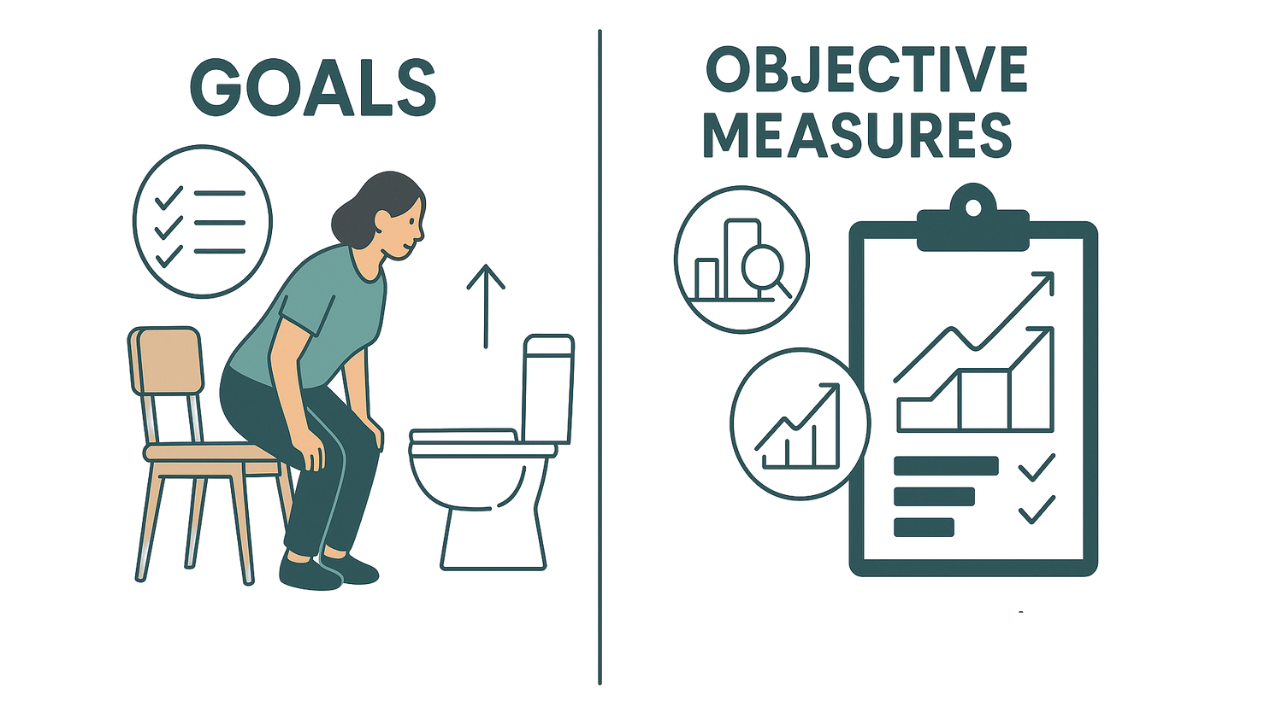
Goals = Functional, occupation-based, client-centered outcomes.
-
What the client will do.
-
Linked to OTPF areas.
-
Measurable, time-bound, observable.
-
Built from occupational performance deficits.
Example:
“Client will complete 5 consecutive sit-to-stands with safe sequencing and no loss of balance to improve toileting independence.”
Objective Measures = Tools to quantify change.
They are NOT goals — they are evidence of progress toward goals.
Examples:
-
BERG Balance Score
-
SLUMS
-
Trail Making Test A/B
-
FMA-UE
-
9-Hole Peg Test
-
MET level duration
-
5xSTS seconds
-
LEFS
-
ABC Scale
Insurance Requirements
Insurance payers increasingly expect these records to be included in your documentation. If you don’t explain the functional significance, insurance will label progress as “not medically necessary.
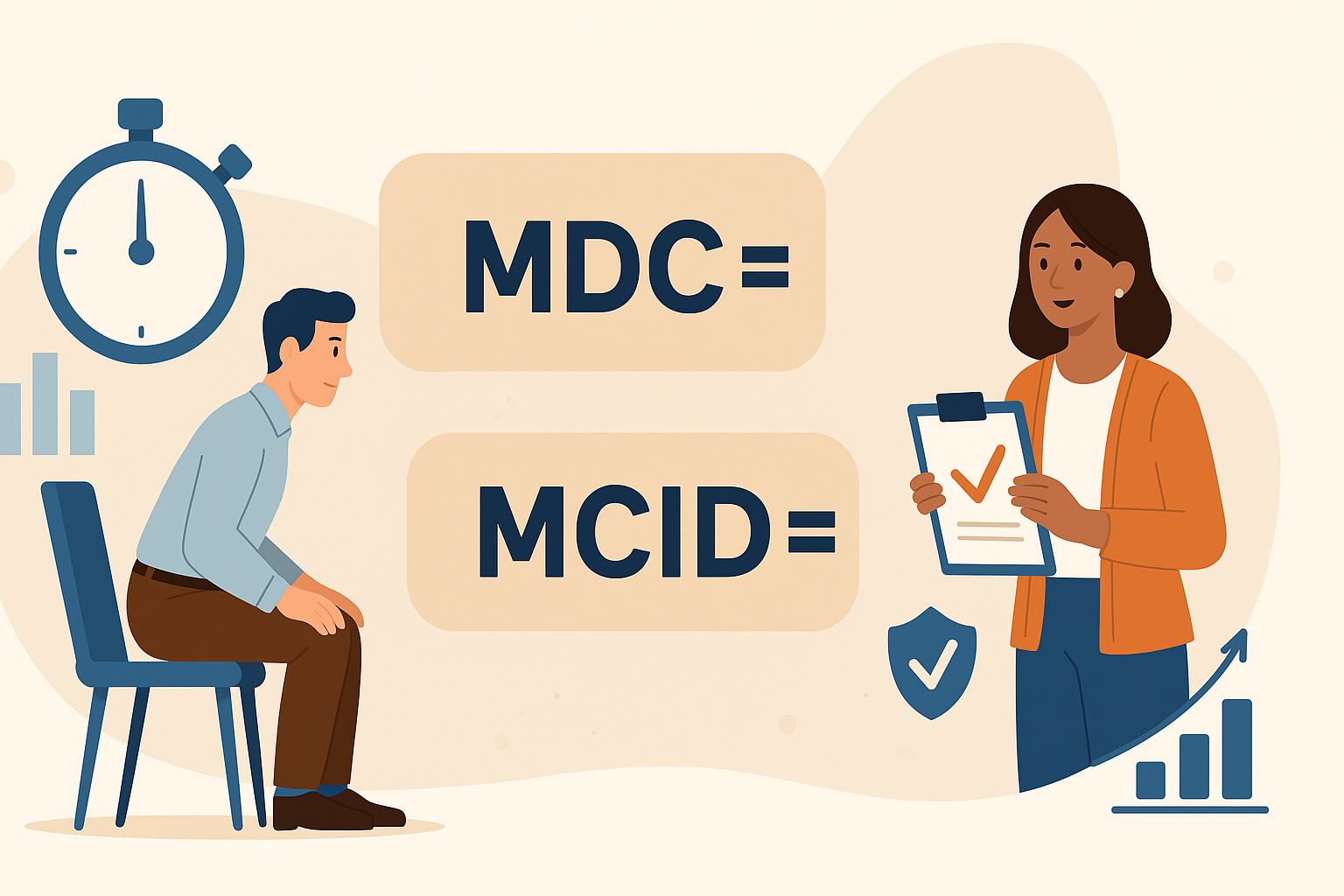
MDC = Minimal Detectable Change
-
STATISTICAL change.
-
Shows the change is real and not measurement error.
-
e.g., “The client improved their 5xSTS by 6 seconds, surpassing MDC = 4.2 seconds.”
.
MCID = Minimal Clinically Important Difference
-
FUNCTIONAL change.
-
Shows the change matters to daily life.
-
e.g., “Improvement in LEFS by 9 points meets MCID, indicating meaningful functional change.”
Functional Progress
Therapists must show WHY a change is meaningful for:
-
safety
-
independence
-
reduced burden of care
-
return to occupation
Goals by Category
Click the plus icon to reveal goal ideas to get you out of your creative brain block!
📩 Download Goals for Everything Booklet 📩ADL and IADL Goals
Occupation-specific goals target the complex body functions, performance skills, cognitive components, sensory integration abilities, motor requirements, endurance, and environmental demands that together create independence in activities of daily living (ADLs) and instrumental activities of daily living (IADLs). These goals reflect the OT’s role in analyzing the full activity, breaking it into its component parts, and restoring the underlying performance patterns necessary for successful occupational performance.
Occupational Performance Deficits Requiring Individual Goals
Toileting
Underlying Skills Required for Occupational Performance
-
Unsupported sitting tolerance of at least 15 minutes
-
Unsupported standing tolerance (or one-hand support) of at least 8 minutes
-
Dynamic sitting balance with trunk rotation
-
Dynamic standing balance with gaze shift and trunk rotation
-
Dual-tasking endurance (cognition + mobility)
-
Sequencing, task initiation, and task termination
-
Sit-to-stand transitional movement (functional mobility domain) at least 5 consecutive repetitions
-
Stand-to-sit transitional movement at least 5 consecutive repetitions
-
Bilateral integration and coordination of bilateral upper extremities while maintaining postural alignment
-
Cardiopulmonary efficiency and self-awareness during sustained activity
-
Oxygen management during functional ambulation (if applicable)
-
Safety and insight for balance-related concerns or other precautions
Grooming
Includes nail clipping, shaving, washing face, applying makeup, etc.
Underlying Skills Required for Occupational Performance
-
Unsupported or supported sitting tolerance of at least 20 minutes
-
Possible unsupported standing tolerance without support for at least 20 minutes
-
Dynamic sitting balance with trunk rotation, trunk flexion, and ability to right to midline
-
Dynamic standing balance with gaze shift, trunk rotation, trunk flexion, and ability to right to midline
-
Dual-tasking endurance (executive functioning + upper-extremity mobility)
-
Sequencing, task initiation, and task termination
-
Bilateral integration and gross and fine motor coordination of BUE while maintaining postural alignment
-
Motor calibration and modulation of fine motor skills
-
Strength, endurance, and power of muscles used for:
-
shoulder flexion-extension
-
shoulder abduction-adduction
-
shoulder internal-external rotation
-
horizontal abduction-adduction
-
elbow flexion-extension
-
forearm pronation-supination
-
wrist flexion-extension
-
gross grasp
-
tip pinch
-
lateral pinch
-
chuck pinch
-
-
Precision of fine motor skills
-
Oxygen management during upright activity (if applicable)
-
Safety and insight for shaving, sanitary care, and management of water temperatures
-
Executive function for sensory integration and regulation, including ability to sense and interpret input from BUE and vision with compensations/adaptations as necessary
Feeding
Underlying Skills Required for Occupational Performance
-
Unsupported or supported sitting tolerance of at least 20 minutes
-
Self-awareness of proper body mechanics and positioning to enhance feeding performance
-
Improved dual-tasking performance (cognition + motor) to maintain safety, attention to task, and sociocognitive and sociocommunication components
-
Sequencing, task initiation, and task termination
-
Identification and correct utilization of relevant and appropriate objects/adaptive equipment
-
Insight and problem solving
-
Bilateral integration and gross and fine motor coordination of BUE while maintaining postural alignment
-
Motor calibration and modulation of fine motor skills related to retrieving and transporting food from plate to mouth without error
-
Strength, endurance, and power of muscles used for:
-
shoulder flexion-extension
-
shoulder abduction-adduction
-
shoulder internal-external rotation
-
horizontal abduction-adduction
-
elbow flexion-extension
-
forearm pronation-supination
-
wrist flexion-extension
-
gross grasp
-
tip pinch
-
lateral pinch
-
chuck pinch
-
Bathing
Underlying Skills Required for Occupational Performance
-
Safety, insight, and awareness during mobility and/or maintaining precautions/contraindications
-
Sufficient problem-solving skills to address spontaneous bathing-related problems
-
Sensory integration and the ability to regulate response to varying water temperatures
-
Upper and lower body strength
-
Sufficient core and back strength (power and endurance) to support dynamic load of upper and lower body mobility
-
Unsupported or supported sitting tolerance of at least 20 minutes
-
Transitional movements required for shower transfers
-
Sustained, selective, and alternating attention with the ability to disregard extraneous information (e.g., “wetness,” droplets)
-
Good dynamic standing performance with sufficient agility to step and return from multiple planes of movement
-
Coordination and reaction time to maintain or return to upright position
-
Knowledge of existence and proper utilization of available durable medical equipment and context-specific adaptive equipment
-
Fine motor strength (tip pinch and grasp) for manipulation of objects necessary for bathing
-
Functional movement patterns required:
-
Shoulder flexion-extension; grasp; pronation-supination; radial-ulnar deviation; wrist flexion-extension
-
Hip flexion-extension and abduction-adduction; knee flexion-extension; ankle inversion-eversion; ankle plantarflexion-dorsiflexion
-
Shoulder flexion-extension; shoulder internal-external rotation; pronation-supination; wrist flexion-extension; gross grasp
-
Upper Body Dressing
Underlying Skills Required for Occupational Performance
-
Selection and retrieval of time- and weather-appropriate clothing
-
Unsupported sitting tolerance of at least 20 minutes
-
Dynamic sitting balance with trunk rotation and trunk flexion with return to midline
-
Dual-tasking endurance (cognition + mobility)
-
Sequencing, task initiation, and task termination
-
Fine motor opposition, coordination, and precision to handle and manipulate fasteners
-
Bilateral integration and coordination of BUE while maintaining postural alignment
-
Modified independence in adaptive equipment or adaptive mobility techniques as necessary
-
Cardiopulmonary efficiency and self-awareness during sustained activity
-
Oxygen management during functional ambulation (if applicable)
-
Safety and insight for sitting balance-related concerns or other precautions
Lower Body Dressing
Underlying Skills Required for Occupational Performance
-
Unsupported sitting tolerance of at least 15 minutes
-
Unsupported standing tolerance (or one-hand support) of at least 8 minutes
-
Dynamic sitting balance with trunk rotation
-
Dynamic standing balance with gaze shift
-
Dual-tasking endurance (cognition + mobility)
-
Management of ambulation aid during task performance
-
Sequencing, task initiation, and task termination
-
Sit-to-stand transitional movement × 5 repetitions
-
Stand-to-sit transitional movement × 5 repetitions
-
Fine motor opposition, coordination, and precision to handle and manipulate fasteners
-
Sufficient fine motor strength (pinch and grasp)
-
Bilateral integration and coordination of BUE while maintaining postural alignment
-
Cardiopulmonary efficiency and self-awareness during sustained activity
-
Oxygen management during functional ambulation (if applicable)
-
Safety and insight for balance-related concerns or other precautions
Donning Socks and Shoes
Underlying Skills Required for Occupational Performance
-
Sufficient upper body, trunk, and lower body range of motion to complete task
-
Good dynamic sitting balance with trunk rotation and trunk flexion with return to midline
-
Fine motor opposition, coordination, and precision for handling and manipulating fasteners
-
Sufficient fine motor strength (pinch and grasp)
-
Knowledge of existence and proper utilization of available context-specific adaptive equipment and adaptive accessories
Simple Goals for Occupation-Specific Tasks (ADLs/IADLs)
Transitional Movements
The patient will demonstrate safe transitional movements from sit-to-stand and stand-to-sit on multiple seated surfaces (sofa, bed, chair, recliner) with/without armrests as evidenced by 5 successful transitions from each surface without physical assistance within __ weeks.
Adaptive Equipment
The patient will demonstrate safe use of adaptive equipment/adapted mobility patterns during participation in (activity) as evidenced by successful performance without loss of balance or need for physical or verbal assistance within 12 weeks.
Medication Management
The patient will demonstrate the performance skills and body functions necessary for completion of medication management with (level of assistance) as evidenced by completion of a medication management assessment within 12 weeks.
Financial Management
The patient will demonstrate the performance skills and body functions necessary for completion of basic/moderate/intermediate financial management tasks with (level of assistance) within 12 weeks.
Gross Motor Coordination for IADLs
The patient will demonstrate increased gross motor coordination of BUE and BLE as evidenced by completion of a walking/ball bounce assessment of 50 bounces, requiring ambulation/stepping in all planes of movement without loss of balance within __ weeks.
Precaution Adherence
The patient will demonstrate adherence to (type of precaution) weight-bearing precautions and physician-placed AROM restrictions as evidenced by self-initiated correction or abstention during __ / __ consecutive treatments within __ weeks.
Specific ADL Performance
-
Toileting hygiene: completed with (level of assistance) within __ weeks
-
Upper body dressing: performed while standing/seated, with/without back support, with (level of assistance) within __ weeks
-
Showering: performed with DME as necessary while standing/seated, with (level of assistance) within __ weeks
-
Grooming/hygiene: performed while standing/seated, with (level of assistance) within __ weeks
-
Lower body dressing: performed with (level of assistance) within __ weeks
-
Meal preparation: simple/moderate/complex meal with (level of assistance) within __ weeks
-
Housekeeping (sweeping, vacuuming, dusting, dishes, cleaning toilet) with (level of assistance) within __ weeks
-
Orthotics/prosthetics: correctly donned/doffed with (level of assistance) within __ weeks
-
Laundry: performed with (level of assistance) within __ weeks
-
Oral care: performed with (level of assistance) within __ weeks
-
Sponge bathing: performed in bed/chair with (level of assistance) within __ weeks
-
Clothing management for toileting: completed with (level of assistance) within __ weeks
Goals Continuums and Progressions for Occupation-Specific Tasks (ADLs/IADLs)
Psychosocial Balance
Checkpoints
-
Complete and discuss roles checklist (25%)
-
Complete and discuss Kawa River creation (50%)
-
Completion and reflection of 2–3 action-oriented goals (75%)
-
Reflection and discussion of self vs. diagnosis (100%)
Fine Motor Occupational Performance
Checkpoints
-
Increase fine motor strength by 4 lbs (25%)
-
Increase by 7 lbs (50%)
-
Increase by 9 lbs (75%)
-
Increase by 11 lbs as final goal (100%)
Norms: Gross grasp norm 25.3 lb; baseline L: 9.2 lb, R: 8.2 lb.
Handwriting Goal
Checkpoints
-
Complete 1-minute ABC writing assessment with video (33.3%)
-
Improve in-hand manipulation using 25/25 beads with tip pinch in <3:30 (33.3%)
-
8–10 sessions of metronome training from 55bpm → 120bpm (33.3%)
Micrographia Goal
Checkpoints
-
Complete standardized handwriting assessment (25%)
-
Create, educate, and issue handwriting HEP (35%)
-
5–10 sessions handwriting interventions (75%)
-
Retest and complete goal (100%)
Life Role Goal
Checkpoints
-
Complete role checklist (25%)
-
Perform 2 tasks for 3 weeks (weeks 1–3)
-
Perform 4 tasks for 3 weeks (weeks 3–6)
-
Perform 6 tasks for 3 weeks (weeks 6–9)
-
Perform 8 tasks for 3 weeks (weeks 9–12)
Lower Extremity Functional Scale
Checkpoints
-
Improve LEFS by 15 points at 4.5 weeks (25%)
-
30 points at 9 weeks (50%)
-
45 points at 13.5 weeks (75%)
-
60 points at 18 weeks (100%)
Health Management of Parkinson’s Disease
Checkpoints
-
Deep proprioceptive input (20%)
-
Kinesiotape (20%)
-
Metronome training (20%)
-
Cold modality (20%)
-
Stretch and self-massage (20%)
Patient-Specific Functional Scale
Checkpoints
-
Complete PSFS and identify functional movement patterns (33.3%)
-
6–8 sessions of provocative testing, strengthening, stretching (33.3%)
-
Increase average score ≥ 2 points (33.3%)
Employment Goal
Checkpoints
-
Skills assessment (25%)
-
Resume finalized (50%)
-
1–3 interviews (75%)
-
Employment or next steps (100%)
QuickDASH Goal
Checkpoints
-
Scar massage and edema management for 1–2 sessions (25%)
-
5–6 sessions therapeutic exercise AROM → AAROM → PROM (50%)
-
4–5 sessions isotonic strengthening (75%)
-
Retest for completion (100%)
Don Socks Goal
Checkpoints
-
Record all goniometric measures (25%)
-
Improve 33% of combined ROM deficits (50%)
-
Improve 66% of combined ROM deficits (75%)
-
Complete donning socks and shoes independently (100%)
Cognitive Goals
Cognitive rehabilitation is a core component of occupational therapy across diagnoses, including stroke, TBI, MCI, dementia, long-COVID, chronic illness, mental health conditions, and more.
Simple Cognitive Goals
Insight & Health Management
Insight Into Cognitive Impairments
The patient will demonstrate understanding of cognitive impairments to improve insight and independence in the domain of health management, as evidenced by a patient-led explanation of diagnosis, symptoms, and compensatory strategies within XX weeks.
Attention
Alternating Attention
The patient will alternate attention between __ tasks with __% accuracy within XX weeks.
Sustained Attention
The patient will sustain attention to a functional task for 5–45 minutes (in 5-minute increments) without distraction or cognitive fatigue within XX weeks.
Divided Attention
The patient will divide attention between __ tasks for __ minutes without signs of frustration, fatigue, or confusion within XX weeks.
Orientation
Orientation to Person, Place, Time, and Event
The patient will orient to person, place, time, and event with 4/4 accuracy across __ sessions within XX weeks.
Problem Solving & Executive Function
Complex Problem Solving
The patient will complete (selected complex problem-solving activity) with __% accuracy within XX weeks.
Judgment & Reasoning
The patient will utilize safe and effective judgment during (occupation) with ≤3 verbal cues within XX weeks.
Behavioral Inhibition
The patient will inhibit inappropriate or distracted behaviors for __ non-consecutive sessions throughout the plan of care.
Sequencing, Initiation, and Termination
Sequencing Functional Tasks
The patient will sequence (occupation) without verbal or tactile cues within XX weeks.
Task Initiation & Termination
The patient will independently initiate and terminate (meaningful task) across __ sessions within XX weeks.
Memory
Auditory Memory
The patient will complete (auditory memory task) with __% accuracy within XX weeks.
Working Memory
The patient will complete (working memory task) with __% accuracy within XX weeks.
Safety Awareness
Safety During Functional Tasks
The patient or caregiver will improve safety awareness during (occupation) as evidenced by task performance without prompts within XX weeks.
Cognitive Goal Progressions & Clinical Continuums
These goals include built-in checkpoints, progressions, and measurable changes that demonstrate clear skill acquisition over time.
SLUMS Cognitive Progression
Primary Goal
SLUMS Score Improvement
The patient will improve cognitive function as evidenced by a 7-point increase on the SLUMS exam within XX weeks.
Domains Captured
SLUMS Subskills
-
Delayed recall with interference
-
Cognitive flexibility & categorization
-
Registration & digit span
-
Abstract thought & time orientation
-
Auditory memory & selective attention
Checkpoints
SLUMS Progression Milestones
-
Baseline Trail Guide Test (15%)
-
+2 points by Week 4 (35%)
-
+4 points by Week 8 (75%)
-
+7 points by Week 12 (100%)
Executive Function Performance Test (EFPT)
Primary Goal
EFPT Score Improvement
The patient will improve executive functioning for everyday tasks as evidenced by a 10-point increase on the EFPT within 6 weeks.
Domains Targeted
EFPT Functional Areas
-
Working Memory
-
Emotional Control
-
Sustained Attention
-
Stress Tolerance
Checkpoints
EFPT Progression Milestones
-
Complete WRAP plan (25%)
-
3–5 sessions: sustained attention + working memory (50%)
-
3–5 sessions: selective + alternating attention + WM load (75%)
-
20+ minutes multicomponent problem-solving (100%)
Attention Continuum
Primary Goal
Divided Attention for 45 Minutes
The patient will demonstrate divided attention capabilities with environmental distractions for 45 continuous minutes without rest breaks.
Checkpoints
Attention Progression Milestones
-
Focused attention without unrelated conversation (25%)
-
Sustained attention > 15 minutes (50%)
-
Selective + alternating attention ≥ 25 minutes (75%)
-
Divided attention ≥ 45 minutes (100%)
Short-Term Auditory Memory Progression
Primary Goal
Recall After Interference
The patient will recall 5 items after 45 minutes, following interference tasks, to improve conversational and workplace functioning.
Checkpoints
Auditory Memory Milestones
-
2–3 words every 10–15 minutes (~3 weeks) (25%)
-
4 words every 15–20 minutes (50%)
-
5 words after 25 minutes (75%)
-
5 words after 45 minutes (100%)
Pre-Driving Cognitive Readiness
Primary Goal
Driving Readiness Cognitive Thresholds
The patient will demonstrate cognitive readiness for driving (or need for referral) by meeting the following requirements.
Checkpoints
Driving-Related Cognitive Milestones
-
MoCA > 27 (20%)
-
Clock Drawing ≥ 6 (20%)
-
Trail Making B < 3 minutes or < 3 errors (20%)
-
Road Sign Worksheet ≥ 85% (20%)
-
Divided attention ≥ 30 minutes without fatigue/confusion (20%)
Trail Making Test A
Primary Goal
Processing Speed & Visual Tracking
The patient will complete TMT-A in under 1 minute 30 seconds to improve visual scanning, processing speed, and executive function.
Cognitive–Motor Dual Task (Auditory Memory + Balance)
Primary Goal
Dual Tasking Across Balance Surfaces
The patient will recall a 7-digit sequence (8/8 trials) while progressing through increasingly unstable balance surfaces.
Checkpoints
Dual-Tasking Progression Milestones
-
5 digits (foam pad) — 25%
-
5 digits (4/4) + 6 digits (4/4) on rocker board — 50%
-
6 digits (8/8) on rocker board multidirectional — 75%
-
7 digits (8/8) on BOSU dome down — 100%
Neuromuscular Re-Education
Neuromuscular Re-Education (NMRE) addresses the integration of the sensory, motor, cognitive, and postural control systems required for safe, efficient, and meaningful occupational performance. These goals support functional motor return, postural control, balance, coordination, sensory processing, tone normalization, and adaptive skill acquisition.
Simple Goals for Neuromuscular Re-Education
Motor Learning & Compensatory Strategy Awareness
Understanding Compensatory Methods
The patient (or caregiver) will demonstrate understanding of adverse compensatory movement patterns during the motor learning process as evidenced by verbally recalling __ / __ predetermined statements within __ weeks.
Positioning, Mobility, and Contracture Prevention
Daily Mobility & Positioning Safety
The patient (or caregiver) will communicate understanding of positioning and daily mobility strategies to prevent contractures and skin breakdown as evidenced by verbal explanation and demonstrated carryover within __ days/weeks.
Tone Management & Normal Movement Patterns
Reduction in Abnormal Muscle Tone
The patient will demonstrate decreased abnormal tone in (specific body part) as evidenced by improved uninhibited active ROM or functional movement patterns by __ degrees within __ weeks.
Normalization of Movement Patterns
The patient will demonstrate improved normal movement patterns as evidenced by performing (occupation-based activity) without compensatory strategies within __ weeks.
Visual–Perceptual and Sensorimotor Performance
Visual–Perceptual Skill Improvement
The patient will demonstrate improved visual-perceptual performance as evidenced by increased performance on (visual-perception assessment) by __ points within __ weeks.
Fall Prevention & Safety Strategies
Fall-Reduction Strategies During Functional Tasks
The patient (or caregiver) will demonstrate understanding and application of fall-reduction strategies during meaningful occupations as evidenced by performance of (occupation-based activity) with ≤ __ cues for safety within __ weeks.
Executive Function and Insight During Motor Tasks
Improved Cognitive–Motor Integration
The patient will demonstrate improved insight and executive function as evidenced by improved (cognitive assessment) score by __ points within __ weeks.
Adaptive Equipment Competency
Use of AE for Occupational Performance
The patient (or caregiver) will demonstrate competent use of adaptive equipment (e.g., __, __, __) to complete ADLs, IADLs, or other occupational activities within __ weeks.
Sensory Compensation Strategies
Compensating for Sensory Loss
The patient (or caregiver) will demonstrate understanding of strategies to compensate for sensory deficits as evidenced by recall and discussion of 5/5 sensory strategies within __ weeks.
Tremor Management
Strategies for Bilateral Tremor Reduction
The patient (or caregiver) will demonstrate ability to apply tremor-reduction strategies during (specific occupation) without therapeutic interference within __ weeks.
Goals Continuums and Progressions for Neuromuscular Re-Education
Dynamic Sitting Balance
Primary Goal
The patient will improve dynamic sitting balance, posture, gait, and intralimb coordination as evidenced by a ≥ 8-point improvement on the SARA within 24 weeks.
Checkpoints
-
Complete 100% of SARA initial assessment (15%)
-
2 sessions: Education on compensatory movement replacement (15%)
-
2 sessions: Rehearsal of goal-directed stepping (15%)
-
2 sessions: Star point balance training (15%)
-
Tandem line, narrow BOS, single-leg tap out x 60 ft without LOB (90%)
-
SARA re-test and outcome improvement (100%)
9-Hole Peg Test (Fine Motor Coordination & Prehension)
Primary Goal
The patient will improve bilateral fine motor coordination as evidenced by a 7-second improvement on the dominant-hand 9HPT score within 12 weeks (MS normative data).
Checkpoints
-
Improve by 2 seconds (25%)
-
Improve by 4 seconds (50%)
-
Improve by 6 seconds (75%)
-
Improve by 7 seconds (100%)
Balance Confidence & Body Awareness
Primary Goal
The patient will improve subjective balance confidence as evidenced by a ≥ 20% improvement on the ABC Balance Scale.
Checkpoints
-
Complete ABC (25%)
-
Identify 3–5 environmental triggers for balance insecurity (50%)
-
4–8 sessions mechanical balance remediation (75%)
-
Re-test and goal achievement (100%)
Sensory Processing & Sensorimotor Integration
Primary Goal
The patient will re-establish sensory processing and sensorimotor integration following AVM or related neurological injury as evidenced by achieving 20/25 accuracy on dull–sharp testing within 24 weeks.
Checkpoints
-
ESTIM trial on scapular/LUE musculature (5%)
-
Static sensory profile: 6 sessions (sharp, dull, hot, cold, rough, smooth) (20%)
-
4–10 NMRE sessions integrating proprioception & visual cortex tasks (50%)
-
6 stereognosis sessions (75%)
-
Final sensory re-test (100%)
Lower Extremity Function
Primary Goal
The patient will improve lower extremity occupational performance as evidenced by a 60-point improvement on the LEFS within 18 weeks.
Checkpoints
-
15-point improvement (4.5 weeks) (25%)
-
30-point improvement (9 weeks) (50%)
-
45-point improvement (13.5 weeks) (75%)
-
60-point improvement (18 weeks) (100%)
Active ROM in Presence of Spasticity
Primary Goal
The patient will improve wrist AROM toward WNL (70° extension) with minimized spasticity as evidenced by a ≥10° total improvement across measurements within 6 weeks.
Self-Management of Spasticity
Primary Goal
The patient will demonstrate understanding and application of 8/8 spasticity inhibition strategies within 12 weeks.
Checkpoints
-
Education on inhibitory strategies and triggers/timing (25%)
-
Trial all strategies: prolonged tendon pressure, oscillation, WB positions, sustained stretch, antagonist activation, e-stim, biofeedback, modalities (75%)
-
Develop and record action plan for home/college environment (100%)
Fugl-Meyer Upper Extremity (FMA-UE)
Primary Goal
The patient will improve motor return as evidenced by an ≥ 8-point improvement on the FMA-UE within 16 weeks.
Checkpoints
-
4 weeks: Good scapular stability
-
8 weeks: Effective scapular/shoulder movement, strong isometrics
-
12 weeks: 1–2° isolated AROM in gravity-eliminated plane
-
16 weeks: Updated FMA-UE demonstrating volitional movement return
Decrease Compensatory Movement Strategies
Primary Goal
The patient will demonstrate improved left shoulder activation with reduced compensatory patterns as evidenced by ≥10° AROM gain in any plane within 12 weeks.
Checkpoints
-
No scapular winging
-
Effective scapular complex movement
-
1–2° isolated AROM
-
1/2 finger subluxation
-
No subluxation
Sitting Balance
Primary Goal
The patient will improve sitting balance as evidenced by a score of 43/44 on the Sitting Balance Scale within 12 weeks.
Checkpoints
-
Complete initial scale (15%)
-
Unsupported sitting 10 minutes with posture correction (25%)
-
Linear/dynamic reach tasks (50%)
-
Lateral lean + rotational activities + gaze shift training (75%)
-
Final scale completion (100%)
Dual Tasking: Auditory Memory + Balance
Primary Goal
The patient will complete 7-digit recall (8/8 trials) while progressing through a multisurface balance continuum within 12 weeks.
Checkpoints
-
5 digits on foam pad (25%)
-
5 digits (4/4) + 6 digits (4/4) on rocker board horizontal (50%)
-
6 digits (8/8) on rocker board multidirectional (75%)
-
7 digits (8/8) on BOSU dome-down (100%)
Vision Goals
Low vision rehabilitation supports individuals with impaired acuity, central or peripheral field loss, cognitive–visual dysfunction, hemispatial neglect, and visual–motor integration difficulties. These goals target safety, environmental navigation, reading/writing, compensatory strategies, sensory integration, and functional independence.
Simple Goals for Low Vision
Caregiver Training & Environmental Modification
Caregiver Use of Low-Vision Strategies
The caregiver will demonstrate appropriate low-vision strategies for context and occupational performance as evidenced by verbal discussion and self-initiated environmental modifications in-home or in-clinic during __ / __ sessions within __ weeks.
Community Resources & Support
Accessing Low-Vision Community Resources
The patient (or caregiver) will communicate understanding of available community resources and how to access them as evidenced by verbal discussion and acknowledgment of written materials within 1 visit.
Visuomotor Coordination
Tracking, Pursuits, and Saccades
The patient will demonstrate improved visuomotor coordination during functional activities as evidenced by improved performance on (assessment or baseline task) with smooth pursuits, accurate saccades, and ≤ __ errors within 12 weeks.
Low-Vision Education & Knowledge
Knowledge of Low-Vision Materials and Resources
The patient (or caregiver) will communicate knowledge of all educational materials provided as evidenced by verbal discussion and independent reference to written resources within __ weeks.
Preferred Retinal Locus Training
Development of a Compensatory Visual Fixation Strategy
The patient will demonstrate improved development and use of a preferred retinal locus (PRL) for central vision loss (or relevant diagnosis) as evidenced by __% accuracy during (baseline activity) within 12 weeks.
Home Reading & Writing Program
Reading/Writing Home Program Adherence
The patient will demonstrate understanding and follow-through of the home reading/writing exercise program as evidenced by verbal explanation of directions and completion of exercises between at least 3 sessions within __ weeks.
Adaptive Equipment Competency
Use of Low-Vision Adaptive Equipment
The patient (or caregiver) will demonstrate competency using low-vision adaptive equipment (e.g., magnifiers, angled stands, contrast tools, task lighting) as evidenced by task-specific performance with ≤ 1 verbal cue within __ days/weeks.
Goals Continuums and Progressions for Low Vision
Pre-Driving Rehabilitation
Driving Readiness Cognitive–Visual Thresholds
The patient will demonstrate executive, visual–motor, and safety-related performance skills necessary for driving readiness (or determination of need for specialist referral) as evidenced by meeting the following checkpoints.
Checkpoints
-
MoCA score > 27 (20%)
-
Clock Drawing Test ≥ 6/10 (20%)
-
Trail Making B < 3 minutes and/or ≤ 3 errors (20%)
-
Road Sign Worksheet ≥ 85% correct (20%)
-
Divided attention > 30 minutes without distraction, fatigue, or confusion (20%)
Trail Making Test
Processing Speed, Visual Scanning, Visual Search
The patient will improve executive functioning and visual–motor processing as evidenced by completing TMT-A in ≤ 1 minute 30 seconds, supporting improvements in visual tracking, scanning, processing speed, and mental flexibility.
Hemispatial Neglect
Improvement in Left Hemispatial Neglect
The patient will demonstrate improved left hemispatial neglect as evidenced by completion of all checkpoints within 12 weeks to support improved occupational performance (e.g., wheelchair mobility, ADLs, IADLs).
Checkpoints
-
5–6 sessions of visual neglect remediation (25%)
-
5–6 sessions body schema & midline orientation training using somatosensory cues (50%)
-
5–6 sessions gross visual-spatial integration activities (75%)
-
Goal completion demonstrated through therapist observation and client report (100%)
Visual–Spatial Awareness
Visuocognitive and Visual–Perceptual Skill Development
The patient will demonstrate improvement in visuocognition and visual–perceptual processing as evidenced by gains in:
(1) Form constancy
(2) Figure–ground perception
(3) Visual closure
(4) Visual organization
(5) Spatial orientation
(6) Visuomotor proficiency
Checkpoints
-
Complete Motor-Free Visual Perception Test (MVPT) assessing spatial relations, figure–ground, discrimination, closure, and visual memory (20%)
-
Conduct movement-based visual-neglect obstacle course (20 cones, diagonal and figure-8 steps, curvilinear paths, tandem line walking) and record baseline and 12-week improvement
-
Assess constructional praxis and visuomotor integration
-
Assess visual organization and document findings for future intervention planning
Visuomotor Integration (BONUS GOAL FROM YOUR FULL LIBRARY)
Hand-Eye Coordination and Visual–Motor Performance
The patient will improve visual–motor integration for functional tasks (writing, feeding, grooming, navigation) as evidenced by improved performance on (visuomotor assessment) by __ points/seconds/accuracy within __ weeks.
Contrast Sensitivity & Environmental Navigation (BONUS GOAL)
Contrast and Environmental Scanning
The patient will improve ability to navigate home or community environments with low contrast as evidenced by successful completion of (environmental navigation task) with ≤ __ cues within __ weeks.
Lighting Management & Glare Control (BONUS GOAL)
Light Adaptation Skills
The patient will demonstrate strategies for managing glare, poor lighting, and contrast loss as evidenced by independent application of lighting modifications during __ / __ sessions.
Cardiac Goals
Cardiac-related occupational therapy goals focus on improving aerobic capacity, activity tolerance, pacing, breath regulation, safety, medication management, and functional mobility while maintaining appropriate medical precautions. These goals support successful community reintegration and independence during ADLs/IADLs across all nine domains of occupation.
Simple Goals for Cardiac Conditions
Activity Tolerance
Functional Endurance for Occupational Performance
The patient will demonstrate improved activity tolerance for occupational completion as evidenced by performing __ minutes of sustained light activity with a BORG rating of ≤ 3/10 within __ weeks.
Breath Regulation
Diaphragmatic & Pursed-Lip Breathing
The patient will demonstrate appropriate diaphragmatic and pursed-lip breathing strategies as evidenced by self-initiated use during 3 consecutive sessions within __ weeks to support functional carryover.
Energy Conservation & Pacing
Use of Energy Conservation During Functional Tasks
The patient (or caregiver) will demonstrate understanding and utilization of energy conservation and pacing techniques as evidenced by independent advocacy and execution of strategies during 3 consecutive sessions within __ weeks.
Dyspnea Management
Reduced Dyspnea During Occupational Tasks
The patient will demonstrate decreased manifestations of dyspnea during functional activities as evidenced by __ consecutive sessions in which they self-initiate rest breaks and apply controlled breathing strategies during tasks lasting 10+ minutes, within the plan of care timeframe.
Sternal Precautions & Adaptive Equipment
Safe Occupational Performance With Sternal Precautions
The patient will demonstrate safe use of adaptive equipment (e.g., __, __, __) to maintain sternal precautions as evidenced by completing (dressing, bathing, mobility) with 100% accuracy and without cues during __ / __ treatments over __ weeks.
Oxygen Equipment Safety
Understanding of Oxygen Use & Safety
The patient will verbalize and demonstrate safe usage of oxygen equipment within __ sessions to support safe discharge and home reintegration.
Sternal/Cardiac Precautions
Knowledge of Cardiac Precautions
The patient will independently recite all cardiac or sternal precautions without error over __ consecutive sessions within a __-week plan of care.
Cardiac Exacerbation & Thrombus Prevention
Managing Exacerbations and Clot Risk
The patient (or caregiver) will demonstrate understanding of how to prevent exacerbation of cardiac conditions or thrombus formation as evidenced by verbal discussion of __ strategies within __ weeks.
Functional Household Mobility
Safe Ambulation Using Least Restrictive Device
The patient (or caregiver) will demonstrate safe functional household mobility using the least restrictive device as evidenced by completion of a multisurface, multielevation obstacle course with no LOB, errors, or fear of falling within a __-week plan of care.
Cardiac Medication Management
Understanding Cardiac Medications
The patient (or caregiver) will demonstrate knowledge of cardiac medications, their side effects, and proper organization methods as evidenced by simulated medication management without errors or cues within __ weeks.
Medication Planner Pre-Fill
Independent Pillbox Organization
The patient (or caregiver) will safely pre-fill a medication planner for a __-prescription regimen, with or without distractions, without errors or cues within __ weeks.
Daily Weight Monitoring
Self-Monitoring of Fluid Retention
The patient will monitor and record weight daily and report deviations from physician parameters 7/7 days weekly, verified by therapist review over a __-week plan of care.
Edema & Inflammation Management
Edema Reduction & Inflammation Control
The patient will demonstrate understanding and application of edema-management and inflammation-prevention strategies (e.g., elevation, compression, diaphragmatic breathing, pacing) as evidenced by correct demonstration without therapist prompting within __ weeks.
Stable Cardiovascular Status
Maintaining Medical Parameters During Therapy
The patient will maintain cardiovascular status (HR, BP, O₂ sats) within physician-assigned parameters for 100% of therapeutic session time during 5/5 consecutive sessions over __ weeks.
Balance & Functional Mobility
Improved Balance for Safe Participation
The patient will improve balance as evidenced by a __-point increase on BERG / TUG / Tinetti within __ weeks to support safe and efficient functional mobility during occupational tasks.
Aerobic Capacity
Improved MET Tolerance for Daily Activity
The patient will improve aerobic capacity as evidenced by sustaining activity at __ MET level for ≥ __ minutes without exceeding a BORG level of 4/10, within __ weeks.
Safety and Insight
Safety and insight goals address fall prevention, awareness of risk factors, body mechanics, infection control, sensory compensation, mobility safety, and environmental awareness. These goals support independent and safe occupational performance across home, community, and clinical settings.
Simple Goals for Safety and Insight
Fall Prevention & General Safety
Understanding of Fall and Safety Precautions
The patient (or caregiver) will demonstrate understanding of fall and safety precautions as evidenced by verbal discussion and demonstration of __ safety strategies within __ sessions.
Infection Control
Proper Hand-Washing Technique
The patient (or caregiver) will verbalize and demonstrate proper hand-washing technique during __ consecutive sessions over __ weeks to support safe health management.
Transfer Safety & Mobility Awareness
Safe Transfers Between Surfaces
The patient (or caregiver) will demonstrate safe mobility and transfer techniques from (surface) to (surface) as evidenced by proper body mechanics and no loss of balance over __ / __ transitions within a __-week plan of care.
Sensory Compensation
Strategies for Sensory Loss and Impairment
The patient (or caregiver) will demonstrate understanding of sensory compensation strategies as evidenced by verbal recollection and discussion of 5/5 predetermined strategies within __ weeks.
Home, Fire, and Oxygen Safety
Environment-Specific Home Safety Strategies
The patient (or caregiver) will verbalize and demonstrate home, fire, and oxygen safety strategies tailored to (bedroom, bathroom, kitchen, living room, hallways, basement, sitting room) during 1 session, as confirmed by the therapist.
Caregiver Body Mechanics
Safe Body Mechanics During Functional Tasks
The caregiver will demonstrate proper body mechanics during (activity or occupation-specific task) without tactile or verbal cues during __ consecutive sessions within __ weeks.
Functional Mobility
Goals for Functional Mobility
Occupational therapy functional mobility goals target the patient’s ability to move safely and efficiently through their environments using the necessary performance skills, body functions, endurance, sequencing abilities, executive functioning, and assistive equipment. These goals support independence across all nine domains of occupation and emphasize safety, body mechanics, and energy conservation.
Simple Goals for Functional Mobility
Bed Mobility
Supine, Side-Lying, Edge of Bed, and Positioning
The patient will demonstrate safe bed mobility from supine to side, supine to sit, EOB to stand, EOB to supine, and achieving proper positioning at rest with [graded level of assistance] as evidenced by physical demonstration of skill during [xx] sessions within [xx] weeks.
Tub/Shower Transfers
Safe Entry and Exit
The patient will transfer safely in/out of the tub/shower with [graded level of assistance] after improving sufficiency of body functions, structures, and performance skills required for this transfer as evidenced by physical demonstration of skill during [xx] sessions within [xx] weeks.
Wheelchair Transfers
Safe Transfer Independence
The patient will transfer safely in/out of wheelchair with [graded level of assistance] after improving sufficiency of body functions, structures, and performance skills required as evidenced by performance during [xx] sessions within [xx] weeks.
Car Transfers
Functional Mobility in Community-Based Occupation
The patient transfers safely in/out of car with [graded level of assistance] after improving sufficiency of body functions, structures, and performance skills required for this transfer as evidenced by performance during [xx] sessions within [xx] weeks.
Steps, Stairs, and Curbs
Ascending and Descending Functional Elevations
The patient will ambulate and clear steps/curbs, both ascending and descending, with [graded level of assistance] after improving sufficiency of body functions, structures, and performance skills required as evidenced by performance during [xx] sessions within [xx] weeks.
Uneven Surfaces
Environmental Navigation
The patient will ambulate on uneven surfaces with various environmental lighting conditions with [graded level of assistance] after improving sufficiency of body functions, structures, and performance skills required as evidenced by performance during [xx] sessions within [xx] weeks.
Durable Medical Equipment (DME)
Competent and Safe Use of Equipment
The patient (or caregiver) will demonstrate competent use of durable medical equipment and/or effective adaptive mobility patterns used for functional mobility (i.e., xxxxxx) for successful completion of activities in all nine domains of occupation within [xx] weeks.
Gross Motor Coordination for Ambulation
Symmetrical and Functional Gait
The patient demonstrates increased gross motor coordination to improve functional ambulation as evidenced by completion of [ambulation assessment] using a symmetrical, functional gait pattern and reciprocal arm swing within [xx] weeks.
Precaution Adherence
Weight-Bearing and AROM Restrictions
The patient will demonstrate adherence to [type of precaution] weight-bearing precautions and physician-placed AROM restrictions as evidenced by self-initiated correction or abstention during xx/xx consecutive treatments within [xx] weeks.
Wheelchair Mobility
Manual or Powered Wheelchair Skills
The patient will demonstrate [manual/powered] wheelchair mobility after improving sufficiency of body functions, structures, and performance skills (visual perception, executive functioning, dual-tasking, attention, strength, endurance, etc.) required for this aspect of functional mobility as evidenced by physical demonstration of skill during [xx] sessions within [xx] weeks.
Ramps and Inclines
Functional Ambulation on Inclines
The patient will ambulate ramps (inclined surfaces) safely with [graded level of assistance] after improving sufficiency of body functions, structures, and performance skills as evidenced by performance during [xx] sessions within [xx] weeks.
Obstacle Course / Multi-Surface Mobility
Safe Functional Ambulation Without Aides (or Least Restrictive Device)
The patient will demonstrate safe functional ambulation without ambulation aide (or using the least restrictive device) as evidenced by successful completion of a multi-surface and multi-elevation obstacle course without loss of balance, error, or fear of falling within a [xx]-week plan of care.
Floor Transfers
Safe Descent to and Ascent from the Floor
The patient will transfer safely on/off floor with [graded level of assistance] after improving sufficiency of body functions, structures, and performance skills as evidenced by performance during [xx] sessions within [xx] weeks.
Toilet Transfers
Safe Functional Bathroom Mobility
The patient transfers safely on/off toilet with [graded level of assistance] after improving sufficiency of body functions, structures, and performance skills required for this transfer as evidenced by performance during [xx] sessions within [xx] weeks.
Bed Transfers
Bed-Level Functional Mobility
The patient transfers safely in/out of bed with [graded level of assistance] after improving sufficiency of necessary skills as evidenced by performance during [xx] sessions within [xx] weeks.
Chair Transfers
Seated Surface Mobility
The patient transfers safely in/out of chair with [graded level of assistance] after improving sufficiency of necessary skills as evidenced by performance during [xx] sessions within [xx] weeks.
Goals Continuums and Progressions for Functional Mobility
Star Excursion Balance Test
Outcome Goal
The patient will demonstrate maintained or improved transitional balance and increased ankle stability during the progression from static to dynamic balance in multiple planes of movement as evidenced by maintenance or increase of the established score on the Star Excursion Balance Test (SEBT).
Checkpoints
-
Complete initial SEBT (25%)
-
Complete 2–4+ training sessions using star grid (50%)
-
Demonstrate improvement of score in 6 weeks (75%)
-
Demonstrate maintenance of 6-week outcomes at 12 weeks (100%)
BERG Assessment
Outcome Goal
The patient will demonstrate an increase in functional balance performance as evidenced by achieving at least 54/56 (or maximum) on the BERG Balance Scale, ensuring safety and reducing fall risk during community and home mobility.
Checkpoints
-
Complete BERG (10%); document deficits in progress note
-
Complete Star Point Assessment (15%); video record
-
Demonstrate ability to step out in ipsilateral anterior diagonal stance, alternating RLE and LLE, holding 5 seconds × 5 trials each leg (20 total trials), without LOB or CGA (50%)
-
Progress starting position from wide BOS to narrow BOS
-
-
Maintain 5-second one-leg stance on both legs without LOB (75%)
-
BERG retest and goal completion (100%)
Lower Extremity Functional Scale
Outcome Goal
The patient will demonstrate improvement in occupations requiring lower extremity function as evidenced by a 60-point increase on the Lower Extremity Functional Scale (LEFS) within 18 weeks.
Deficits: All activities are extremely difficult or quite a bit difficult.
Checkpoints
-
4.5 weeks → +15 points (25%)
-
9 weeks → +30 points (50%)
-
13.5 weeks → +45 points (75%)
-
18 weeks → +60 points (100%)
Lower Body Strength for Functional Mobility
Outcome Goal
The patient will demonstrate improved lower body strength and stamina as evidenced by performing the Five-Times-Sit-to-Stand Test independently or with CGA, improving by at least 6 seconds to support transfers, bed mobility, and stair negotiation.
Checkpoints
-
2–4 sessions: education on body mechanics, BLE strengthening (33%)
-
2–4 sessions: transitional movement refinement with grab bar use as needed (66%)
-
Repetition and control to completion of goal (100%)
Gross Motor Coordination
Outcome Goal
The patient will independently demonstrate improved gross motor coordination as evidenced by successful completion of 10 sit-to-stands with or without external aids using proper body mechanics to increase independence in ADLs.
Checkpoints
-
4–8 sessions: isolated mechanics training using therex + NMRE (25%)
-
4–6 sessions: task-specific training using timed 5×STS with Min A → supervision continuum (50%)
-
2–3 sessions: education in body mechanics, inhibitory strategies, energy conservation; endurance training for 10 consecutive STS (75%)
-
Goal completion (100%)
Sitting Balance
Outcome Goal
The patient will demonstrate improved sitting balance as evidenced by achieving a score of 43/44 on the Sitting Balance Scale within 12 weeks.
Checkpoints
-
Complete Sitting Balance Scale (15%)
-
2–4 sessions: unsupported sitting × 10 minutes with self-correction (25%)
-
2–6 sessions: linear and dynamic reach activities while seated (50%)
-
2–4 sessions: lateral lean + rotational trunk activities + gaze shift training (75%)
-
Final scale execution at 12 weeks (100%)
-
Progression: Once the patient scores >43, begin static/dynamic standing balance continuum
Scar Management and Inflammation
Simple Goals for Scar and Inflammation Management
Skin Breakdown Prevention
The patient (or caregiver) will communicate understanding of the mechanism and prevention of skin breakdown as evidenced by verbal discussion with the practitioner and demonstration of learned skills within [xx] days/weeks.
Pressure Ulcer Prevention
The patient (or caregiver) will communicate understanding of the mechanism and prevention of pressure ulcers as evidenced by verbal discussion with the practitioner and demonstration of learned skills within [xx] days/weeks.
Inflammation and Edema Reduction
The patient will demonstrate decreased inflammation/edema in [body site] as evidenced by [change in edema measurement such as circumferential measurement, volumeter, pitting scale, etc.] within [xx] weeks.
Edema Management Goals
Checkpoints
● Complete, issue, and educate on successful completion of HEP for scar massage, edema management, and tendon gliding (25%)
● 4–6 sessions of scar massage and edema management (75%)
Therapeutic Exercise
Simple Goals for Therapeutic Exercise
AROM Improvements
The patient will demonstrate increased [UE/LE] AROM as evidenced by an increase of [xx] degrees in [specific osteokinematic movements] within [xx] weeks.
HEP Understanding
The patient will demonstrate understanding of functional deficits and the correct course of action to improve safety and independence by verbally and physically demonstrating their assigned home exercise program within [xx] weeks.
Functional Strength
The patient will demonstrate improved functional strength as evidenced by an improvement of [MMT/Pinch Gauge/Dynamometer] of [arthrokinematic movement pattern] from xx to xx within xx weeks.
Aerobic Capacity
The patient will demonstrate increased aerobic capacity as evidenced by improving from a 15-minute task at MET Level [xx] to a 15-minute task at MET Level [xx] without symptoms of fatigue, pain, or duress within [xx] weeks.
Functional Balance
The patient will demonstrate improved functional balance as evidenced by improvement in TUG/BERG outcomes from [xx] to [xx] within [xx] weeks.
Vestibular Function
The patient will demonstrate improved vestibular signs/symptoms as evidenced by resolved [type of nystagmus] during assessment and improved self-perception on the Patient Specific Functional Scale within [xx] weeks.
Fine Motor Coordination
The patient will demonstrate improved fine motor coordination and neuromuscular communication as evidenced by improvement in 9-Hole Peg Test (or similar) from xx to xx within xx weeks.
Goals Continuums and Progressions for Therapeutic Exercise
Lower Extremity Functional Scale
Checkpoints
● 4.5 weeks: Improve by 15 points (25%)
● 9 weeks: Improve by 30 points (50%)
● 13.5 weeks: Improve by 45 points (75%)
● 18 weeks: Improve by 60 points (100%)
Health Assessment Questionnaire & Hand Strength
Checkpoints
● Complete HAQ assessment (25%)
● 6 weeks: Improved hand strength (50%)
● 12 weeks: Maintain or further improve strength and increase HAQ score (100%)
Wrist Active Range of Motion
Checkpoints
● Edema controlled with figure-8 measurement (25%)
● 2 weeks: Increase 5° (50%)
● 4 weeks: Increase 10° (75%)
● 6 weeks: Increase 15° (100%)
Sit to Stand & Gross Motor Coordination
Checkpoints
● 4–8 sessions: Isolated mechanics using therex and NMRE (25%)
● 4–6 sessions: Task-specific 5×STS with Min A → supervision (50%)
● 2–3 sessions: Body mechanics education, inhibitory strategies, endurance progression (75%)
● Goal completion (100%)
Don Socks Goal
Checkpoints
● Baseline goniometer readings and Brief Pain Inventory (25%)
● Improve kinematic measurements by ≥33% (50%)
● Improve measurements by ≥66% (75%)
● Goal completion (100%)
Home Exercise Program
Checkpoints
● Issue HEP and confirm receipt (25%)
● Perform HEP in session to confirm competency (50%)
● Demonstrate consistent HEP participation for 2–6 sessions (75%)
● Goal completion (100%)
Lower Body Strength and Muscle Stamina
Checkpoints
● 2–4 sessions: Body mechanics and BLE strengthening (33%)
● 2–4 sessions: Transitional movement refinement with grab bar (66%)
● Goal completion (100%)
Lower Body Active Range of Motion
Checkpoints
● LUE AROM WNL in gravity-eliminated plane (25%)
● BUE AROM 90° isometric hold × 30 sec (50%)
● LUE AROM 120° isometric hold × 20 sec (75%)
● Achieve ≥150° LUE AROM (100%)
Medication Management
Simple Goals for Medication Management
Medication Regimen Adherence
The patient will adhere to medication/treatment regimen without error, setup, or verbal direction for x/x consecutive days over xx weeks.
Safe Anticoagulant Management
The patient (or caregiver) will demonstrate ability to manage anticoagulant therapy safely without error, setup, or verbal direction for x/x consecutive days over xx weeks.
Medication Knowledge and Organization
The patient (or caregiver) will demonstrate understanding of current medications, side effects, and proper organization/management techniques as evidenced by simulated medication-management performance without errors or warranted verbal cues within [xx] weeks.
Medication Planner Pre-Fill
The patient (or caregiver) will demonstrate proper pre-fill of a medication planner as evidenced by completing a simulated [xx]-prescription medication management activity—with or without environmental distractions—without error or verbal cues within [xx] weeks.
Medication Identification and Understanding
The patient (or caregiver) will demonstrate knowledge of dosage, frequency, actions, side effects, and interactions for all current medications as evidenced by identifying each medication from visual aid and leading discussion of purpose and precautions within [xx sessions/weeks].
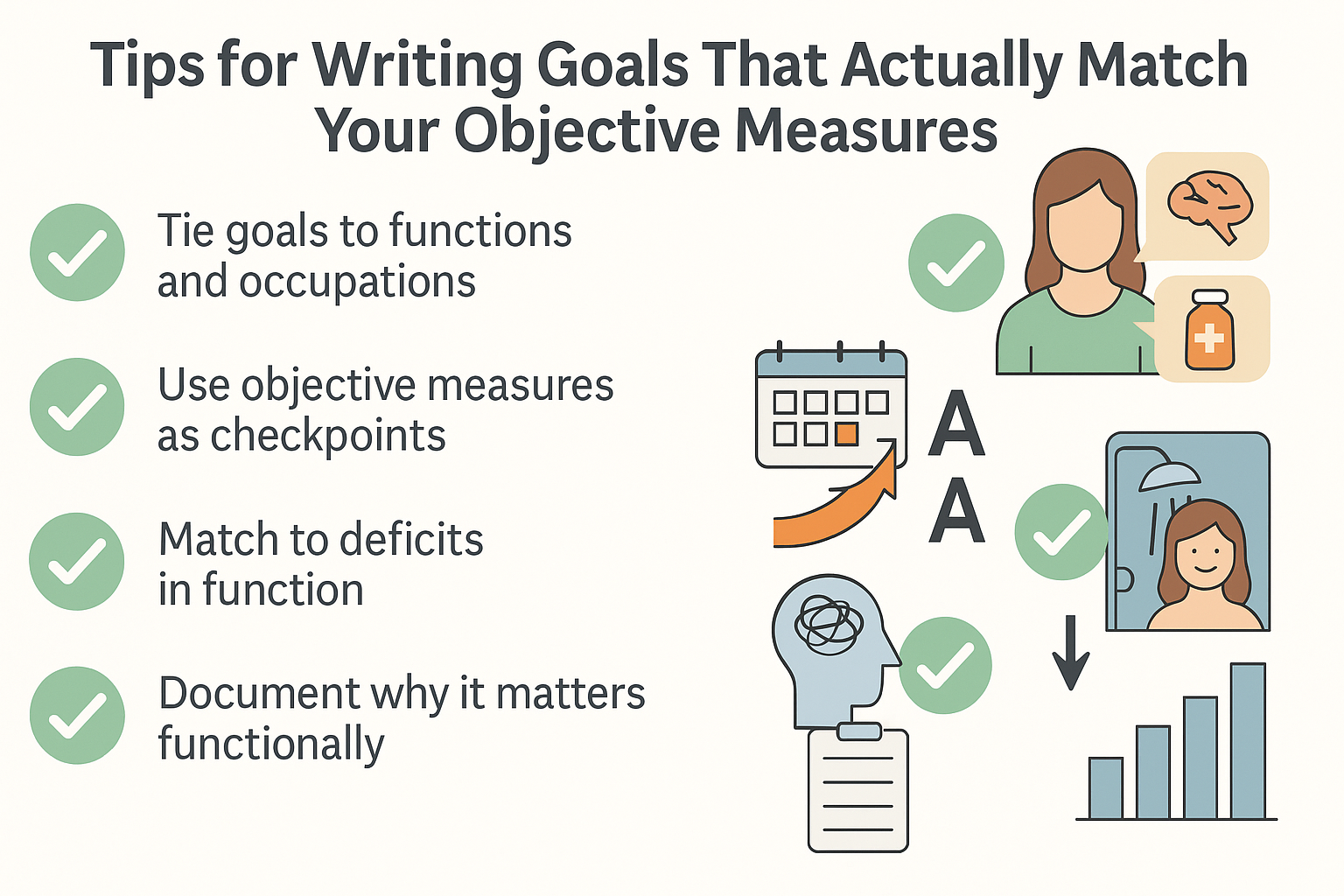
Tips for Writing Goals That Actually Match Your Objective Measures
Matching Measures to Real Deficits
If you’re working on… → Use…
Balance / Fall Risk
Use:
-
BERG Balance Scale
-
TUG (Timed Up and Go)
-
SEBT (Star Excursion Balance Test)
Strength / Endurance
Use:
-
MMT (Manual Muscle Testing)
-
Grip/Pinch Dynamometer
-
5xSTS (Five Times Sit-to-Stand)
Dual-Tasking
Use:
-
Dual-task performance tests
-
Cognitive-motor task analysis
-
Timed functional tasks with a cognitive load
Functional Executive Function (EF)
Use:
-
EFPT (Executive Function Performance Test)
-
Trail Making Test B
-
IADL-based performance analysis
Memory
Use:
-
SLUMS subtests (recall, category generation, working memory)
-
Structured word-recall tasks with interference
Hand Function / Fine Motor
Use:
-
9-Hole Peg Test
-
Grip or Pinch Dynamometer
-
Dexterity-based performance tasks
Lower Extremity Function
Use:
-
LEFS (Lower Extremity Functional Scale)
Vision / Visual Processing
Use:
-
MVPT (Motor-Free Visual Perception Test)
-
Visual scanning and saccade tests
Safety Awareness
Use:
-
C-SAFE
-
Occupation-based safety tasks (kitchen, medication, transfers, mobility)
If your goal and your measure don’t match → insurance will say “not medically necessary.
These are examples and should always be verified for your patient using your clinical expertise.
How to Explain WHY the Score Matters
Insurance doesn’t care that the number changed.
They care how it affects function.
Example:
“BERG improved from 18/56 to 43/56, reducing fall risk and enabling safe shower transfers.”
Example:
“Client improved 5xSTS by 6 seconds, which increases toilet transfer safety and reduces caregiver need.”
Example:
“SLUMS improved by 4 points, improving problem-solving needed for medication management.”
What to Document to Make Your Case
If you track these things, you leave very little room for auditors [ or AI-auditors] to skills of a therapist:
Always document (or, as much as possible 🤪) :
-
Sequencing errors
-
Safety errors
-
Number of cues
-
Cognitive fatigue
-
Compensations used
-
Insight (or lack of insight)
-
Carryover between sessions
-
Environmental demands
-
Time required to complete the task
-
Accuracy/error rate
These connect the measure back to FUNCTION — which is what matters.