
6 Fine Motor and Hand Strengthening Activities for Occupational Therapy
Jul 26, 2026
6 Fine Motor and Hand Strengthening Activities for Occupational Therapy
Fine motor skills and hand strength support a wide range of everyday occupations, from fastening clothing and opening containers to managing medication, preparing meals, writing, using a phone, and handling money. When weakness, pain, reduced coordination, sensory changes, or impaired motor control affects the hand, even familiar activities may become slow, frustrating, or difficult to complete independently.
Occupational therapy intervention should therefore move beyond strengthening the hand simply for the purpose of producing greater force. The therapist must identify which grasp pattern, pinch pattern, manipulation skill, or endurance demand is interfering with occupational performance. A participant who struggles to turn a key may need a different intervention than someone who drops pills, cannot sustain a writing utensil, or becomes fatigued while preparing food.
Member Resources:
- Classification of Hand Movements Picture Guide
- Synergies of Hand Grasp Picture Guide
- The Kaapandji Scoring Tool for Prehension Screen
- Activity Analysis Visual Guide
Fine Motor Skill and Hand Strength Are Not the Same
Member Resource:
Hand strength refers to the ability of the muscles of the hand and forearm to generate and sustain force.
Fine motor skill refers to the controlled use of the hands and fingers during precise movements.
A participant may have adequate strength but still demonstrate difficulty with:
- finger isolation
- movement timing
- object rotation
- graded force
- manipulation within the hand
- release accuracy
- bilateral coordination
- sensory discrimination
Another participant may understand the movement and coordinate it accurately but lack the strength or endurance required to complete the task repeatedly.
Occupational therapy practitioners should identify whether performance is limited primarily by:
- weakness
- pain
- joint stiffness
- impaired sensation
- inflammation/edema
- reduced dexterity
- motor planning
- tremor
- bradykinesia
- fatigue
- reduced attention
- compensatory movement
The intervention should then be selected and graded according to the actual limitation.
This is not an inclusive list, but these are some of our favorite fine motor activities used in outpatient occupational therapy.
1. Therapy Eggs for Functional Grasp Strength
Link to product: Exercise Eggs
Resistive therapy eggs or balls can be used to practice spherical and cylindrical grasp patterns.
These grasp patterns are commonly used when a person:
- opens a jar
- holds a cup
- carries a bottle
- grips a hairbrush
- holds a tool
- stabilizes a food container
- squeezes a household product
Activity setup
Position the participant comfortably at a table with the forearm supported as needed.
Select a resistance level that allows the participant to complete the movement through the available range without excessive pain or compensation.
Ask the participant to:
- wrap the fingers and thumb around the therapy egg
- squeeze slowly
- hold briefly
- release with control
- allow the hand to relax before the next repetition
The therapist may practice:
- full-hand grasp
- cylindrical grasp
- isolated finger compression
- thumb opposition
- sustained grasp
- controlled release
Make the activity more functional
Instead of using a therapy egg, therapy ball, or therapy putty, pair the exercise with actual objects that require a similar grasp.
For example:
- hold and turn an empty jar
- stabilize a cup while stirring
- grasp a hairbrush
- hold a water bottle
- carry a lightweight container
- open a large screw-top lid
This helps the therapist determine whether strength gained during an exercise transfers to the intended occupation. At our clinic, we have a bag of, what seems like, every kind of everyday object possible so that we can ensure our interventions are transferable.
Grade the activity down
- use softer resistance
- reduce repetitions
- shorten the hold
- support the forearm
- use a larger object
- allow rest between repetitions
Grade the activity up
- increase resistance gradually
- increase hold time
- add controlled wrist positioning
- complete the task with the forearm unsupported
- alternate between exercise and functional object use
- increase the duration of sustained grasp
Watch for compensation
The participant may attempt to generate more force by:
- elevating the shoulder
- abducting the arm
- flexing the trunk
- holding the breath
- excessively flexing the wrist
- pressing the object into the table
These patterns may indicate that the resistance is too high or that proximal stability needs to be addressed.
2. Therapy Eggs for Pinch Strength
Link to product: Exercise Eggs
Therapy eggs can also be used to practice specific pinch patterns.
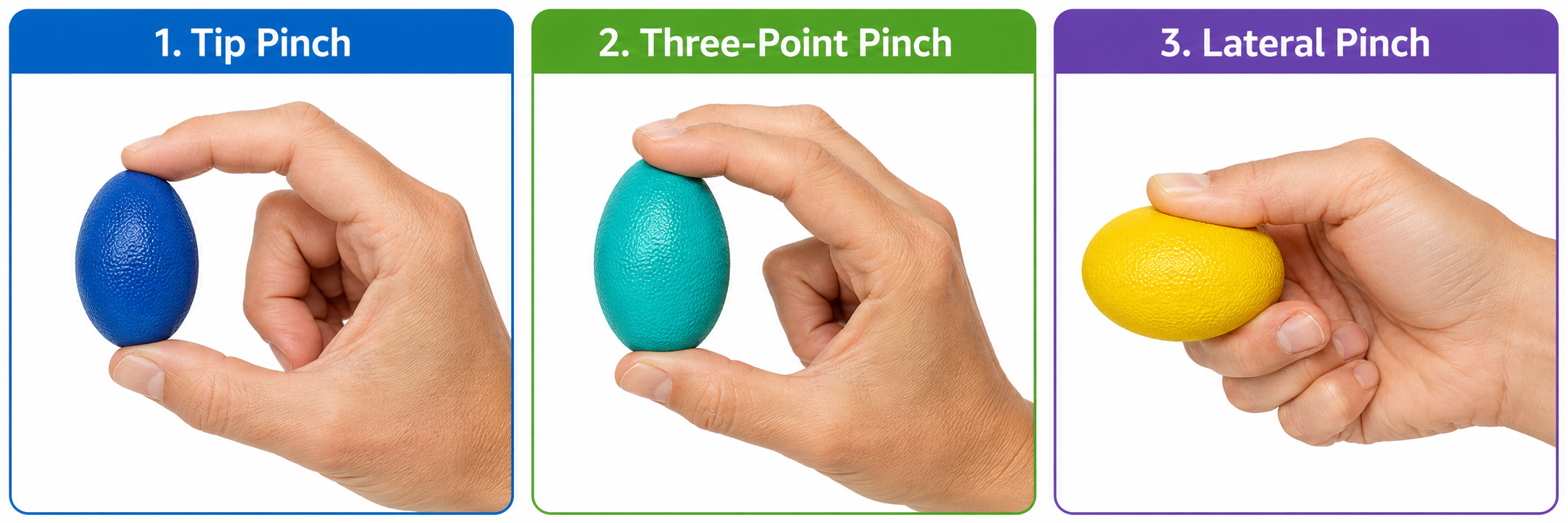
Common pinch patterns include:
Tip pinch
The tip of the thumb meets the tip of the index finger.
This pattern is used for:
- picking up pills
- handling coins
- fastening jewelry
- retrieving small objects
Three-point pinch
The thumb opposes the index and middle fingers.
This pattern is used for:
- holding a pencil
- manipulating small containers
- handling eating utensils
- picking up larger pills or fasteners
Lateral pinch
The thumb presses against the side of the index finger.
This pattern is used for:
- turning a key
- holding a card
- pulling a zipper
- managing paper
- opening small packets
We use exercise eggs and other tools like sponges in various sizes and squishy balls to practice tip, three-point, and lateral pinch with different resistance levels and monitoring pain and compensatory movement.
Activity setup
Position the forearm in a neutral and supported position.
Ask the participant to compress the therapy egg using one pinch pattern at a time.
Complete a small number of controlled repetitions before changing patterns.
The therapist should observe:
- thumb alignment
- finger placement
- joint stability
- movement range
- force control
- pain
- fatigue
- substitution by other fingers
Functional progression
After practicing the pinch pattern, immediately use it during a meaningful task.
Examples include:
- picking up medication beads
- turning a key
- pulling a zipper
- handling coins
- opening a packet
- fastening a button
- holding a pen
- removing a card from a wallet
This helps the participant connect the exercise to everyday performance. In fact, we have this coin dispenser at our clinic that offers a decent amount of resistance while the patient places various size coins into it during the session. You would be surprised at how valuable something like this activity can be for generalizability!
Document tolerance
Record:
- resistance level
- pinch pattern
- repetitions
- hold time
- pain rating
- fatigue
- range
- compensation
- change across sets
3. Clothespins and Binder Clips for Pinch Strength and Release Control
Product links:
- Clothespins - I always tend to lean more toward the colored versions of everything so that I can always have a cognitive-related component possibility
- Binder Cips
Clothespins and binder clips are inexpensive tools that can be used to address pinch strength, fine motor control, release accuracy, and hand endurance.
We use clips of varying resistance and asks the participant to alternate between tip pinch, three-point pinch, and lateral pinch. We also tend to vary positioning by having the person stand and perform task seated for maximum variability.
Activity setup
Provide clips with several resistance levels.
Ask the participant to attach them to:
- the edge of a container
- a vertical pole
- a piece of cardboard
- a drying rack
- fabric
- a folder
- a simulated clothing line
The participant may place and remove the clips using different pinch patterns.
Functional applications
Clip activities may relate to:
- handling clothing fasteners
- opening food packaging
- organizing papers
- manipulating office supplies
- securing household items
- managing clips used during laundry or crafts
Please make sure you explain the connection to the participant’s goals rather than assuming that clip use is automatically functional.
Grade the activity down
- use larger clips
- use low resistance
- position materials close to the body
- allow the forearm to rest on the table
- reduce the number of clips
- use one consistent pinch pattern
Grade the activity up
- increase clip resistance
- vary pinch patterns
- position clips at different heights
- require reaching across midline
- use smaller targets
- add sorting by color or number
- complete the task in standing
- increase the number of repetitions
Add a cognitive component
The participant might:
- follow a color sequence
- place clips according to written instructions
- alternate between two pinch patterns
- reproduce a visual pattern
- sort clips by resistance
- remember where each color belongs
This adds attention, sequencing, and working-memory demands without losing the hand-function focus.
What to observe
Document:
- clip resistance
- pinch pattern
- number completed
- drops
- time required
- release accuracy
- fatigue
- pain
- compensatory movement
- need for repositioning
4. Bead Activities for In-Hand Manipulation and Dexterity
Small beads can be used to address precision, finger isolation, in-hand manipulation, visual-motor coordination, and controlled release.
We use bead activities in a variety of ways in clinic including bead sorting, bead placement, feeding simulations, and gathering multiple beads into the palm before releasing them one at a time into a small target.
What is in-hand manipulation?
In-hand manipulation is the ability to move an object within one hand without using the other hand or placing the object on a surface.
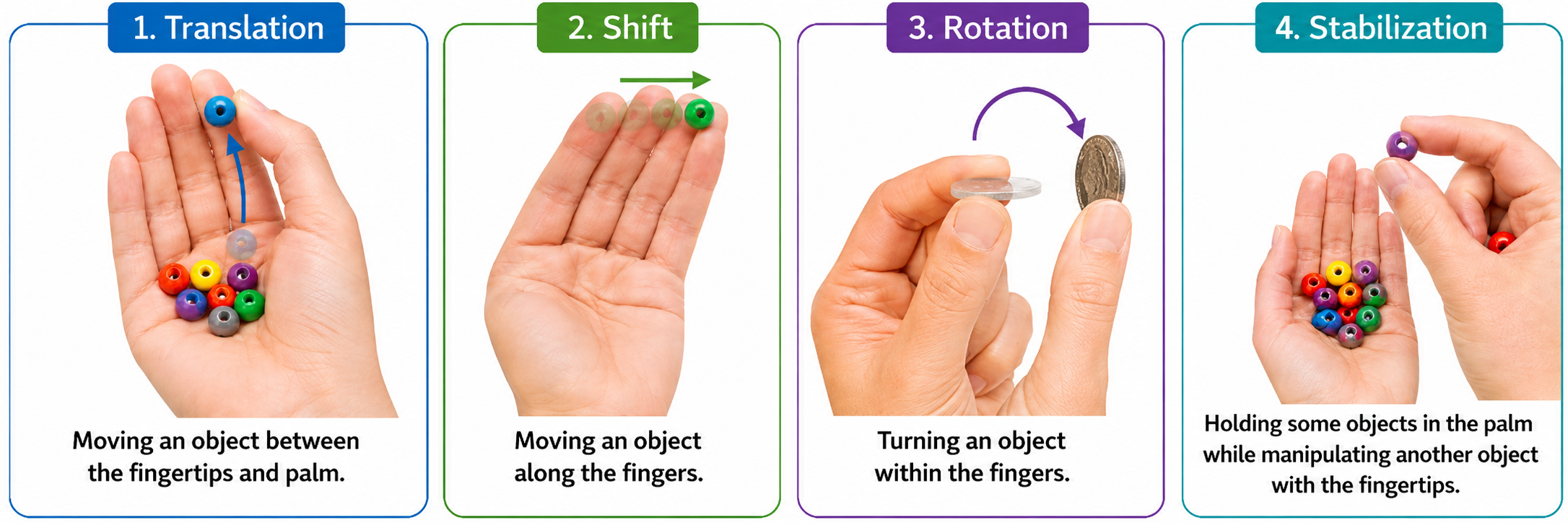
It includes:
Translation
- Moving an object between the fingertips and palm.
- Example: moving a coin from the palm to the fingertips.
Shift
- Moving an object along the fingers.
- Example: adjusting a pencil into writing position.
Rotation
- Turning an object within the fingers.
- Example: turning a pencil over to use the eraser.
Stabilization
- Holding some objects in the palm while manipulating another object with the fingertips.
- Example: holding several coins while placing one coin into a machine.
Activity setup
Place beads or small objects on the table.
Ask the participant to:
- pick up several beads one at a time
- store them in the palm
- move one bead at a time back to the fingertips
- place each bead into a narrow container
The participant should attempt to complete the task without using the opposite hand or dropping the remaining beads.
Functional alternatives
Beads may be replaced with:
- coins
- buttons
- small screws
- game pieces
- dry beans
- small food items
- medication-sized objects
Grade the activity down
- use larger objects
- use a wide container
- allow bilateral assistance
- reduce the number stored in the palm
- use high-contrast objects
- reduce sorting requirements
Grade the activity up
- use smaller objects
- increase the number held in the palm
- use a narrow opening
- add color sorting
- require a specific sequence
- complete the task without looking continuously at the hand
- place objects at different locations
Observe the movement pattern
The participant may:
- drop objects when opening the hand
- use the table to reposition them
- compensate with the opposite hand
- move all objects together instead of isolating one
- demonstrate reduced thumb opposition
- become slower as fatigue increases
These patterns provide more information than completion time alone.
5. Feeding Simulations With Spoons and Small Objects
A feeding simulation can address grasp, utensil control, wrist stability, forearm rotation, graded force, visual-motor coordination, and transport of an object through space.
Activity setup
Place small, nonfood items in one container and an empty container nearby.
Ask the participant to:
- grasp the spoon
- scoop one or more items
- lift the spoon
- transport it to the second container
- release the items without spilling
Depending on the participant, alternatives may include:
- dry beans
- cotton balls
- pom-poms
- cereal pieces
- rice
- pasta
- weighted practice material
What this activity may address
- utensil grasp
- hand-to-mouth movement pattern
- wrist control
- forearm supination
- shoulder stability
- visual guidance
- movement speed
- spill control
- sustained attention
- endurance
Make it more occupation-centered
Practice with the actual utensil and dish the participant uses at home.
The therapist may compare:
- standard spoon
- built-up handle
- angled spoon
- lightweight utensil
- weighted utensil
- shallow versus deep bowl
- nonslip surface
The goal may be adaptation rather than simply increasing strength.
Grade the activity down
- use larger and lighter objects
- shorten the transport distance
- stabilize the bowl
- support the forearm
- use a built-up handle
- reduce repetitions
Grade the activity up
- use smaller objects
- increase transport distance
- vary the container location
- add forearm rotation
- require controlled placement
- simulate a full feeding sequence
- combine with postural demands
What to document
Record:
- utensil used
- grasp pattern
- number of successful transfers
- spills
- drops
- time
- assistance
- wrist position
- fatigue
- pain
- response to adaptation
6. Therapy Putty for Functional Hand Strength and Finger Control
Product Link: Therapy Putty
Member Resource: Generic Therapy Putty Home Exercise Program for you assign something client specific
Therapy Putty can be used to address several hand movements within one material.
We have used therapy putty to facilitate finger spread, fingertip pinch, flat pinch, power grip, finger extension, finger scissoring, and full-hand grasp.
Possible therapy putty activities
Power grasp
Squeeze the putty through the whole hand.
This may support tasks such as holding containers, gripping tools, and carrying objects.
Tip pinch
Pinch small pieces using the thumb and index finger.
This may support handling pills, coins, and fasteners.
Three-point pinch
Pinch using the thumb, index, and middle fingers.
This may relate to writing, utensil use, and object control.
Lateral pinch
Press the thumb against the side of the index finger.
This may relate to keys, cards, paper, and zippers.
Finger extension
Place putty around the fingers and spread them apart.
This may support hand opening and release.
Finger isolation
Press one finger into the putty at a time.
This may address isolated movement used during typing, device use, and button pressing.
Object retrieval
Hide beads, coins, or buttons inside the putty and ask the participant to locate and remove them.
This combines strength, tactile discrimination, manipulation, and problem solving.
Grade the activity down
- use softer putty
- reduce the volume
- shorten the duration
- perform one movement pattern
- support the forearm
- use larger hidden objects
- provide rest between sets
Grade the activity up
- increase resistance gradually
- increase repetitions
- combine several movement patterns
- use smaller hidden objects
- require manipulation without visual guidance
- move directly into a functional task afterward
11 Ways to Grade Fine Motor and Hand Strengthening Activities
Object size: Larger objects are generally easier to grasp and manipulate. Smaller objects require more precision.
Object weight: Heavier objects increase strength and stabilization demands.
Resistance: Clips, putty, and hand exercisers can be selected at different resistance levels.
Surface friction: Objects may be easier to manipulate on a nonslip surface than on a smooth tabletop.
Reach distance: Keeping the object close reduces proximal demand. Moving it farther away adds reaching and postural control.
Target size: A wide container is easier than a narrow slot or opening.
Speed: A slower pace may support control and accuracy. Time demands should be added only when they are relevant.
Repetitions: Increase repetitions gradually while monitoring movement quality, pain, and fatigue.
Sensory demand: The task can be completed with full vision, reduced visual reliance, or objects with different textures.
Cognitive demand: The participant may sort, sequence, count, remember instructions, or follow a visual pattern while manipulating objects.
Bilateral demand: The task may require one hand to stabilize while the other manipulates, as commonly occurs during dressing, meal preparation, and container management.
Connect the Activity to the Required Hand Function
Begin with the occupation needing to be improved!
Ask:
- What is the participant trying to hold?
- How much force is required?
- Which fingers are used?
- Does the task require sustained or brief force?
- Is the object manipulated within the hand?
- Does one hand stabilize while the other works?
- Is accurate release required?
- Does the person need speed, endurance, or precision?
- Would an adaptive device be more effective than strengthening alone?
For example, difficulty opening a medication bottle may involve several factors:
- reduced grip strength
- reduced pinch strength
- hand pain
- poor coordination
- difficulty understanding the closure
- reduced sensation
- an inaccessible container design
A therapy egg alone may not resolve the problem. The therapist may need to address strength while also recommending an easier container or pharmacy packaging. Both are appropriate in an occupational therapy plan of care!
What Occupational Therapy Practitioners Should Document
Strong documentation should identify the hand demand, dosage, quality of performance, response to grading, and functional relevance.
Useful variables include:
- hand used
- dominance
- grasp or pinch pattern
- resistance
- object size
- repetitions
- hold time
- number of successful placements
- drops
- spills
- time to completion
- pain
- fatigue
- edema
- compensatory movement
- cueing
- assistance
- rest breaks
- adaptive equipment
- change across trials
- occupational task being addressed
Sample Documentation: Pinch Strength
- The participant completed a seated pinch-strengthening activity using 24 clips of two resistance levels.
- The participant placed eight clips using tip pinch, eight using three-point pinch, and eight using lateral pinch with the right hand.
- The participant completed 20 of 24 placements independently and required four rest breaks secondary to thumb fatigue. Shoulder elevation emerged during the final six repetitions and decreased following forearm support and reduction to the lower-resistance clips. The activity addressed pinch patterns required for medication handling, zipper management, and opening small household packages.
Sample Documentation: In-Hand Manipulation
- The participant completed an in-hand manipulation activity involving translation of five small beads from the palm to the fingertips and placement into a narrow container.
- The participant successfully translated and placed 17 of 20 beads without using the opposite hand. Three objects were dropped when the participant attempted to stabilize more than four beads in the palm. Performance improved when the task was modified to three beads per trial. No pain was reported.
Sample Documentation: Feeding Simulation
- The participant completed 30 simulated feeding transfers using a standard teaspoon and dry beans.
- The participant successfully transferred 24 of 30 items without spilling and demonstrated reduced wrist stability during the final 10 repetitions.
- Use of a built-up handle improved grasp security and increased successful transfer accuracy to 9 of 10 during the final trial. The participant reported reduced hand fatigue with the adapted utensil.
Sample Documentation: Theraputty
- The participant completed six theraputty exercises targeting full grasp, finger extension, tip pinch, three-point pinch, lateral pinch, and finger isolation.
- Each exercise was completed for two sets of eight repetitions using soft resistance. The participant required verbal cues to maintain neutral wrist positioning during full grasp and demonstrated increased pain from 2 of 10 to 4 of 10 during lateral pinch. Lateral pinch was discontinued, and no further increase in pain occurred. The activity addressed hand strength and motor control required for writing, container management, and clothing fasteners.
Hand Strengthening Should Improve Occupational Performance
A participant may become better at squeezing putty without becoming more successful at fastening clothing, preparing food, managing medication, or writing. I am a firm believer that what we call "preperatory activities" or "activities to support occupation" (whatever era of OT you learned it) still have a place! So, after a hand-strengthening activity, return to the functional task.
Ask:
- Is the object easier to hold?
- Can the participant sustain the grasp longer?
- Are fewer objects dropped?
- Has pain changed?
- Is less compensation required?
- Is the movement more efficient?
- Does an adaptation improve performance more than exercise?
- Can the participant complete the task safely at home?
Continue Learning With Us
Did you find this information helpful? Please share this article with another occupational therapy practitioner, student, educator, or rehabilitation professional who may benefit from it.
Would you like access to the clinical resources discussed throughout this article? Explore our membership options to find the level of support that works best for you.
Looking for a more formal learning and mentorship experience? Learn more about the Functional Cognition Lab Mentorship Program.
You can also explore our AOTA-approved courses and clinical resource packages for additional education, treatment resources, and practical tools you can use in rehabilitation practice.
Interested in receiving free functional cognition education each week? Subscribe to the Functional Cognition Lab Newsletter.