
Occupational Therapy Goals for ADLs and IADLs
Aug 03, 2026
Occupational Therapy Goals for ADLs and IADLs: Dressing, Toileting, Grooming, Bathing, Feeding, and Home Management
by Michelle C. Eliason, MS, OTR/L
Dear Members, check out your Membership Library where you have access to the Resource Bundles with your membership. I would also like to encourage you to leave a Marco Polo message for asynchronous discussion about how this content may currently relate to your clinical practice or education!
Membership Resources: This article and its companion audio are free to read and listen to. Links throughout the article connect members of the Functional Cognition Lab to related printables, treatment tools, courses, and clinical resources that align with the topic being discussed. Membership also includes access to the full resource library and direct clinical support. Find out more about membership on the Membership Options Page
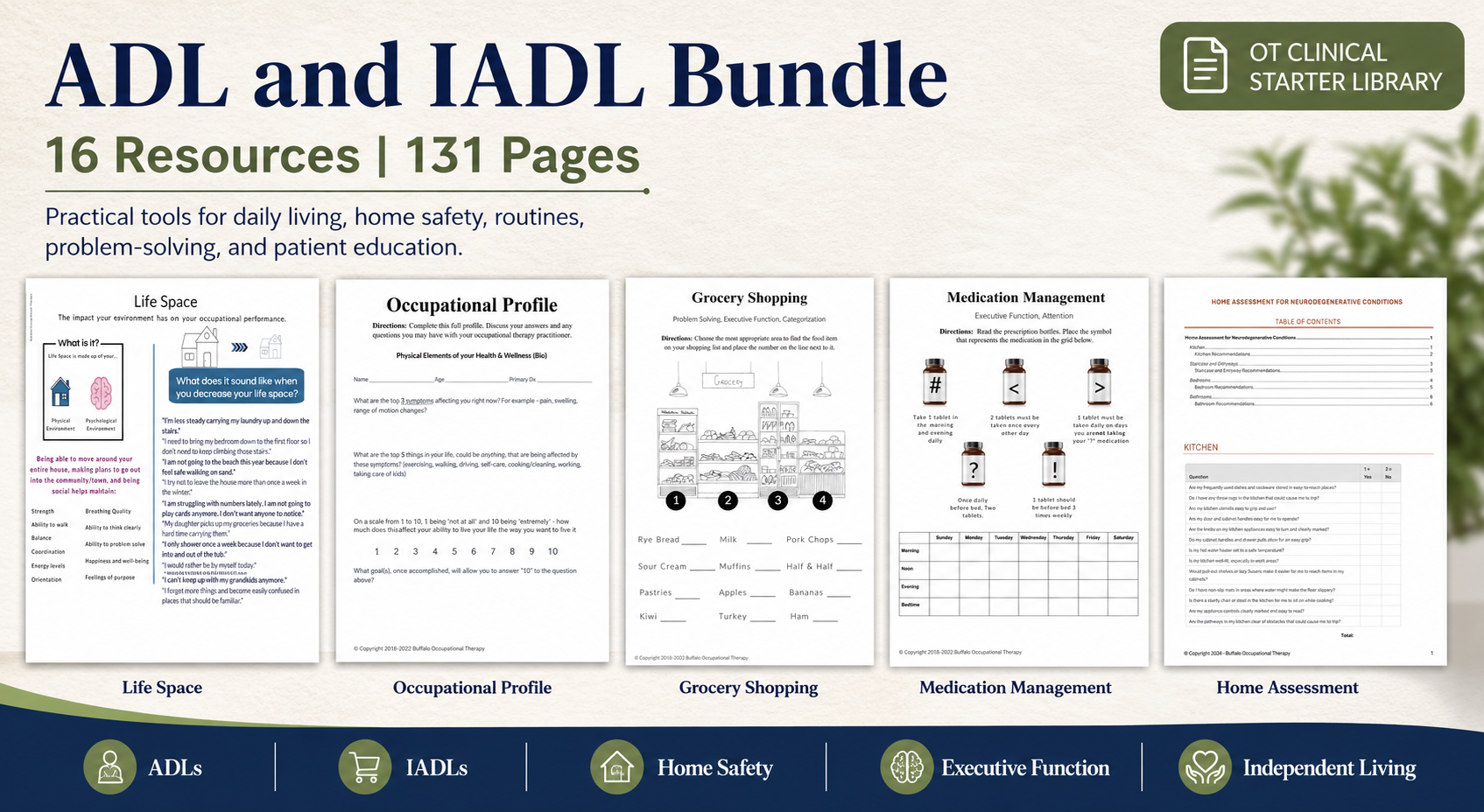
**Just want the resources mentioned in this article?: Download the ADL and IADL Bundle
Activities of daily living and instrumental activities of daily living are at the center of occupational therapy practice. These occupations are often the reason a person is referred to therapy in the first place. They may be unable to dress without assistance, complete toileting safely, prepare a meal, manage medication, maintain their home, or return to an important family or work role.
Writing goals for these areas can still be difficult. ADL and IADL performance depends on far more than whether the person can complete the final task. Dressing may require sitting balance, range of motion, bilateral hand use, sequencing, initiation, safety awareness, cardiopulmonary endurance, and the ability to manage adaptive equipment. Meal preparation may require planning, standing tolerance, hand function, visual scanning, divided attention, judgment, and cleanup. When several performance barriers are present, it can be tempting to write a long goal that attempts to capture every body function and performance skill involved.
Strong occupational therapy goals do not need to name every possible underlying component. They should identify the occupation, define the level of performance expected, describe the assistance or equipment permitted, and establish how success will be measured. Component skills may still be addressed through short-term goals or intervention objectives, but the long-term goal should remain connected to what the participant needs and wants to do in daily life.
Member Resources:
- AROM of motion measurement guide for common ADLs and IADLs (23 pages)
- Printable Template for Activity Analysis
- Activity Analysis and Functional Cognition Education Resource
- Performance Skills related to common ADLs
What Makes an ADL or IADL Goal Functional?
A functional goal describes what the participant will perform, under what conditions, and with what level of assistance. It should be specific enough that another therapist could determine whether the goal was met without relying entirely on clinical interpretation.
For example, the statement “The participant will improve dressing performance” is too broad. It does not tell us whether the person is working on upper-body dressing, lower-body dressing, clothing selection, fasteners, adaptive equipment, or balance during clothing management.
A stronger goal would be:
The participant will complete lower-body dressing while seated, using a reacher and sock aid as needed, with setup assistance and no more than one verbal cue within six weeks.
This version identifies the occupation, position, permitted equipment, assistance level, cueing, and timeframe.
The goal should also reflect what is meaningful and realistic for the participant. Independent performance is not always the most appropriate outcome. A person may reach modified independence with adaptive equipment, require supervision for safety, or complete part of the task while a caregiver assists with another portion. The goal should describe meaningful progress rather than automatically requiring unsupported independence.
Occupational Therapy Goals for Toileting
Toileting requires a combination of mobility, balance, clothing management, hygiene, sequencing, initiation, safety awareness, and access to the bathroom environment. The therapist should identify which part of the occupation is creating the greatest barrier rather than writing one broad goal for “toileting independence.”
A participant may transfer safely but struggle with clothing management. Another may manage clothing and hygiene but fail to recognize the need to initiate the routine. Someone else may complete the task physically but require supervision because of poor balance or limited awareness of precautions.
Toileting transfer goal
The participant will complete toilet transfers using the prescribed mobility device and grab bar with supervision and no loss of balance across three consecutive sessions within six weeks.
Toileting hygiene goal
The participant will complete toileting hygiene using adaptive equipment as needed with no more than minimal assistance within eight weeks.
Clothing-management goal
The participant will manage lower-body clothing before and after toileting while maintaining standing balance with one-hand support and no more than contact guard assistance within six weeks.
Toileting-sequence goal
The participant will initiate, sequence, and complete the toileting routine with no more than one verbal cue across four out of five opportunities within eight weeks.
Safety and precaution goal
The participant will independently follow prescribed weight-bearing and movement precautions during toileting transfers and clothing management across three consecutive sessions within four weeks.
A long-term toileting goal can be supported by shorter goals addressing sit-to-stand performance, standing tolerance, trunk rotation, reach, balance, hand use, or sequencing. However, those component goals should be selected because they clearly limit toileting performance.
Occupational Therapy Goals for Grooming and Oral Care
Grooming may include washing the face, brushing teeth, shaving, applying makeup, clipping nails, styling hair, or managing skin care. Each activity places different demands on posture, upper-extremity movement, visual access, fine motor control, bilateral coordination, endurance, sequencing, and safety.
A participant who can sit at the sink but cannot manipulate a toothbrush needs a different goal from someone who has adequate hand function but becomes fatigued while standing. The goal should name the actual grooming task whenever possible.
Simple grooming goal
The participant will complete face washing, hair care, and oral hygiene while seated at the sink with setup assistance and no more than one verbal cue within four weeks.
Standing grooming goal
The participant will complete a 15-minute grooming routine while standing at the sink with supervision, no loss of balance, and use of one upper extremity for support as needed within six weeks.
Oral-care goal
The participant will complete oral care using adapted equipment as needed with modified independence across three consecutive sessions within six weeks.
Fine motor grooming goal
The participant will manipulate grooming items, including toothpaste caps, razor controls, and small containers, without dropping items in at least 90% of attempts within six weeks.
Sequencing goal
The participant will independently initiate and complete a four-step morning grooming routine using a visual checklist as needed within six weeks.
Safety language should match the task. Shaving goals may include appropriate use of an electric or manual razor. Water-based grooming may require temperature awareness. Nail care may require visual access, sensation, precision, and judgment. The therapist should define the behavior rather than documenting only that the participant will “increase safety awareness.”
Occupational Therapy Goals for Feeding
Feeding goals should distinguish between eating, feeding, and swallowing. Occupational therapy may address positioning, utensil management, hand-to-mouth movement, bilateral hand use, adaptive equipment, pacing, endurance, visual attention, and environmental setup. Swallowing safety may require collaboration with speech-language pathology and the broader medical team.
A person may understand how to eat but be unable to stabilize the bowl, scoop food, transport the utensil, or maintain posture throughout the meal. Another may complete the physical movements but become distracted, impulsive, or fatigued.
Utensil-management goal
The participant will use the prescribed utensil to retrieve and transport food from plate to mouth with no more than two spills during a full meal within six weeks.
Adaptive-equipment goal
The participant will independently select and use appropriate adaptive feeding equipment during meals across three consecutive sessions within four weeks.
Feeding-endurance goal
The participant will maintain an upright seated position and participate in feeding for at least 20 minutes without physical assistance for postural correction within six weeks.
Bilateral hand-use goal
The participant will stabilize a bowl or plate with one hand while manipulating a utensil with the opposite hand in at least 90% of opportunities within six weeks.
Attention and pacing goal
The participant will sustain attention to feeding and use an individualized pacing strategy throughout a 20-minute meal with no more than one verbal redirection within six weeks.
The outcome should focus on successful meal participation rather than listing every muscle group involved. Strength, range of motion, motor control, and endurance may be treatment targets, but the feeding goal should describe what those improvements are expected to support.
Occupational Therapy Goals for Bathing and Showering
Bathing may require transfers, sitting and standing balance, reaching in several directions, temperature regulation, object manipulation, sequencing, safety judgment, use of durable medical equipment, and tolerance for a demanding environment.
It is important to describe the bathing method. Showering while standing, showering from a tub bench, and sponge bathing from a bed or chair are different occupations with different demands.
Shower-transfer goal
The participant will complete entry into and exit from the shower using the prescribed tub bench and grab bars with supervision and no loss of balance within six weeks.
Seated-showering goal
The participant will complete upper- and lower-body washing while seated on a shower chair using a handheld showerhead and long-handled sponge with no more than minimal assistance within eight weeks.
Standing-bathing goal
The participant will maintain safe standing balance with one-hand support while washing the perineal area and managing bathing supplies with contact guard assistance within six weeks.
Sponge-bathing goal
The participant will complete sponge bathing from a supported seated position with setup assistance and no more than two verbal cues within four weeks.
Bathing-sequence goal
The participant will initiate, sequence, and terminate a bathing routine using a written checklist and no more than one verbal cue within eight weeks.
Temperature and safety goal
The participant will independently verify safe water temperature and correctly use prescribed bathing equipment across three consecutive sessions within four weeks.
Bathing goals should consider whether the participant can gather supplies, manage towels and clothing, dry the body, and safely leave the bathing area. Completing only the washing portion may not represent completion of the full occupation.
Occupational Therapy Goals for Upper-Body Dressing
Upper-body dressing may involve clothing selection, retrieval, sitting or standing tolerance, shoulder movement, bilateral coordination, visual-spatial processing, sequencing, fastener management, and the use of adaptive techniques.
Goals should identify the type of clothing when it changes the task demand. Donning a pullover shirt differs from managing a button-down shirt, jacket, bra, or garment with a zipper.
Basic upper-body dressing goal
The participant will don and doff a pullover shirt while seated without back support and with no more than setup assistance within four weeks.
Hemiplegic dressing goal
The participant will complete upper-body dressing using a taught hemiplegic dressing sequence with no more than one verbal cue within six weeks.
Fastener-management goal
The participant will manage five clothing fasteners, including buttons or a zipper, using adaptive equipment as needed with at least 80% accuracy within six weeks.
Clothing-selection goal
The participant will independently select weather- and activity-appropriate clothing for three simulated daily situations within four weeks.
Jacket goal
The participant will don and doff a jacket and manage the zipper with modified independence within eight weeks.
When selection, retrieval, and dressing are all concerns, they may be addressed in one functional sequence. The therapist should avoid performing the planning and setup for the participant if those are the skills being evaluated.
Occupational Therapy Goals for Lower-Body Dressing
Lower-body dressing frequently requires trunk flexion, hip mobility, sitting balance, standing tolerance, transitional movement, bilateral hand use, clothing management, and knowledge of adaptive equipment. It can also involve substantial cardiopulmonary effort.
The goal should specify whether the participant is dressing from a seated or standing position and whether equipment such as a reacher, dressing stick, or sock aid is permitted.
Lower-body dressing goal
The participant will don and doff pants while seated, using a reacher as needed, and complete standing clothing management with supervision within eight weeks.
Sock and shoe goal
The participant will don socks and shoes using a sock aid and long-handled shoehorn with modified independence within six weeks.
Balance-related dressing goal
The participant will maintain standing balance with one-hand support for at least five minutes while completing lower-body clothing management without loss of balance within six weeks.
Fastener goal
The participant will manage shoe closures and lower-body clothing fasteners with no more than one verbal cue in four out of five trials within six weeks.
Adaptive-method goal
The participant will independently select and use the safest dressing position and prescribed adaptive equipment during lower-body dressing across three consecutive sessions within six weeks.
Range of motion goals may support dressing, but exact joint angles should not automatically become the primary outcome. The more meaningful question is whether the participant can reach the foot, manipulate the clothing, maintain balance, and complete the task safely. If full range is not expected, adaptation may be more effective than pursuing a predetermined set of kinematic values.
Occupational Therapy Goals for Functional Transfers
Transfers often appear inside other ADL goals because they determine whether the participant can access the toilet, shower, bed, chair, vehicle, or household work surface.
Goals should name the surfaces, assistance, equipment, and safety requirements.
Multiple-surface transfer goal
The participant will complete sit-to-stand and stand-to-sit transfers from a standard chair, bed, sofa, and toilet using the prescribed mobility device with supervision and no loss of balance within six weeks.
Repeated-transfer goal
The participant will complete five consecutive sit-to-stand transfers from a standard-height chair without physical assistance and with consistent use of safe hand placement within six weeks.
Bed-transfer goal
The participant will complete transfer into and out of bed using adaptive equipment as needed with modified independence within eight weeks.
Precaution-adherence goal
The participant will independently maintain prescribed precautions during transfers across three consecutive sessions within four weeks.
Repeated sit-to-stand performance may be a useful component measure, but it should remain connected to the transfer demands the participant encounters in daily life.
Occupational Therapy Goals for Medication Management
Medication management includes interpreting instructions, opening containers, sorting medication, remembering schedules, initiating the routine, identifying errors, and arranging refills. A clinic-based sorting task captures only part of the occupation.
Medication-sorting goal
The participant will organize a seven-day simulated medication routine according to written instructions with 100% accuracy and no more than one verbal cue within six weeks.
Medication-routine goal
The participant will independently use a prescribed reminder and organization system to complete morning and evening medication routines in at least 90% of opportunities over two consecutive weeks.
Error-detection goal
The participant will independently identify and correct all intentionally placed errors in a simulated medication organizer across three consecutive trials within six weeks.
Refill-management goal
The participant will identify when medication refills are needed and complete the steps required to request a refill with no more than one verbal cue within eight weeks.
Caregiver-training goal
The participant and caregiver will independently demonstrate the prescribed medication-organization and verification routine before discharge.
The level of assistance should reflect the complete routine. Someone may sort pills accurately but still require support to remember when to take them or to respond appropriately when the schedule changes.
Occupational Therapy Goals for Meal Preparation
Meal preparation includes planning, obtaining ingredients, organizing materials, using appliances, sequencing steps, monitoring time, serving food, and cleaning the work area. A goal that addresses only cooking may miss several essential parts of the occupation.
Instead of describing meals as “simple, moderate, or severely complex,” define the demands. A simple meal may require three ingredients and no heat. A more complex meal may involve multiple items, stove use, timing demands, or simultaneous steps.
Simple meal-preparation goal
The participant will prepare a familiar cold meal involving at least four ingredients with setup assistance and no more than one verbal cue within six weeks.
Heated-meal goal
The participant will prepare a familiar heated meal using an appliance safely, complete all required steps, and turn off the appliance without verbal prompting within eight weeks.
Full meal-management goal
The participant will plan, prepare, serve, and clean up after a balanced meal with supervision and no safety errors within 12 weeks.
Meal-planning goal
The participant will select a meal, identify required ingredients, create an organized shopping list, and sequence the preparation steps with no more than one verbal cue within six weeks.
Problem-solving goal
The participant will identify and implement an appropriate alternative when one ingredient or kitchen tool is unavailable in four out of five trials within eight weeks.
Endurance and pacing goal
The participant will complete a 30-minute meal-preparation activity using independently selected pacing and seated-rest strategies without therapist-initiated rest within eight weeks.
The goal should recognize safe and effective strategy use. Taking a seated break or preparing ingredients in advance may represent better occupational performance rather than incomplete recovery.
Occupational Therapy Goals for Housekeeping and Laundry
Housekeeping requires more than strength and endurance. It may involve planning, collecting supplies, safe use of equipment, bending, carrying, reaching, environmental awareness, task initiation, and completion of cleanup.
The exact household activity should be named because sweeping, vacuuming, washing dishes, cleaning a bathroom, and managing laundry create different demands.
Housekeeping goal
The participant will complete a 20-minute household-cleaning routine involving two predetermined tasks with supervision and use of pacing strategies as needed within eight weeks.
Dish-management goal
The participant will load, unload, and organize dishes using safe body mechanics and no more than one verbal cue within six weeks.
Laundry goal
The participant will sort, wash, dry, fold, and place one load of laundry using adaptive techniques as needed with supervision within 10 weeks.
Vacuuming goal
The participant will vacuum a designated room while safely managing the cord, changing directions, and using pacing strategies with no loss of balance within eight weeks.
Household-organization goal
The participant will organize frequently used household items into accessible locations and independently return items to the designated areas in at least 90% of opportunities within six weeks.
Caregiver-burden goal
The participant will independently complete four predetermined household-management responsibilities on at least five days per week for three consecutive weeks within 12 weeks.
This last goal connects occupational performance with a meaningful family role and reduction in caregiver demand. The specific responsibilities should be selected collaboratively rather than assigned solely by the therapist.
Occupational Therapy Goals for Financial Management
Financial management may involve recognizing bills, budgeting, calculating totals, completing payments, using digital systems, detecting suspicious information, and maintaining records. The task should be matched to the participant’s actual level of responsibility.
Basic financial-management goal
The participant will identify currency, calculate the total cost of three items, and provide the correct payment with at least 90% accuracy within six weeks.
Bill-payment goal
The participant will accurately review and complete payment for three simulated household bills using a written checklist and no more than one verbal cue within eight weeks.
Budgeting goal
The participant will create a weekly spending plan using predetermined income and expenses with at least 90% accuracy within eight weeks.
Digital financial-management goal
The participant will complete a simulated online payment using appropriate password, verification, and fraud-awareness strategies with supervision within eight weeks.
Safety-judgment goal
The participant will identify potentially unsafe or fraudulent financial requests in four out of five simulated situations within six weeks.
Goals should not use labels such as basic, moderate, or intermediate without describing what the level actually requires.
Occupational Therapy Goals for Orthotics, Prosthetics, and Adaptive Equipment
Using adaptive equipment is an occupational skill. The participant must identify the equipment, position it correctly, remember when to use it, inspect it for problems, and incorporate it into the routine.
Orthotic-management goal
The participant will independently don and doff the prescribed orthosis, confirm correct positioning, and verbalize the wearing schedule and skin-check routine within four weeks.
Prosthetic-management goal
The participant will don, doff, and complete a basic inspection of the prescribed prosthesis with no physical assistance across three consecutive sessions within eight weeks.
Adaptive-equipment goal
The participant will independently select and correctly use the prescribed reacher, sock aid, and long-handled shoehorn during lower-body dressing within six weeks.
Caregiver-training goal
The caregiver will independently demonstrate safe setup, use, and maintenance of the participant’s prescribed bathing and transfer equipment before discharge.
The goal should measure actual use within the occupation rather than knowledge of the equipment alone.
Occupational Therapy Goals for Handwriting and Fine Motor Performance
Fine motor goals should identify the functional activity the hand is expected to support. A change in grip or pinch strength may be useful, but it is stronger when paired with improved performance during writing, fastening, medication handling, food preparation, or container management.
Functional pinch-strength goal
The participant will increase pinch strength sufficiently to independently manage clothing fasteners and open three commonly used household containers within eight weeks.
A separate measurable strength target may be included when there is a clear baseline and an appropriate expected change, but the occupational outcome should remain visible.
Handwriting goal
The participant will write a five-sentence functional message with legible letter formation, consistent spacing, and completion within five minutes across three consecutive trials within eight weeks.
Handwriting-endurance goal
The participant will complete 10 minutes of functional writing without a decline in legibility or an increase in hand pain greater than two points within six weeks.
In-hand manipulation goal
The participant will translate and place 20 small objects from the palm to the fingertips without using the opposite hand and with no more than two drops within six weeks.
Micrographia goal
The participant will complete a functional handwriting sample with consistent letter size and at least 90% legibility using independently selected amplitude or pacing strategies within eight weeks.
For participants with Parkinson’s disease, the goal may involve strategy use, cueing, adaptive writing tools, pacing, and improved readability. The goal should not promise elimination of micrographia if compensation is the more realistic outcome.
Occupational Therapy Goals for Health Management
Health management includes understanding symptoms, implementing strategies, organizing appointments, following precautions, monitoring response to activity, and communicating with healthcare providers.
A goal should measure what the participant will do with the education rather than simply whether education was provided.
Chronic-condition self-management goal
The participant will describe three symptoms that affect daily performance and independently select an appropriate management strategy for each within six weeks.
Symptom-strategy goal
The participant will trial at least four individualized strategies for managing pain, dystonia, fatigue, or motor symptoms and document perceived effectiveness and functional impact within eight weeks.
Precaution-management goal
The participant will independently identify and follow all prescribed movement and weight-bearing precautions during self-care and household tasks across three consecutive sessions within four weeks.
Oxygen-management goal
The participant will independently manage oxygen tubing and prescribed flow setup during functional mobility and self-care without line entanglement or interruption of use across three consecutive sessions within six weeks.
Activity-monitoring goal
The participant will independently recognize signs of excessive exertion and initiate an appropriate pacing, breathing, or rest strategy during three consecutive functional activities within six weeks.
Education becomes occupational therapy intervention when the participant can apply the information during actual routines.
Occupational Therapy Goals for Roles, Employment, and Participation
Occupation-specific goals can extend beyond self-care and household tasks. A participant may want to return to a role as a parent, spouse, employee, volunteer, student, or community member.
These goals should focus on behaviors within the participant’s control. “The participant will obtain employment within 24 weeks” may depend on the job market, employer decisions, transportation, and other external factors. A therapist can address employment readiness and participation, but cannot guarantee that an employer will offer a position.
Family-role goal
The participant will consistently complete six collaboratively selected household or family-management responsibilities each week for three consecutive weeks within 12 weeks.
Employment-readiness goal
The participant will complete a vocational skills assessment, develop an updated resume, identify three appropriate employment opportunities, and participate in at least two interview-preparation activities within 12 weeks.
Work-task goal
The participant will complete a simulated 45-minute work task using appropriate body mechanics, pacing, and symptom-management strategies with no more than one cue within eight weeks.
Community-participation goal
The participant will plan and complete one community activity using appropriate transportation, scheduling, mobility, and symptom-management strategies with supervision within eight weeks.
Role-balance goal
The participant will identify current role demands, establish three meaningful participation priorities, and implement an action plan for at least two priorities within eight weeks.
Tools such as a role checklist, Kawa-based reflection, or participant-directed action planning may support the process, but completing the tool is not usually the final occupational outcome.
Using Standardized Measures in ADL and IADL Goals
Standardized measures can support goal development and progress monitoring, but they should not replace direct measurement of occupational performance. A change in score is most meaningful when it corresponds with a change the participant experiences during daily life.
Measures such as the QuickDASH, Lower Extremity Functional Scale, Patient-Specific Functional Scale, grip and pinch testing, handwriting assessments, and performance-based ADL measures can help quantify baseline limitations and change. The therapist should understand the scoring direction, range, measurement properties, and expected amount of meaningful change before assigning a numerical target.
A goal should not automatically require an extremely large change simply because the scale allows it. The expected improvement should be grounded in the participant’s baseline, diagnosis, prognosis, timeframe, and intervention plan.
A combined goal may be stronger:
The participant will demonstrate improved upper-extremity function as evidenced by improved performance during dressing and meal preparation, with a clinically meaningful reduction on the QuickDASH within 12 weeks.
The standardized score contributes useful evidence, while the occupational outcomes show what changed in daily life.
Using Goal Progressions Without Turning Treatment Into a Checklist
A goal continuum can be helpful when it represents meaningful stages of occupational performance. However, the checkpoints should describe changes in ability, assistance, complexity, or carryover. Simply completing a predetermined number of treatment sessions does not prove that the participant has progressed.
For example, a lower-body dressing progression might begin with identifying and learning the equipment, continue with donning one garment using verbal cues, progress to completing the full task with setup assistance, and end with consistent modified independence. Each stage represents a meaningful change in occupational performance.
A meal-preparation progression might move from planning and gathering supplies to preparing one component, then completing a simple meal, and finally managing preparation, serving, and cleanup. A life-role progression might begin with selecting meaningful responsibilities and gradually increase the number completed consistently at home.
Progress percentages can be useful for internal tracking, but the clinical meaning should remain clear. A participant is not 50% recovered simply because two of four checkpoints were completed. The checkpoints indicate movement toward the goal, not a precise percentage of human performance.
Common Problems With ADL and IADL Goals
One common problem is writing goals that state the participant will perform an occupation “after demonstrating sufficient body functions and performance skills.” That language delays the occupation until the therapist believes all prerequisites have been restored. In practice, occupational therapy can address the occupation directly while simultaneously remediating, compensating for, or adapting the underlying limitations.
Another problem is listing every joint movement, muscle action, cognitive skill, and sensory function within one goal. Activity analysis should guide intervention, but the goal does not need to reproduce the entire activity analysis. The goal should remain readable and measurable.
Goals also become weaker when they use vague terms such as “safe,” “appropriate,” “improved,” or “sufficient” without defining the behavior. Safety may mean no loss of balance, correct equipment use, adherence to precautions, identification of hazards, or independent initiation of a rest break. State what safety looks like within that occupation.
Finally, the goal should not require an outcome that is largely controlled by someone else. Employment, caregiver behavior, discharge placement, and driving clearance may depend on systems beyond the participant. Occupational therapy goals should focus on the participant’s preparation, performance, strategy use, and participation.
A Practical Formula for ADL and IADL Goals
A strong occupation-specific goal can usually be built with the following structure:
The participant will perform the named occupation under defined conditions, using specified equipment or strategies, with a measurable level of assistance, accuracy, safety, or consistency, within a realistic timeframe.
For example:
The participant will complete lower-body dressing while seated, using a reacher and sock aid as needed, with setup assistance and no more than one verbal cue within six weeks.
Or:
The participant will prepare and clean up after a familiar heated meal using a written checklist, with supervision and no safety errors, within eight weeks.
These goals are clear without becoming rigid. They allow the therapist to grade the task, teach strategies, modify the environment, and document exactly how performance changes.
Final Thoughts
Occupational therapy goals for ADLs and IADLs should help the reader see the person’s life, not only the impairment. Toileting goals should describe how the participant will access and complete the toileting routine. Dressing goals should show how the person will manage clothing, balance, fasteners, and equipment. Meal-preparation goals should reflect planning, preparation, safety, and cleanup. Health-management goals should show how the participant will apply knowledge and strategies outside the treatment session.
The body functions and performance skills underneath each occupation still matter. Balance, strength, endurance, range of motion, hand function, attention, sequencing, and judgment may all require intervention. However, these components should support the occupational outcome rather than replace it.
The strongest goals tell us what the participant will be able to do, what support will remain available, and why the change matters in everyday life.
About the Author
Michelle Eliason, MS, OTR/L is an occupational therapist, rehabilitation researcher, educator, and founder of BOT Portal and Buffalo Occupational Therapy. Her clinical and scholarly work focuses on neurological rehabilitation, functional cognition, cognitive-motor performance, aging, and the translation of rehabilitation science into practical occupational therapy evaluation, intervention, and clinical reasoning.
Learn more about : Michelle C. Eliason, MS, OTR/L
Continue Learning With Us
Did you find this information helpful? Please share this article with another occupational therapy practitioner, student, educator, or rehabilitation professional who may benefit from it.
Would you like access to the clinical resources discussed throughout this article? Explore our membership options to find the level of support that works best for you.
Looking for a more formal learning and mentorship experience? Learn more about the Functional Cognition Lab Mentorship Program.
You can also explore our AOTA-approved courses and clinical resource packages for additional education, treatment resources, and practical tools you can use in rehabilitation practice.
Interested in receiving free functional cognition education each week? Subscribe to the Functional Cognition Lab Newsletter.