8 Occupational Therapy Activities for Balance and Functional Mobility
Aug 01, 2026
8 Occupational Therapy Activities for Balance and Functional Mobility
by Michelle C. Eliason, MS, OTR/L
Dear Members, check out your Membership Library where you have access to the Resource Bundles with your membership. I would also like to encourage you to leave a Marco Polo message for asynchronous discussion about how this content may currently relate to your clinical practice or education!
Membership Resources: This article and its companion audio are free to read and listen to. Links throughout the article connect members of the Functional Cognition Lab to related printables, treatment tools, courses, and clinical resources that align with the topic being discussed. Membership also includes access to the full resource library and direct clinical support. Find out more about membership on the Membership Options Page
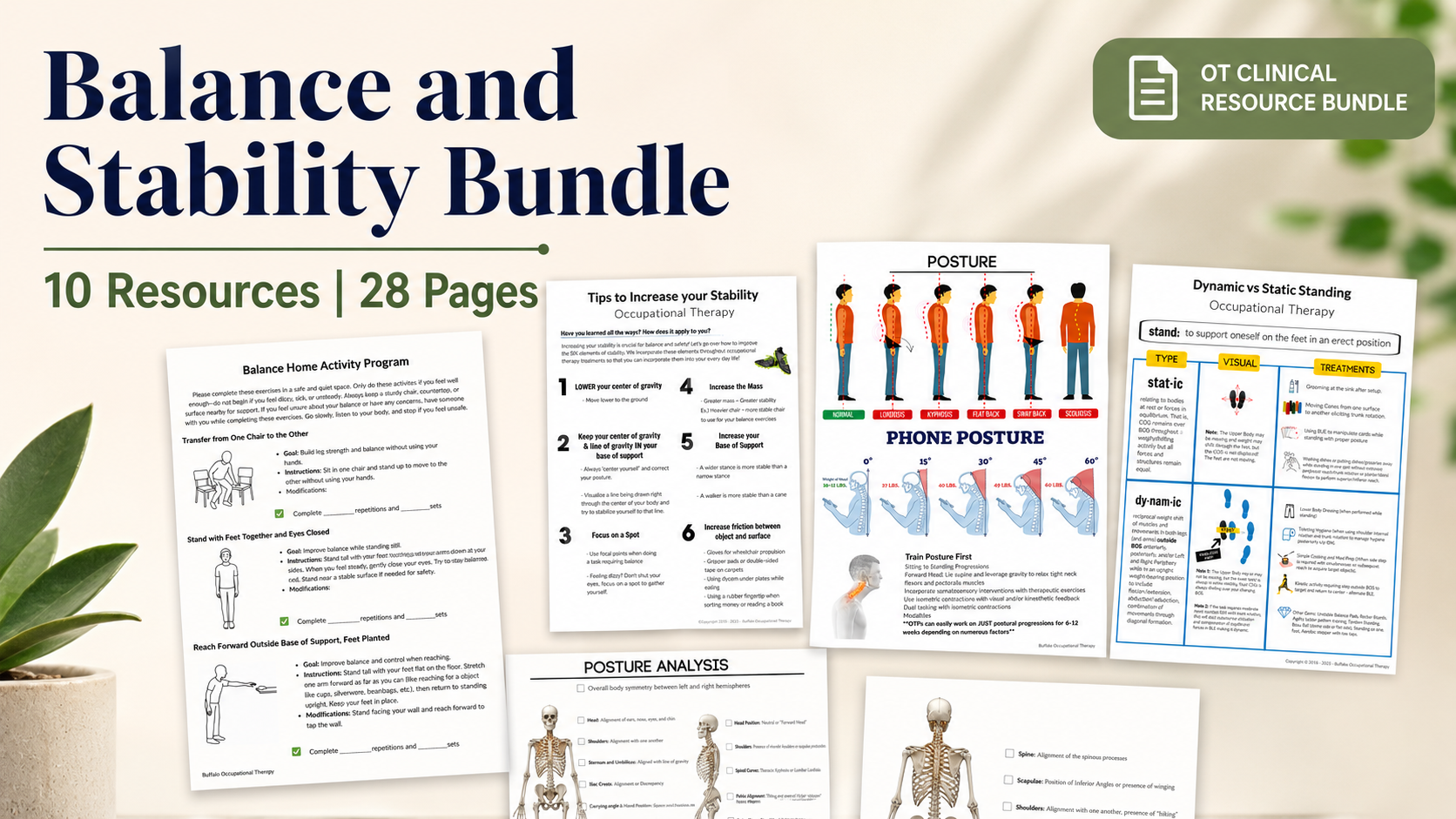
Just want the resources mentioned in this article?: Download the Balance and Stability Bundle
- Occupational Therapy Intervention Dashboard
- Balance and Stability Goals for Neuromuscular Re-Education
- Balance and Stability in Occupational Therapy
Balance and functional mobility are closely connected to occupational performance.
A person must maintain postural control while standing at the sink, reaching into a cabinet, stepping around furniture, carrying laundry, getting into the shower, retrieving an object from the floor, or moving through a busy community environment.
For occupational therapy practitioners, balance intervention should not stop at asking a participant to stand on an unstable surface or walk through a hallway.
The practitioner should consider:
- what the person is trying to do
- where balance begins to deteriorate
- which environmental demands contribute to difficulty
- whether the person can recover from a loss of stability
- how cognition, vision, fatigue, and object handling affect mobility
- whether the activity reflects a meaningful occupational demand
The activities below were adapted from the interventions we use every week in clinic to facilitate goal-directed interventions using functional ambulation, obstacle-course, reaching, ball, cone-tapping, backward-walking, carrying, and gaze-shifting activities.
If you want to red more on what happens to a patient when balance is complicated by cognitive dual-tasking, head to "Balance is fine until something happens".
Balance Is More Than Standing Still
Member Resource
Static balance refers to maintaining stability while the body remains relatively still.
Dynamic balance involves maintaining or regaining control while the body moves, the base of support changes, or an external demand is introduced.
Functional mobility often requires both.
A participant may stand safely with feet apart but have difficulty when asked to:
- turn
- reach outside the base of support
- step over an obstacle
- carry an object
- look away from the direction of movement
- move backward
- change speed
- respond to an unexpected demand
This is why balance intervention should include the types of movement and environmental conditions that occur during everyday occupations.
1. Functional Reaching at Different Heights
Place meaningful objects at several heights and distances.
The participant may be asked to retrieve or place items:
- at shoulder height
- above eye level
- at waist level
- below the knees
- near the floor
- across midline
- slightly outside the base of support
Possible objects include:
- towels
- clothing
- food containers
- grooming supplies
- lightweight dishes
- household items
- therapy cones
This activity can address dynamic standing balance, weight shifting, postural control, visual guidance, reach accuracy, and safe object retrieval.
Make the activity occupationally meaningful
Rather than asking the participant to move cones without context, simulate:
- putting groceries into a cabinet
- retrieving clothing from a dresser
- placing dishes onto shelves
- gathering supplies for grooming
- loading or unloading a washer
- reaching for items during meal preparation
Grade the task down
- keep objects within easy reach
- use a wider base of support
- allow upper-extremity support
- use lightweight, easy-to-grasp objects
- complete the task while seated
- reduce the number of repetitions
Grade the task up
- vary the reach direction
- place objects farther outside the base of support
- require stepping rather than leaning
- use different object sizes
- add a carrying component
- require the participant to remember a sequence
What to observe
- use of stepping reactions
- excessive trunk movement
- reliance on upper-extremity support
- loss of balance
- hesitation
- reach accuracy
- ability to return to midline
- safety awareness
2. Floor-Level Retrieval
Place a safe object on or near the floor and ask the participant to retrieve it.
This task may resemble:
- picking up dropped clothing
- retrieving a household item
- reaching into a low cabinet
- feeding a pet
- managing laundry
- collecting an object from beneath a table
The therapist can observe how the participant lowers and raises the body, controls the center of mass, maintains the base of support, and selects an appropriate strategy.
Possible strategies
The participant may:
- bend at the hips and knees
- use a staggered stance
- use one hand for support
- step closer before reaching
- use adaptive equipment
- sit before retrieving the object
There is not always one ideal movement pattern. The safest strategy depends on the participant’s strength, joint mobility, diagnosis, balance, pain, precautions, and environment.
Grade the task
Adjust:
- object height
- object size
- distance from the body
- availability of support
- number of repetitions
- whether the participant must carry the item afterward
Avoid encouraging unsafe repetition
Repeated floor retrieval may be inappropriate for someone with significant fall risk, orthostatic symptoms, pain, or movement precautions. The activity should be selected because it reflects a relevant need, not because reaching toward the floor automatically improves balance.
3. Side Stepping and Direction Changes
Ask the participant to move laterally along a counter, wall, or marked pathway.
The task can include:
- stepping to colored markers
- moving around furniture
- placing objects onto a surface
- opening and closing cabinet doors
- retrieving items from several stations
- changing direction on verbal or visual command
Side stepping may be relevant when moving through tight areas, positioning beside a bed or toilet, working at a kitchen counter, or navigating around obstacles.
Grade the activity down
- allow hand support
- reduce step width
- use a predictable route
- move slowly
- provide visual floor markers
- reduce the distance
Grade the activity up
- remove upper-extremity support
- vary step length
- carry a lightweight object
- add direction changes
- use a narrower pathway
- require visual scanning
- introduce a stop-and-start rule
Observe
- foot clearance
- crossing of the feet
- trunk alignment
- speed
- weight-shift symmetry
- need for support
- ability to stop safely
- awareness of obstacles
4. Cone Tapping for Controlled Weight Shifting
Place several cones or floor targets around the participant.
Ask the participant to tap each target with one foot while maintaining balance on the other leg.
The original guide includes ipsilateral cone tapping to address unilateral weight bearing, lower-extremity control, and eye-foot coordination. It also emphasizes slow movement, external support, and close assistance when needed.
Possible variations
- tap one cone repeatedly
- alternate feet
- tap cones in a color sequence
- tap targets placed forward, sideways, and diagonally
- follow a metronome
- call out the next target unpredictably
- match the tap to a functional direction
Functional applications
This activity may relate to:
- stepping into clothing
- clearing a shower threshold
- stepping over clutter
- positioning the foot during transfers
- navigating curbs
- changing direction while walking
What to document
- duration of single-limb support
- number of successful taps
- use of upper-extremity support
- accuracy
- speed
- loss of balance
- stepping reactions
- cueing
- confidence
The goal is controlled weight shifting, not rapid cone contact.
5. Backward Walking With Environmental Awareness
Backward walking can be used selectively to address posterior stepping, balance reactions, lower-extremity coordination, and movement in confined spaces.
It may relate to:
- backing away from a counter
- repositioning near a chair
- moving around a bathroom
- backing up while opening a door
- adjusting position during transfers
Set up the task
Use a clear, controlled pathway with close guarding as indicated.
The participant may walk backward:
- between two visual markers
- toward a chair
- while following a slow rhythm
- while maintaining light contact with a counter
- after checking the environment behind them
Grade the task down
- use a short distance
- provide hand support
- use a wide pathway
- give step-by-step cues
- allow the participant to look behind frequently
Grade the task up
- add a destination
- include a controlled turn
- carry a lightweight object
- vary speed
- require the participant to stop at a marked point
- combine with a realistic positioning task
Safety considerations
Backward walking should not be used simply because it is difficult. It requires clear environmental control, appropriate assistance, and a meaningful reason for inclusion.
Document:
- step length
- foot clearance
- path deviation
- speed
- hesitation
- need for visual checking
- assistance
- response to cues
6. Obstacle-Course Navigation
Create a route using safe clinic or household objects.
Possible features include:
- cones
- low hurdles
- aerobic steps
- chairs
- narrow pathways
- changes in direction
- objects to retrieve
- surfaces to approach or avoid
The original guide includes hurdle negotiation, figure-eight walking, and obstacle courses designed to simulate demands encountered during continuous community mobility.
Make the course functional
A useful obstacle course should represent something the participant may encounter, such as:
- walking around furniture
- stepping over a threshold
- moving through a crowded room
- navigating store displays
- approaching a chair
- carrying items through the home
- turning in a small bathroom
Possible instructions
Ask the participant to:
- choose the safest route
- step over low obstacles
- walk around higher ones
- stop at a designated station
- retrieve an item
- carry it to another location
- complete a turn before sitting
What to observe
- obstacle detection
- foot clearance
- speed regulation
- route selection
- turning
- postural control
- use of assistive devices
- attention to the environment
- safety judgment
- ability to recover after contact or misstep
Avoid excessive equipment for its own sake
Adding ankle weights, heavy objects, unstable surfaces, and cognitive demands simultaneously may create difficulty without clarifying the participant’s actual limitation.
Change one or two variables at a time so the therapist can understand why performance changed.
7. Carrying a Tray, Bag, or Basket During Mobility
Ask the participant to carry a functional object through a controlled route.
Possible items include:
- a tray with empty or partially filled cups
- a laundry basket
- a shopping bag
- a small meal tray
- a bag of personal belongings
- a container of household supplies
The original guide includes walking while holding a bag or tray of cups, connecting mobility with object transport and everyday task demands.
Functional applications
This may simulate:
- carrying a meal
- transporting laundry
- moving groceries
- carrying work materials
- bringing items from one room to another
- managing belongings during community mobility
Grade the task down
- use an empty tray
- carry one lightweight object
- use a short, straight route
- allow one hand to remain free
- reduce walking speed
- provide a nearby surface for rest
Grade the task up
- add several objects
- vary object position
- include turns
- navigate around furniture
- carry a partially filled cup
- open a door
- place the objects at different destinations
What to observe
- grip security
- tray or bag stability
- spills
- drops
- visual attention
- foot clearance
- walking speed
- ability to turn
- balance reactions
- prioritization of the object versus walking safety
A participant who stares continuously at the tray may miss environmental hazards. Another may focus on walking and allow objects to shift. Both patterns are clinically meaningful.
8. Ball or Balloon Activities for Dynamic Postural Control
A balloon or large exercise ball can introduce an external movement demand while the participant maintains sitting or standing balance.
The original guide includes balloon batting at the edge of a mat and large-ball bouncing in standing to address postural control, righting reactions, visual tracking, and sustained upper-extremity engagement.
Balloon activity
Position the participant in supported or unsupported sitting as appropriate.
Ask them to:
- bat the balloon with alternating hands
- reach in different directions
- return to midline
- respond to unpredictable movement
- keep the balloon from touching the floor
This can be useful when standing is not yet safe or when seated balance is directly relevant to dressing, bathing, or bed mobility.
Large-ball activity
In standing, ask the participant to:
- bounce the ball to the therapist
- catch and return it
- vary the direction
- reach at different heights
- step toward the ball before returning it
Grade the activity
Adjust:
- sitting versus standing
- ball size
- speed
- direction
- reach distance
- number of repetitions
- predictability
- base of support
- assistance level
What to observe
- righting reactions
- trunk control
- reach outside the base of support
- balance recovery
- hand-eye coordination
- fatigue
- use of compensatory movements
- ability to continue without losing form
9 Ways to Grade Balance and Mobility Activities
- Base of support: A wider base generally provides more stability. A narrower or changing base increases demand.
- Center-of-mass movement: Reaching, bending, turning, and carrying move the center of mass and increase the need for postural control.
- Surface: A firm, level surface is usually less demanding than foam, grass, carpet, ramps, or uneven terrain.
- Visual demand: Performance may change when the participant looks away from the direction of movement, searches for objects, or moves through clutter.
- Upper-extremity use: A participant may perform differently when hands are free, holding an assistive device, reaching, or carrying an object.
- Speed: Faster is not always better. Slower movement may reflect caution, control, or an effective safety strategy.
- Predictability: A rehearsed route is less demanding than one involving changing directions or unexpected obstacles.
- Cognitive demand: Following directions, remembering destinations, or responding to questions may affect mobility. Add cognitive load only when it reflects the participant’s functional needs.
- Fatigue: Performance may deteriorate over repeated trials or longer distances. The therapist should document when this occurs.
What Occupational Therapy Practitioners Should Document
A strong note should explain the activity, assistance, observed movement pattern, response to grading, and occupational relevance.
Useful variables include:
- distance
- number of repetitions
- surface
- route complexity
- object carried
- obstacle height
- reach direction
- assistance level
- assistive device
- loss of balance
- stepping reactions
- upper-extremity support
- cueing
- speed
- fatigue
- pain or symptoms
- safety awareness
- change across trials
Avoid writing only that the participant completed a “dynamic balance activity.”
That description does not explain what the person did or why skilled therapy was required.
Sample Documentation: Functional Reaching
The participant completed a standing household-item retrieval activity involving 18 objects positioned between knee and shoulder height. The participant independently retrieved 14 of 18 objects while maintaining balance without upper-extremity support. Four objects placed below knee level required contact guard assistance and one verbal cue to step closer before reaching. The participant demonstrated two episodes of posterior weight shift but recovered using a stepping response. Performance improved when the task was modified to allow a staggered stance.
Sample Documentation: Obstacle Navigation
The participant completed four trials of a 40-foot mobility route containing two turns, three low obstacles, and one narrow pathway while using a rolling walker. The participant cleared 10 of 12 obstacles independently and required two verbal cues to slow before turning. One obstacle was contacted during the first trial without loss of balance. No additional contacts occurred after visual markers were added to the floor. The activity addressed safe household navigation and environmental awareness during functional mobility.
Sample Documentation: Carrying Activity
The participant carried a lightweight laundry basket over a 60-foot indoor route and placed three clothing items into designated storage locations. The participant completed the route without loss of balance but demonstrated reduced foot clearance and increased lateral path deviation when visually attending to the basket. One verbal cue to stop before checking the contents improved path control during the final trial. The participant required supervision for turning and object placement.
Balance Training Should Transfer to Everyday Occupation
A participant may improve at standing on foam and still have difficulty carrying a meal, stepping into the shower, or reaching into a low cabinet.
This does not mean preparatory balance work has no value. It means the therapist must deliberately connect the preparatory activity to occupational performance.
Ask:
- Where does the participant lose stability in daily life?
- Is the difficulty related to strength, coordination, vision, sensation, cognition, fear, or environmental setup?
- What objects must the person handle?
- Does the person need to reach, turn, bend, step, or carry?
- Would an adaptive device or environmental change improve safety?
- Can the strategy be used outside therapy?
For more information and ideas for Balance and Stability Goals, head to the Goals Article
About the Author
Michelle Eliason, MS, OTR/L is an occupational therapist, rehabilitation researcher, educator, and founder of BOT Portal and Buffalo Occupational Therapy. Her clinical and scholarly work focuses on neurological rehabilitation, functional cognition, cognitive-motor performance, aging, and the translation of rehabilitation science into practical occupational therapy evaluation, intervention, and clinical reasoning.
Learn more about : Michelle C. Eliason, MS, OTR/L
Continue Learning With Us
Did you find this information helpful? Please share this article with another occupational therapy practitioner, student, educator, or rehabilitation professional who may benefit from it.
Would you like access to the clinical resources discussed throughout this article? Explore our membership options to find the level of support that works best for you.
Looking for a more formal learning and mentorship experience? Learn more about the Functional Cognition Lab Mentorship Program.
You can also explore our AOTA-approved courses and clinical resource packages for additional education, treatment resources, and practical tools you can use in rehabilitation practice.
Interested in receiving free functional cognition education each week? Subscribe to the Functional Cognition Lab Newsletter.