
Michelle C. Eliason, MS, OTR/L
Occupational Therapist | Clinician-Scientist | Rehabilitation Researcher | Educator
Professional Biography
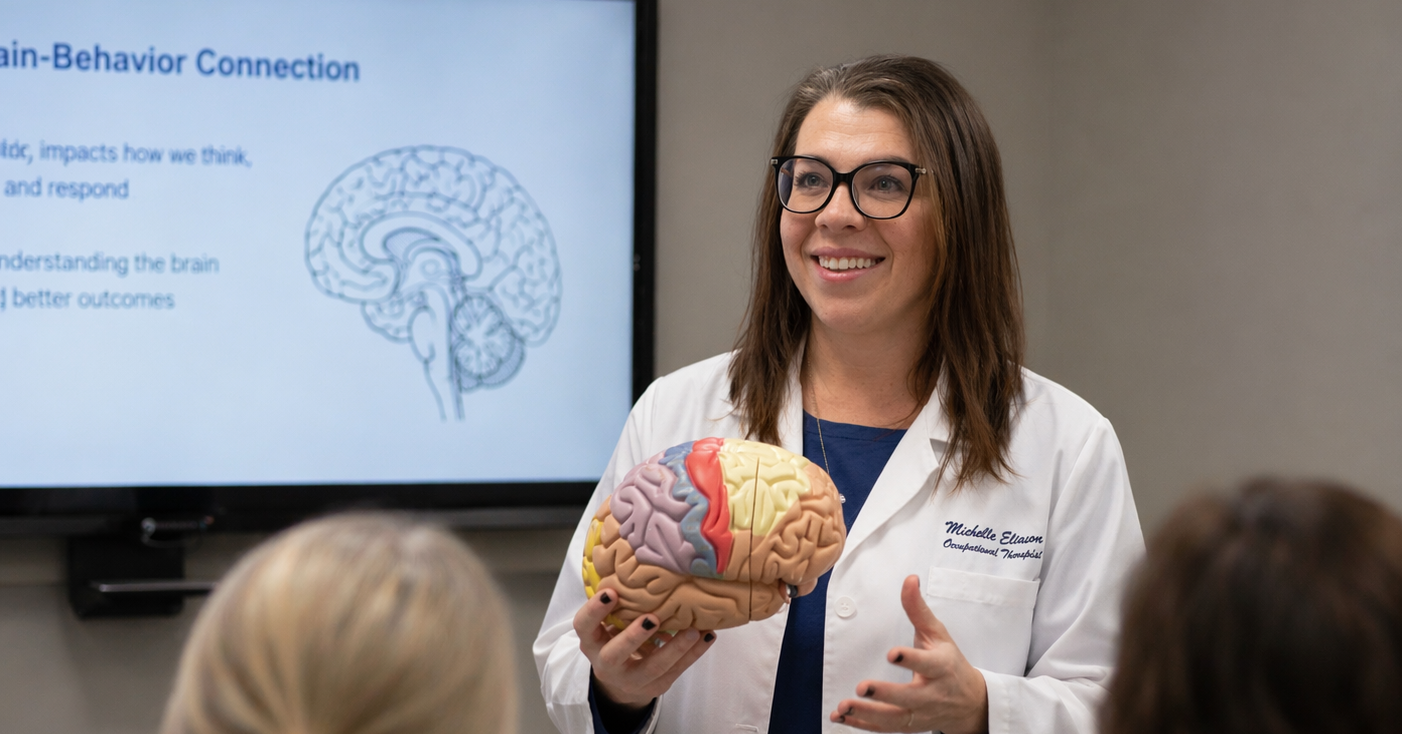
Michelle Eliason, MS, OTR/L, is an occupational therapist, rehabilitation researcher, educator, and founder and clinical director of Buffalo Occupational Therapy. She has practiced in adult rehabilitation since 2016 across outpatient neurological rehabilitation, inpatient rehabilitation, skilled nursing, and brain injury services. Through Buffalo Occupational Therapy, she has developed an outpatient practice focused on functional cognition, neurological rehabilitation, clinical reasoning, and integrative approaches to occupational performance. She also develops continuing education and clinician-training programs and has served as a fieldwork educator and mentor to occupational therapy students and practicing clinicians.
Michelle is currently completing her PhD in Rehabilitation Science at the University at Buffalo, where her research focuses on brain structural covariance and precision rehabilitation in normal and pathological aging. Her broader research interests include neuroimaging, cortical structure, traumatic brain injury, cognitive aging, neuroplasticity, and non-invasive neuromodulation. She serves as a research assistant in the University at Buffalo Brain Functional Recovery Lab and has contributed to research examining traumatic brain injury, aging, cortical morphometry, functional connectivity, and transcranial direct current stimulation. Most recently, she is an adjunct professor in the University at Buffalo's Occupational Therapy department.
Her scholarly work includes peer-reviewed publications in Frontiers in Human Neuroscience, GeroScience, and Archives of Physical Medicine and Rehabilitation, as well as presentations through the American Congress of Rehabilitation Medicine, the American Occupational Therapy Association, the University at Buffalo, and other professional and academic organizations.
In addition to her clinical and research work, Michelle has taught occupational therapy kinesiology and physical rehabilitation coursework, developed continuing education in areas including upper- and lower-extremity rehabilitation, activity analysis, balance and postural control, physical rehabilitation, and dual tasking, and has provided structured mentorship in cognitive-motor rehabilitation and clinical reasoning.
Michelle currently serves as a member of the New York State Education Department Board of Occupational Therapy and has held additional leadership and service roles within occupational therapy, rehabilitation research, community health, and professional education.
Through BOT Portal, Michelle brings together her clinical, educational, and research experience to translate rehabilitation science into practical resources for occupational therapy practitioners, with an emphasis on helping clinicians connect foundational concepts with evaluation, clinical reasoning, intervention, and real-world occupational performance.
Professional Focus & Areas of Expertise
Michelle’s clinical, educational, and research work centers on adult occupational therapy and rehabilitation science, with particular emphasis on:
- Neurological rehabilitation
- Functional cognition
- Executive function and cognitive rehabilitation
- Cognitive-motor interaction and dual tasking
- Stroke and acquired brain injury
- Traumatic brain injury and concussion
- Parkinson’s disease and other neurological conditions
- Motor control, neuromotor recovery, and functional movement
- Balance, postural control, and functional mobility
- Activity analysis and occupational performance
- Aging, cognitive decline, and dementia
- Neuroplasticity and rehabilitation
- Neuroimaging and cortical morphometry
- Structural covariance and brain network organization
- Transcranial direct current stimulation (tDCS)
- Precision rehabilitation
Education
Michelle’s academic training spans occupational therapy, rehabilitation science, occupational science, and the humanities, providing a multidisciplinary foundation for her clinical, educational, and research work.
PhD Candidate, Rehabilitation Science
University at Buffalo | 2023–Present
Anticipated Graduation: May 2027
Michelle is completing her doctoral training in Rehabilitation Science with a research focus on brain structural covariance and precision rehabilitation in normal and pathological aging. Her doctoral work examines patterns of brain structure and network organization with the broader goal of advancing more individualized approaches to neurorehabilitation.
Master of Science, Occupational Therapy
University at Buffalo | 2012–2016
Graduate education in occupational therapy provided the foundation for Michelle’s clinical practice across adult rehabilitation, neurological rehabilitation, cognitive rehabilitation, and occupational performance.
Bachelor of Science, Occupational Science — Magna Cum Laude
University at Buffalo | 2012–2016
Michelle completed undergraduate training in occupational science alongside her professional occupational therapy education, with an emphasis on understanding the relationship between human function, participation, activity, and occupation.
Bachelor of Arts, English
University at Buffalo | 2009–2010
Her background in English contributes to her work in professional writing, clinical education, research dissemination, and the translation of complex rehabilitation concepts into accessible educational resources.
Associate of Science, Science
Erie Community College
Michelle also completed an Associate of Science degree as part of her early academic training.
Clinical Practice & Professional Experience
Michelle’s clinical career has focused on adult rehabilitation across outpatient neurological rehabilitation, inpatient rehabilitation, skilled nursing, brain injury services, and rehabilitation leadership. Her experience spans direct patient care, clinical program development, interdisciplinary rehabilitation, clinician education, and practice management.
Founder & Clinical Director
Buffalo Occupational Therapy | Buffalo, New York | 2016–Present
Michelle founded Buffalo Occupational Therapy and developed the practice around adult outpatient neurorehabilitation, functional cognition, and integrative occupational therapy treatment. In addition to direct clinical care, she leads clinical operations, program development, interdisciplinary care delivery, continuing education initiatives, and clinician mentorship.
Her work through Buffalo Occupational Therapy has also included supervising and educating occupational therapy students in adult neurorehabilitation, with emphasis on clinical reasoning, functional cognition, evaluation, goal development, and real-world task-based intervention planning.
Lead Occupational Therapist & Medical Report Writer
National Brain Injury Institute | Remote | 2019–2021
Michelle served as a lead occupational therapist within a brain injury service setting, contributing occupational therapy expertise and medical report development for individuals with acquired brain injury.
Occupational Therapist
Kenmore Mercy Hospital Medical Rehabilitation Unit | Buffalo, New York | 2020–2021
Michelle practiced occupational therapy within an inpatient medical rehabilitation environment, contributing to interdisciplinary rehabilitation for adults with complex medical and functional needs.
Director of Rehabilitation & Occupational Therapist
Dynamic Rehab / O’Neill Care and Rehab | Nebraska | 2017–2018
Michelle served in both clinical and rehabilitation leadership roles, combining direct occupational therapy practice with responsibility for rehabilitation service delivery and departmental operations.
Occupational Therapist
Elderwood | Buffalo, New York | 2016–2017
Early in her occupational therapy career, Michelle practiced within post-acute and skilled rehabilitation, building experience in adult rehabilitation, functional performance, and the rehabilitation needs of medically complex and aging populations.
Across these settings, Michelle’s clinical experience has contributed to the perspective that now guides her educational work through BOT Portal: connecting foundational knowledge of body systems, cognition, movement, and occupational performance with the clinical reasoning required to translate those concepts into individualized rehabilitation practice.
Academic, Teaching & Mentorship Experience
Michelle has experience in university teaching, clinical education, research mentorship, and professional mentorship. She has served as adjunct occupational therapy faculty, a graduate teaching assistant in research methods, a Level II fieldwork educator, and a structured mentor to occupational therapy clinicians and interdisciplinary trainees. Her educational work emphasizes clinical reasoning, functional cognition, neurorehabilitation, evidence interpretation, and translating foundational rehabilitation concepts into real-world practice.
At the University at Buffalo, Michelle also contributes to graduate research mentorship and interdisciplinary research activities and has provided research mentorship related to neurorehabilitation, neuroimaging, and transcranial direct current stimulation.
Research
Michelle’s research focuses on precision rehabilitation, structural covariance, neuroimaging, cognitive aging, traumatic brain injury, neuroplasticity, and neuromodulation. Her doctoral work in Rehabilitation Science examines how patterns of brain structure and network organization change across normal and pathological aging, with the broader goal of identifying markers that may help support more individualized rehabilitation approaches.
Her current and recent research includes work examining cortical and subcortical structural relationships, traumatic brain injury, mild cognitive impairment and dementia, cortical thickness, functional connectivity, and transcranial direct current stimulation (tDCS). She has contributed to multi-site neurorehabilitation research and has led projects investigating nonlinear structural coupling across cognitive decline and the role of cortical thickness in neuromodulation and treatment response.
Primary Research Interests
- Precision rehabilitation
- Structural covariance and brain network organization
- Normal and pathological aging
- Mild cognitive impairment and dementia
- Traumatic brain injury and concussion
- Cortical thickness and brain morphometry
- Functional connectivity
- Neuroplasticity
- Transcranial direct current stimulation (tDCS)
- Cognitive and neurological rehabilitation
Michelle’s research reflects the same translational perspective that guides her clinical and educational work: understanding neurological and structural mechanisms in ways that can ultimately contribute to more precise, individualized rehabilitation practice.
Peer-Reviewed Scholarship
Michelle’s scholarly work focuses on neurorehabilitation, brain structure, aging, traumatic brain injury, neuroplasticity, and neuromodulation. Her peer-reviewed publications reflect a translational research approach that connects neurological mechanisms with questions relevant to rehabilitation and functional recovery.
Peer-Reviewed Publications
Eliason M, Kalbande PP, Saleem GT. Is non-invasive neuromodulation a viable technique to improve neuroplasticity in individuals with acquired brain injury? A review. Frontiers in Human Neuroscience. 2024;18:1341707. doi:10.3389/fnhum.2024.1341707.
Eliason MC, Nagella AB, Cuadra C, et al. Surface-based morphometry reveals divergent aging trajectories in veterans with and without traumatic brain injury. GeroScience. 2025. doi:10.1007/s11357-025-01893-2.
Nagella AB, Eliason M, Li S, Saleem G. Effect of the APOE4 Genotype on the Cerebrospinal Fluid Amyloid-beta and Tau Levels in Veterans with Traumatic Brain Injury. Archives of Physical Medicine and Rehabilitation. 2026;107(5):e24. doi:10.1016/j.apmr.2026.02.064.
Additional Scholarly Work
Michelle has also contributed to preprint and ongoing scholarly work examining transcranial direct current stimulation, cortical thickness, functional connectivity, mild traumatic brain injury, and structural brain changes associated with cognitive aging and dementia.
Her scholarship supports the broader mission of BOT Portal: translating rehabilitation science into clinically meaningful knowledge that occupational therapy practitioners can use to strengthen evaluation, intervention, and clinical reasoning.
Selected Presentations & Scholarly Dissemination
Michelle has presented and disseminated clinical and research work through professional conferences, academic institutions, rehabilitation organizations, and occupational therapy education programs. Her presentations span neurorehabilitation, traumatic brain injury, cognitive aging, functional cognition, dual tasking, neuroplasticity, and rehabilitation science.
Selected scholarly and professional presentations include:
- American Congress of Rehabilitation Medicine (ACRM) — research related to traumatic brain injury, aging, brain structure, APOE4, and neuroplasticity.
- American Occupational Therapy Association Annual Conference — exploratory research examining cognitive assessment and activity-based functional cognitive performance among aging traumatic brain injury survivors.
- University at Buffalo Center for Translational Science Colloquium — work examining transcranial direct current stimulation and functional connectivity following mild traumatic brain injury.
- University at Buffalo Perry Poster Presentations — research involving cortical thickness, surface area, neuroimaging, and neuromodulation, including mentorship of award-winning doctoral poster work.
- BOT Occupational Therapy Symposium — Dual Tasking and Cognitive Load During Occupational Performance.
- New York State Occupational Therapy Association Conference — Long-term Community-based (Geriatric) Occupational Therapy.
- International and university-based occupational therapy education through organizations and institutions including the Ghana Occupational Therapy Association, University of Perpetual Help, and University at Buffalo.
Across these activities, Michelle’s scholarly dissemination emphasizes translating research and clinical experience into information that is meaningful for rehabilitation practitioners, students, researchers, and interdisciplinary audiences.
Professional Affiliations & Qualifications
Michelle maintains active involvement in occupational therapy, neurorehabilitation, and rehabilitation research organizations that support her clinical, educational, and scholarly work.
Her professional affiliations and qualifications include:
- American Occupational Therapy Association (AOTA) — Member, 2014–Present
- New York State Occupational Therapy Association (NYSOTA) — Member, 2016–Present
- American Congress of Rehabilitation Medicine (ACRM) — Member
- American Society of Neurorehabilitation — Member, 2025–Present
- World Federation of Occupational Therapists (WFOT) — Member, 2025–Present
- AOTA Preferred Provider of Continuing Education
- Impact Trained Occupational Therapist (ITOT) — Certified 2025
Her professional affiliations reflect the interdisciplinary nature of her work across occupational therapy practice, neurological rehabilitation, rehabilitation science, research, and continuing professional education.