
Functional Cognition Pattern
Problem: Balance is Fine...Until Something Changes
They walk fine in a straight line—but things fall apart when the situation changes.
What this really is...
A breakdown in the brain’s ability to adapt movement when conditions change.
→ Dynamic Balance & Cognitive Adaptability Impairment
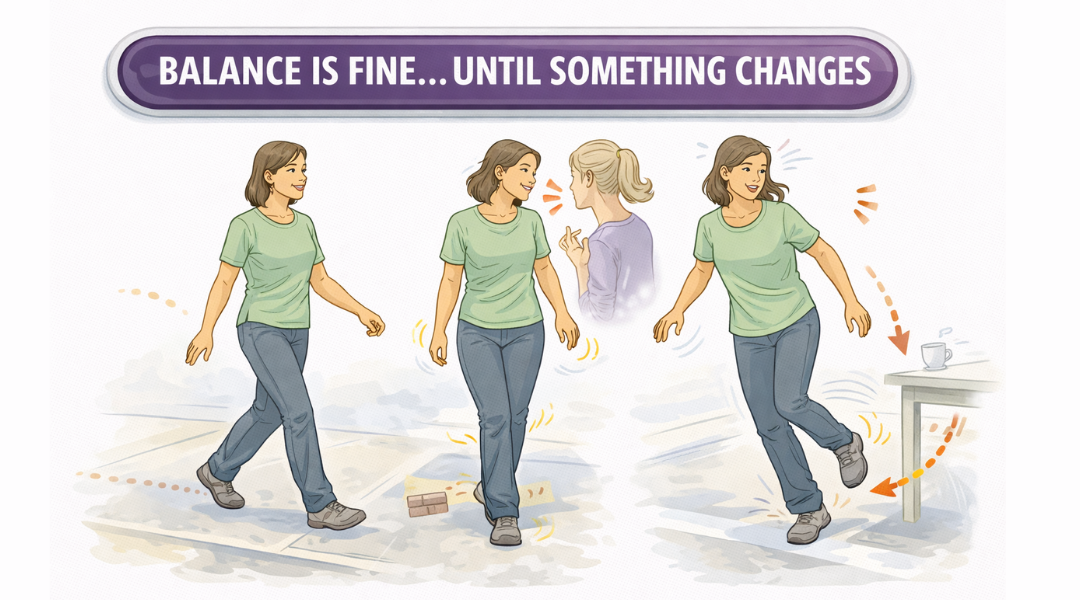
🧠 What You Are Seeing
- They walk well in simple conditions
- But when something changes, they:
- lose balance
- slow down significantly
- hesitate
- become unsafe
Changes may include:
- turning
- talking while walking
- stepping over objects
- reacting to the environment
They’re stable—until they have to adapt.
⚙️ What Is Actually Happening
Balance is not just physical—it’s adaptive.
The brain must:
- process new information
- shift attention quickly
- update movement plans
- respond in real time
👉 When demands change:
- attention is divided
- reaction time slows
- movement becomes less stable
The system can’t adjust fast enough.
🔎 Real Clinical Example
Patient demonstrates:
- steady gait in a straight path
- normal strength and posture
But when asked to:
- turn quickly
- step over an obstacle
- walk while talking
- respond to a change in direction
They:
- lose balance
- stop moving to think
- misstep or hesitate
- require assistance
→ Static balance is intact
→ Dynamic adaptation is impaired
⛓️💥 Skills Breakdown
- Walks straight → struggles with turning
- Stands stable → loses control during change
- Moves safely → becomes unsafe with added demand
- Maintains balance → can’t adapt quickly
⚠️ Why This Gets Missed
- Balance is often tested in controlled, predictable conditions
- Straight-line walking appears normal
- Problems only emerge during change or complexity
We assume:
“If they can walk, their balance is fine.”
But real-world balance requires constant adaptation.
🛠️ What To Do About It
- Introduce controlled changes into movement
- Practice turning, stopping, and directional shifts
- Add cognitive demand gradually (talking, decision-making)
- Train obstacle negotiation and environmental response
At the same time:
- build reaction time
- improve attention shifting
- increase tolerance to changing conditions
The goal is not just stability—
it’s adaptability and safety.
These are starting points - not full interventions.
Treating this effectively requires structured progression, dynamic task variation, and cognitive-motor training under changing conditions.
This is where most clinicians get stuck.
How This Fits Into Clinical Practice
Standard balance testing may not capture performance under changing conditions.
- Tests measure stability in controlled settings
- Functional tasks reveal adaptability in real environments
Performance can be tracked through:
- response to change
- reaction time
- balance during transitions
- safety under dynamic conditions
This is critical for fall prevention and community mobility.
If they can’t adapt, they can’t stay safe.
Want to Go Deeper
This is where balance, cognition, and safety intersect.
Learn how to:
- assess dynamic balance and adaptability
- train movement under changing conditions
- improve safety in real-world environments