
5 Reasons Why PNF Still Belongs in the Rehabilitation Toolbox
Aug 06, 2026
5 Reasons Why PNF Still Belongs in the Rehabilitation Toolbox
Proprioceptive Neuromuscular Facilitation continues to have Relevance
Membership Resources: This article and its companion audio are free to read and listen to. Links throughout the article connect members of the Functional Cognition Lab to related printables, treatment tools, courses, and clinical resources that align with the topic being discussed. Membership also includes access to the full resource library and direct clinical support. Find out more about membership on the Membership Options Page
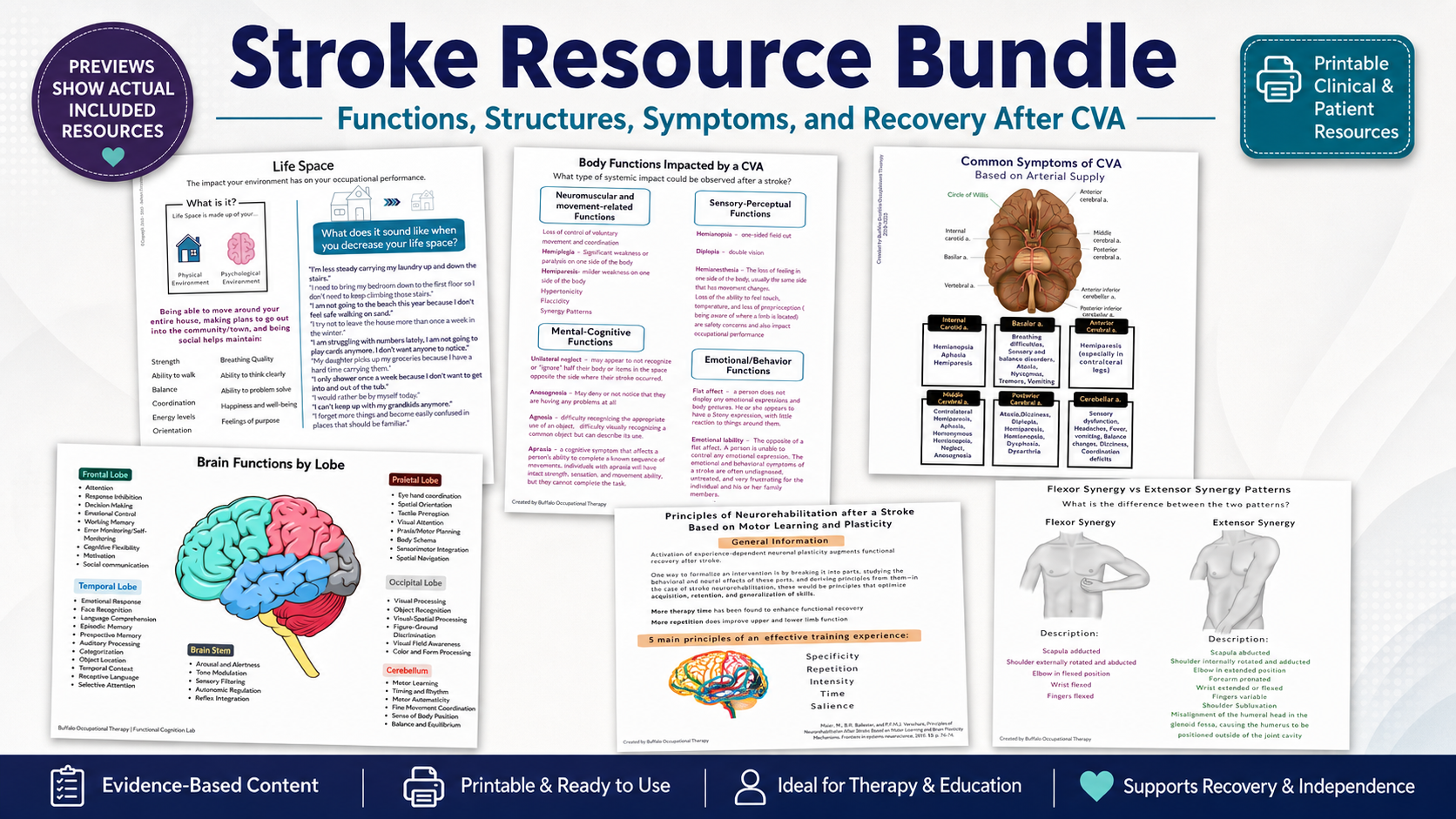
Just want the resources mentioned in this article? Download the Stroke Resource Bundle:
Proprioceptive neuromuscular facilitation, better known as PNF, tends to get placed into one of two categories.
Some practitioners treat it as a foundational rehabilitation approach that should never be questioned. Others dismiss it as an outdated neurorehabilitation method built on theories we have supposedly moved beyond.
I do not think either position is particularly helpful.
PNF does not have to explain every aspect of neurological recovery to remain clinically relevant. It also does not need to be used as a complete treatment system. It can simply remain what it has always been at its most useful: a structured method of guiding, resisting, lengthening, coordinating, and practicing movement.
Once we look at PNF through that lens, its continued relevance becomes much easier to understand.
What Is Proprioceptive Neuromuscular Facilitation?
PNF is a rehabilitation approach that uses proprioceptive input to influence movement. Depending on the technique selected, the practitioner may use resistance, stretch, tactile input, verbal cueing, visual guidance, traction, approximation, or carefully timed muscle contractions.
The goal is not simply to make a muscle contract.
PNF can be used to address movement initiation, range of motion, flexibility, strength, stability, coordination, motor control, relaxation, and functional movement performance.
Contemporary descriptions of PNF continue to identify facilitation, inhibition, strengthening, and relaxation as its central components. Proposed mechanisms include reciprocal innervation, post-isometric relaxation, autogenic inhibition, stress relaxation, and the use of sensory information related to joint position, muscle length, and tension.
PNF originated in the 1940s through the work of Herman Kabat and was later developed through the clinical work of Margaret Knott and Dorothy Voss. Early applications focused heavily on neurological rehabilitation and drew from concepts involving irradiation, reciprocal innervation, inhibition, and proprioceptive stimulation.
The historical explanation matters, but it should not trap us.
We can acknowledge that some early neurophysiological claims were broader than current evidence supports while still recognizing that the actual movement strategies remain useful.
1. PNF Is More Than a Stretching Technique
One reason PNF gets misunderstood is that many people learn only the stretching portion. They remember contract-relax or hold-relax from school and assume PNF is simply a complicated way to stretch a hamstring, but that is only one small part of it.
PNF includes techniques such as rhythmic initiation, dynamic reversals, stabilizing reversals, rhythmic stabilization, repeated contractions, hold-relax, and contract-relax. These techniques can be selected to help a patient begin movement, improve control through a range, build strength, increase stability, reduce resistance to movement, or coordinate agonist and antagonist muscle activity.
A recent systematic review of PNF for shoulder dysfunction described dynamic reversal, stability reversal, rhythmic stability, hold-relaxation, and contraction-relaxation among the techniques used clinically (Zhu, C., Huang, X., Yu, J. et al., 2025).
PNF is not one exercise. It is a framework for deciding how sensory input, resistance, positioning, and movement sequencing may help the patient perform more effectively.
Helpful Resource: Resistance, range, speed, position, assistance, and task complexity can all be adjusted to grade the activity for the just-right challenge.
2. The Body Does Not Move in Straight Lines
Human movement is rarely isolated to one anatomical plane. We do not move through life by performing perfect shoulder flexion, followed by isolated elbow extension, followed by forearm rotation.
We reach into cabinets. Pull clothing across the body. Bring utensils toward the mouth. Roll in bed. Push up from a chair. Rotate the trunk while stepping. Carry objects while walking. Reach behind the body during dressing and hygiene.
These movements combine flexion, extension, abduction, adduction, and rotation.
PNF patterns reflect that reality through diagonal and spiral movement.
Research protocols continue to define PNF patterns as diagonal, spiral-shaped movements performed through range and often against resistance.
That does not mean every patient must perform a textbook D1 or D2 pattern exactly as it was taught decades ago. It means the principle remains useful.
Movement is multiplanar. Functional tasks require coordinated movement across joints. Rotation matters. Trunk contribution matters. Scapular movement matters. Pelvic control matters. Distal positioning affects proximal movement, and proximal stability influences distal mobility.
3. The Fascial Perspective Deserves More Attention
PNF is usually defended through a neuromotor lens. That is reasonable, but it may not be the only explanation for why diagonal and spiral movement patterns are useful.
Fascia forms a continuous connective tissue network around and between muscles, bones, nerves, blood vessels, and other structures. It participates in force transmission and influences how tissues move relative to one another. Epimuscular myofascial force transmission also means force is not transferred only through the tendon of one isolated muscle. It can be transmitted between muscles and surrounding connective tissues.
This gives us another way to think about PNF.
When a patient repeatedly moves only within a limited, protected, or highly predictable range, they may lose movement variability. Soft tissues may become less tolerant of loading in certain directions. Fascial layers may not glide as freely. Muscles may shorten, joint capsules may stiffen, and the patient may begin organizing movement around pain, weakness, fear, spasticity, or compensation.
Diagonal and spiral movement expose the body to lengthening, shortening, rotation, load, and tension across multiple connected tissues.
That does not allow us to claim that PNF definitively “breaks up adhesions.” That wording goes beyond what we can prove. However, it is reasonable to say that PNF may support tissue mobility, fascial gliding, movement variability, range of motion, and tolerance for multiplanar loading.
Helpful Resources:
- For patients with spasticity or hemiplegia, PNF may also be incorporated alongside broader strategies for managing and inhibiting spasticity.
- Practitioners working in stroke rehabilitation may use selected PNF principles to address movement initiation, trunk control, proximal stability, and coordinated upper-extremity movement.
4. PNF Connects Mobility and Stability
Rehabilitation often separates mobility and stability as though they are completely different treatment goals.
In real movement, they are constantly interacting.
A person needs enough mobility to reach beyond the base of support, rotate the trunk, advance the leg, or position the hand. At the same time, the body must stabilize other segments so the movement can occur efficiently.
PNF gives the therapist several ways to address that relationship.
Rhythmic stabilization can help a patient respond to resistance without losing position. Stabilizing reversals can challenge control against changing directions of force. Dynamic reversals can improve coordinated movement between opposing muscle groups. Repeated contractions can support movement where the patient loses strength or control.
This is particularly useful when a patient can produce an isolated movement on the mat but cannot control the same body segment while sitting, standing, reaching, or walking.
Position changes the task.
Your patient may demonstrate adequate movement in supine and then appear to lose that ability while seated. The same thing may happen again when transitioning to standing. A functional rehabilitation plan must address movement across positions and environments rather than assuming that success in one position automatically transfers to another.
PNF can help bridge those positions because it allows the practitioner to adjust support, resistance, sensory input, and task demands without abandoning the movement goal.
Helpful Resource: This interaction between mobility and stability is also central to occupational therapy approaches for balance and postural control.
5. Where Does Motor Learning Fit?
PNF should not replace contemporary motor-learning principles. It should be integrated with them. Repetition still matters. Intensity still matters. Specificity and Salience and time still matter
A patient will not become independent with dressing simply because they completed ten assisted diagonal patterns on a mat. The pattern has to connect to function.
For example, an upper-extremity diagonal may help prepare the patient for reaching toward a sleeve, pulling clothing across the body, bringing a grooming item toward the face, or stabilizing an object during meal preparation. A lower-extremity pattern may help address components needed for stepping, foot clearance, weight shifting, or moving the leg into a vehicle.
The PNF technique is not the final occupation. It is a way to identify, practice, and strengthen components of the occupation. If we keep that distinction in mind, PNF from becoming ritualistic. We are not performing a pattern because the pattern itself is sacred. We are using it because it addresses a measurable movement problem that interferes with function.
Helpful Resource: When PNF is used to prepare a patient for transfers, stepping, reaching, or walking, the intervention should connect to measurable occupational therapy goals for functional mobility.
Does the Evidence Support PNF?
The evidence is not uniform across every diagnosis, technique, and outcome. That should not surprise us because PNF is a broad treatment approach rather than one standardized intervention.
Still, it is inaccurate to say there is no contemporary evidence supporting its use.
A 2025 systematic review and meta-analysis involving 12 studies and 968 participants with scapulohumeral periarthritis found improvements in pain, shoulder function, and daily living ability. The authors reported large overall effects for shoulder function and activities of daily living, although the included studies varied in quality and methodology.
A randomized crossover study combining myofascial techniques and PNF in people with systemic lupus erythematosus reported improvements in pain, functional capacity, physical function, and fatigue. Because the intervention combined two approaches and included only 17 participants, we cannot assign the outcomes to PNF alone. It still demonstrates that PNF can be incorporated safely within a broader functional rehabilitation protocol.
More broadly, PNF has been studied in relation to range of motion, pain, strength, balance, movement initiation, coordination, and functional performance.
That does not make PNF superior to every alternative intervention. It means it remains a reasonable option when the selected technique matches the patient’s impairment and functional goal.
PNF Is Not Always the Right Choice
Keeping PNF in the toolbox does not mean using it for everyone.
A technique should be selected because it solves a problem, not because the therapist is comfortable performing it.
PNF may be helpful when the patient has difficulty initiating movement, coordinating movement across joints, maintaining stability, moving through available range, tolerating multiplanar loading, or transitioning from isolated motion into a more functional pattern.
It may be less useful when the primary limitation is uncontrolled pain, acute tissue injury, severe joint instability, unaddressed structural restriction, significant medical instability, or a task-specific problem that would be better treated through direct practice of the occupation.
Timing matters too.
Long-duration PNF stretching immediately before maximal power activities may temporarily reduce force production or explosive performance. Some studies have reported acute reductions in jumping, sprinting, or maximal-effort performance after stretching, while longer-term PNF training may still provide benefits.
The lesson is not that PNF is bad. The lesson is that intervention selection, dosage, and timing matter in precision rehabilitation.
How Occupational Therapy Practitioners Can Use PNF Functionally
Occupational therapy practitioners should not feel obligated to perform PNF exactly as if they were demonstrating it during a practical examination.
The principles can be incorporated into meaningful activity.
A patient may reach diagonally across the body to retrieve clothing. They may stabilize a container with one hand while rotating and pulling with the other. They may practice trunk rotation while transferring objects between surfaces. They may reach from a low position to a high shelf while maintaining balance. They may carry an object while walking and adjusting to changes in direction.
A PNF-informed intervention might combine grasp, trunk rotation, shoulder movement, midline crossing, resistance, and controlled release within one functional sequence.
Stop Asking Whether PNF Is Outdated
The better question is whether the practitioner understands what problem they are trying to solve. PNF should not be defended because it is traditional. It should not be rejected because it is old. Its relevance comes from the principles that remain useful like Human movement is multiplanar, sensory input influences motor output, resistance can improve awareness, control, and strength, mobility and stability must work together, and muscles and connective tissues do not function as completely isolated structures. Movement must eventually connect to occupation.
PNF remains clinically relevant because it gives practitioners a structured way to work with those realities. We do not have to accept every historical explanation in order to preserve a valuable method. Science frequently changes how we explain why an intervention works. That does not automatically mean the intervention stops working. PNF does not need to be the entire toolbox, but it deserves to remain inside it.
Continue Learning With Us
Did you find this information helpful? Please share this article with another occupational therapy practitioner, student, educator, or rehabilitation professional who may benefit from it.
PNF requires more than memorizing diagonal patterns. Practitioners must understand how the trunk, pelvis, scapula, upper extremity, and lower extremity work together during functional movement. Explore the Overview of the Upper Extremity, Overview of the Lower Extremity, and Trunk, Pelvis, and Posture Course.
Would you like access to the clinical resources discussed throughout this article? Explore our membership options to find the level of support that works best for you.
Looking for a more formal learning and mentorship experience? Learn more about the Functional Cognition Lab Mentorship Program.
You can also explore our AOTA-approved courses and clinical resource packages for additional education, treatment resources, and practical tools you can use in rehabilitation practice.
Interested in receiving free functional cognition education each week? Subscribe to the Functional Cognition Lab Newsletter.
Helpful References:
Özgüç, M. M., & Soyal, M. (2026). Comparison of the Effects of Myofascial Release Technique and Proprioceptive Neuromuscular Facilitation Technique on Maximal Strength and Physical Fitness Parameters. Eurasian Journal of Sport Sciences and Education, 8(2), 216–226. https://doi.org/10.47778/ejsse.120
Torres-Quiles, J.-M., Cuesta-Barriuso, R., & Pérez-Llanes, R. (2025). Efficacy of Myofascial Techniques and Proprioceptive Neuromuscular Facilitation in the Treatment of Patients with Systemic Lupus Erythematosus—Randomized Crossover Clinical Study. Healthcare, 13(13), 1625. https://doi.org/10.3390/healthcare13131625
Yang, Y., Mayo, A., Levy, T. et al. Compression of morbidity by interventions that steepen the survival curve. Nat Commun 16, 3340 (2025). https://doi.org/10.1038/s41467-025-57807-5
Zhu, C., Huang, X., Yu, J. et al. The clinical efficacy of proprioceptive neuromuscular facilitation technique in the treatment of scapulohumeral periarthritis: a systematic review and meta-analysis. BMC Musculoskelet Disord 26, 288 (2025). https://doi.org/10.1186/s12891-025-08303-w
Hareem Mehboob, Ihsan Ullah, Dr. Farah Iqbal, Fariha Wahab, Hafiza Aqsa Ishfaq, Muhammad Usama Ali, et al. The Effects of Connective Tissue Manipulation versus Proprioceptive Neuromuscular Facilitation on Gait, Postural Control, and Hip Alignment in Children with Cerebral Palsy and Hip Displacement. JHWCR [Internet]. 2026 Jun. 2 [cited 2026 Aug. 6];4(11):1-11. Available from: https://jhwcr.com/index.php/jhwcr/article/view/1669