
Occupational Therapy Goals for Functional Mobility
Aug 03, 2026
Occupational Therapy Goals for Functional Mobility: Ambulation, Transfers, Balance, Wheelchair Mobility, and Community Access
by Michelle C. Eliason, MS, OTR/L
Dear Members, check out your Membership Library where you have access to the Resource Bundles with your membership. I would also like to encourage you to leave a Marco Polo message for asynchronous discussion about how this content may currently relate to your clinical practice or education!
Membership Resources: This article and its companion audio are free to read and listen to. Links throughout the article connect members of the Functional Cognition Lab to related printables, treatment tools, courses, and clinical resources that align with the topic being discussed. Membership also includes access to the full resource library and direct clinical support. Find out more about membership on the Membership Options Page
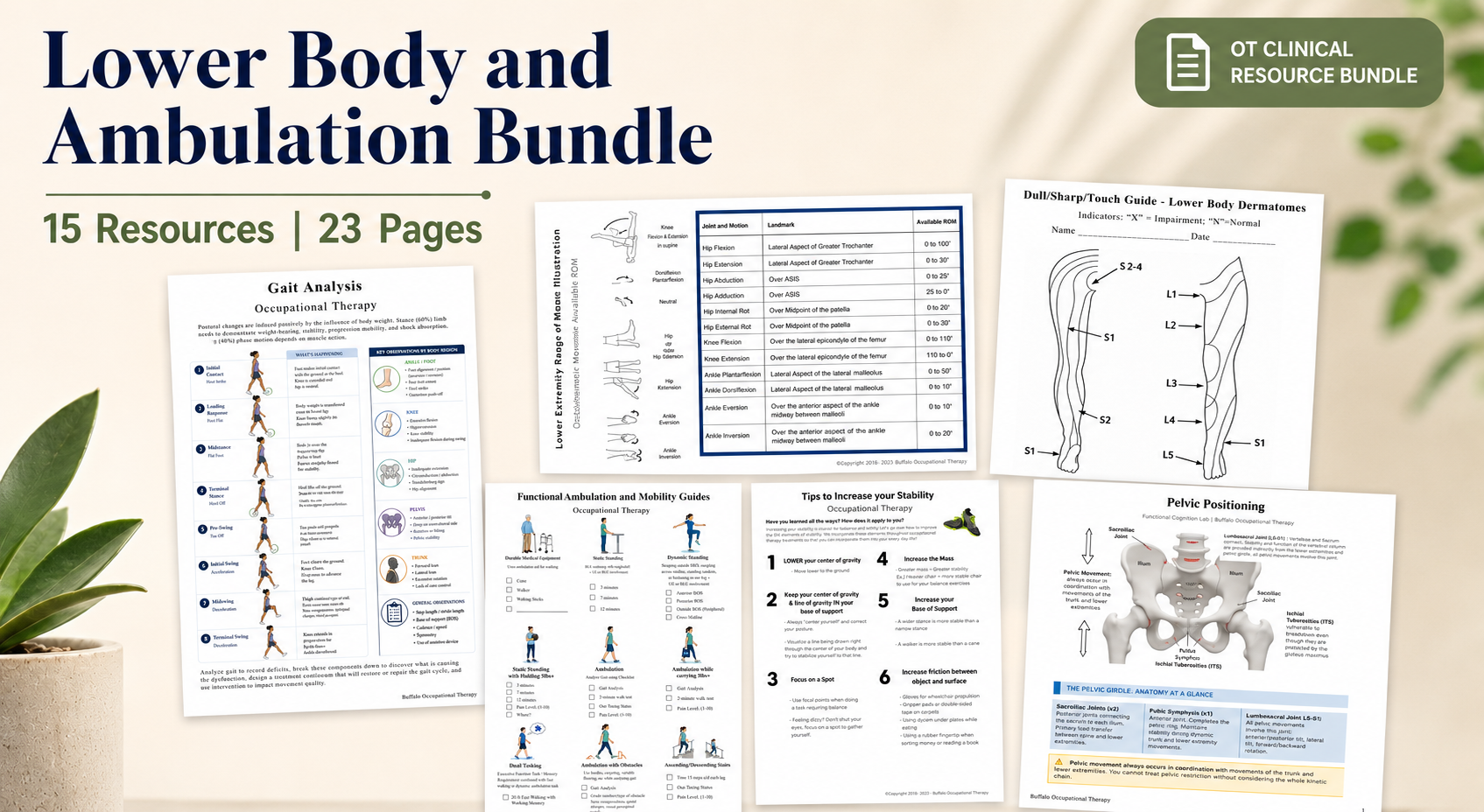
Just want the resources mentioned in this article?: Download the Lower Body and Ambulation Bundle
Functional mobility and ambulation is woven into nearly every area of occupational performance. A person may need to move from bed to standing before they can begin a morning routine, transfer on and off the toilet, enter a shower safely, navigate a curb, move across an uneven parking lot, position a wheelchair at a work surface, or get in and out of a car to participate in the community. When mobility becomes difficult, the impact extends far beyond walking. It can affect self-care, health management, household responsibilities, social participation, work, leisure, and the ability to remain safely in the home.
Writing occupational therapy goals for functional mobility can be challenging because mobility performance depends on many interacting factors. Strength, balance, motor planning, visual perception, endurance, cognition, precautions, confidence, assistive-device management, and environmental demands may all influence the task. It is easy for a goal to become so broad that it no longer tells us what the participant is expected to do or how progress will be measured.
Strong functional mobility goals should identify the actual mobility task, the environment in which it occurs, the level of assistance or equipment permitted, and the performance standard that will indicate success. Body functions and performance skills still matter, but they should support the occupational outcome rather than replace it.
Member Resources:
- Gait Analysis Resource
- Lower Extremity Active Range of Motion Resource
- Functional Ambulation Overview Handout
- Function Ambulation Screening Tool (Anecdotal/Informal)
- Functional Ambulation in Occupational Performance Handout
What Makes a Functional Mobility Goal Meaningful?
A functional mobility goal should describe movement in the context of daily life. “The participant will improve mobility” is too broad because it does not identify whether the person needs to work on bed mobility, toilet transfers, wheelchair use, curb negotiation, floor recovery, or community ambulation.
A stronger goal would be:
The participant will transfer from bed to standing using the prescribed walker with supervision, no loss of balance, and no more than one verbal cue across three consecutive sessions within six weeks.
This goal names the task, the equipment, the level of assistance, the performance standard, and the timeframe.
Functional mobility goals should also reflect the participant’s actual priorities. A person who lives in a single-level apartment may not need a stair goal. Someone who uses a wheelchair as their primary means of mobility may benefit more from goals addressing positioning, doorway navigation, pressure relief, and access to household surfaces than from a generalized ambulation goal. The therapist should begin with the environments and routines the participant needs to manage.
5 Occupational Therapy Goals for Bed Mobility
Member Resource: Transitional Movement Guide
Bed mobility may involve rolling, moving from supine to sitting, repositioning, managing bedding, moving to the edge of the bed, and preparing for transfer. These tasks often require trunk control, upper- and lower-extremity coordination, sequencing, endurance, and the ability to follow precautions.
A participant may be able to sit at the edge of the bed once positioned but be unable to roll or move from supine independently. Another may complete the movement physically but forget the sequence, violate precautions, or become short of breath during the transition.
1. Rolling goal
The participant will roll from supine to right and left side using the bedrail as needed with supervision across three consecutive sessions within four weeks.
2. Supine-to-sit goal
The participant will move from supine to sitting at the edge of the bed using a taught movement sequence with minimal assistance and no more than one verbal cue within six weeks.
3. Sit-to-supine goal
The participant will return from sitting at the edge of the bed to supine with supervision while maintaining prescribed precautions within six weeks.
4. Bed-positioning goal
The participant will independently reposition the trunk and lower extremities for comfort, pressure management, and alignment using prescribed equipment within four weeks.
5. Full bed-mobility goal
The participant will complete rolling, supine-to-sit, edge-of-bed positioning, and return to supine with supervision and no loss of balance across three consecutive sessions within eight weeks.
The therapist should define whether bedrails, leg lifters, wedge systems, or caregiver assistance are permitted. Modified independence with appropriate equipment may be the most realistic and meaningful outcome.
5 Occupational Therapy Goals for Sit-to-Stand and Stand-to-Sit Transfers
Sit-to-stand and stand-to-sit transitions are required during toileting, dressing, bathing, meal preparation, community mobility, and access to household furniture. These movements involve lower-extremity strength, forward weight shift, balance, motor planning, hand placement, and controlled descent.
The goal should identify the type and height of the surface because transferring from a firm armchair is different from rising from a low sofa, toilet, bed, or recliner.
1. Basic sit-to-stand goal
The participant will complete sit-to-stand and stand-to-sit transfers from a standard-height chair using the prescribed mobility device with supervision and no loss of balance within four weeks.
2. Multiple-surface goal
The participant will safely transfer on and off a bed, standard chair, sofa, recliner, and toilet with supervision and consistent use of safe hand placement within eight weeks.
3. Repeated-transfer goal
The participant will complete five consecutive sit-to-stand transfers from a standard-height chair without physical assistance and with controlled descent on all repetitions within six weeks.
4. Low-surface goal
The participant will rise from and return to a low household surface using the prescribed adaptive technique with contact guard assistance and no more than one cue within eight weeks.
5. Transfer-strategy goal
The participant will independently select and use an appropriate transfer strategy based on surface height, armrest availability, and mobility-device placement across four out of five trials within six weeks.
Repeated transfers can be useful for strength and endurance, but the quality of the movement still matters. Ten uncontrolled repetitions do not necessarily represent better functional performance than five safe, well-sequenced repetitions.
4 Occupational Therapy Goals for Toilet Transfers
Toilet transfers combine mobility with clothing management, confined-space navigation, balance, and safety. The participant may need to use grab bars, a raised toilet seat, a commode, or a mobility device while also managing the timing and urgency of the routine.
1. Toilet-transfer goal
The participant will transfer on and off the toilet using the prescribed grab bar and mobility device with supervision and no loss of balance within six weeks.
2. Raised-seat goal
The participant will independently position and use a raised toilet seat during toilet transfers across three consecutive sessions within four weeks.
3. Clothing-management transfer goal
The participant will maintain standing balance with one-hand support while completing clothing management before and after toileting with contact guard assistance within six weeks.
4. Precaution-adherence goal
The participant will independently maintain prescribed weight-bearing and movement precautions throughout toilet transfers and clothing management across three consecutive sessions within four weeks.
The therapist should consider the actual bathroom layout. Performance in a spacious clinic may not transfer to a narrow bathroom with limited grab-bar access.
4 Occupational Therapy Goals for Tub and Shower Transfers
Tub and shower transfers may require stepping over a threshold, managing a tub bench, turning in a confined space, controlling descent, managing wet surfaces, and coordinating equipment. The goal should specify the transfer method and the durable medical equipment being used.
1. Tub-bench transfer goal
The participant will transfer in and out of the tub using a tub transfer bench with supervision, no loss of balance, and no more than one verbal cue within six weeks.
2. Shower-entry goal
The participant will enter and exit a walk-in shower using grab bars and the prescribed mobility device with contact guard assistance within six weeks.
3. Threshold goal
The participant will safely step over a simulated shower threshold while maintaining one-hand support and no loss of balance in four out of five trials within six weeks.
4. Caregiver-training goal
The participant and caregiver will independently demonstrate safe setup and use of prescribed bathing equipment before discharge.
The transfer goal should account for wet surfaces, space constraints, equipment placement, and the participant’s ability to manage clothing and supplies before and after the transfer.
4 Occupational Therapy Goals for Wheelchair Transfers
Wheelchair transfers require more than moving from one surface to another. The participant must position the chair, manage brakes and footrests, align the body, use appropriate hand placement, and complete the transfer without losing balance or violating precautions.
1. Wheelchair-transfer goal
The participant will transfer between wheelchair and bed using the prescribed transfer technique with minimal assistance and no more than one verbal cue within six weeks.
2. Brake and footrest management goal
The participant will independently lock wheelchair brakes, move footrests, and position the chair before transfers in four out of five opportunities within four weeks.
3. Sliding-board goal
The participant will complete wheelchair-to-bed transfers using a sliding board with supervision and correct board placement across three consecutive sessions within eight weeks.
4. Caregiver-assisted transfer goal
The caregiver will demonstrate safe wheelchair transfer assistance using the prescribed technique and body mechanics without therapist correction before discharge.
The level of assistance should reflect the full task, including preparation and cleanup. A participant who physically completes the transfer but requires repeated cueing for brakes is not yet independent.
4 Occupational Therapy Goals for Car Transfers
Car transfers may involve seat height, door width, leg management, trunk rotation, balance, mobility-device placement, and the ability to manage the vehicle environment. The goal should be based on the type of vehicle the participant actually uses whenever possible.
1. Car-transfer goal
The participant will transfer in and out of a standard-height vehicle using the prescribed mobility device with supervision and no loss of balance within eight weeks.
2. Leg-management goal
The participant will independently manage both lower extremities into and out of the vehicle using a leg lifter as needed within six weeks.
3. Device-management goal
The participant will safely position, fold, and retrieve the prescribed mobility device during simulated car entry and exit with no more than one verbal cue within eight weeks.
4. Passenger-access goal
The participant will complete a full passenger-entry routine, including approaching the vehicle, opening the door, sitting, managing the legs, and securing the mobility device, with supervision within eight weeks.
A clinic simulation can be useful, but actual vehicle practice may be necessary because seat height, door configuration, and available space vary substantially.
4 Occupational Therapy Goals for Floor Transfers
Floor transfers may be important for fall recovery, childcare, household activities, exercise, gardening, or religious participation. Not every participant needs to become independent from the floor, but the therapist should consider what the person would do after a fall and whether caregiver assistance or emergency procedures are more appropriate.
1. Floor-transfer goal
The participant will transfer from standing to the floor and return to standing using a stable support surface with contact guard assistance and no loss of balance within eight weeks.
2. Fall-recovery goal
The participant will demonstrate a safe fall-recovery sequence, including environmental assessment, movement toward stable support, and return to sitting or standing with supervision within eight weeks.
3. Emergency-response goal
The participant will independently demonstrate how to access a phone, alert system, or caregiver when unable to rise from the floor within four weeks.
4. Modified floor-mobility goal
The participant will move from floor sitting to a supported kneeling position and then to a chair using the prescribed sequence with minimal assistance within eight weeks.
The goal should reflect safety and realism. For some participants, the appropriate outcome is not independent floor recovery but effective emergency planning.
5 Occupational Therapy Goals for Wheelchair Mobility
Manual and powered wheelchair mobility require visual scanning, spatial judgment, upper-extremity control, problem solving, attention, endurance, and the ability to navigate real environments. The goal should specify the mobility system and the conditions under which the participant is expected to use it.
1, Manual wheelchair goal
The participant will propel a manual wheelchair 150 feet over level indoor surfaces and complete two turns and one doorway with supervision within six weeks.
2. Powered wheelchair goal
The participant will operate a powered wheelchair through hallways, doorways, and designated household spaces with no collisions and no more than one verbal cue within eight weeks.
3. Pressure-relief goal
The participant will independently complete the prescribed wheelchair pressure-relief routine at recommended intervals across three consecutive sessions within four weeks.
4. Wheelchair-positioning goal
The participant will independently position the wheelchair at the bed, toilet, and table with appropriate brake use and clearance in four out of five trials within six weeks.
5. Community-wheelchair goal
The participant will navigate a 300-foot community-style route containing doorways, turns, a ramp, and pedestrian traffic using the prescribed wheelchair with supervision and no collisions within 10 weeks.
The therapist should avoid bundling every visual, cognitive, and motor skill into the wording of the goal. Those abilities may explain the intervention plan, but the goal should remain focused on wheelchair performance.
5 Occupational Therapy Goals for Household and Community Ambulation
Household and community ambulation often involves narrow pathways, furniture, changes in direction, object transport, bathroom access, and transitions between surfaces. A participant may walk safely in an open hallway but struggle in a crowded home.
1. Household ambulation goal
The participant will ambulate 150 feet through a simulated household environment using the prescribed mobility device with supervision, no loss of balance, and no contact with obstacles within six weeks.
2. Narrow-space goal
The participant will navigate a narrow bathroom or bedroom pathway, complete a turn, and approach a functional surface using the prescribed mobility device with no more than one verbal cue within six weeks.
3. Object-transport goal
The participant will ambulate 75 feet while transporting a lightweight household item with supervision and no loss of balance within six weeks.
4. Multiroom-navigation goal
The participant will navigate between three designated household locations while remembering and completing one functional task at each location with no more than one cue within eight weeks.
5. Least-restrictive-device goal
The participant will demonstrate safe household ambulation using the least restrictive clinically appropriate mobility device, with supervision and no loss of balance across three consecutive sessions within eight weeks.
The phrase “least restrictive device” should not be interpreted as no device whenever possible. The correct device is the one that supports safe and effective occupational performance.
5 Occupational Therapy Goals for Curbs, Steps, and Stairs
Curbs and stairs may limit access to the home, transportation, community buildings, and social environments. The goal should identify the height, number of steps, railing availability, device use, and level of assistance.
1. Curb-negotiation goal
The participant will ascend and descend a standard curb using the prescribed mobility device with contact guard assistance and no loss of balance in four out of five trials within eight weeks.
2. Step goal
The participant will ascend and descend four steps using one handrail and the prescribed sequence with supervision within eight weeks.
3. Stair goal
The participant will ascend and descend one flight of stairs using the prescribed handrail and mobility strategy with no more than one rest break and supervision within 10 weeks.
4. Community-entry goal
The participant will safely negotiate the steps or curb required to enter the home or primary community destination with caregiver supervision within eight weeks.
5. Device-management goal
The participant will independently position and manage the prescribed cane or walker during curb negotiation in four out of five trials within six weeks.
A generalized goal to “clear steps and curbs” is less useful than one that reflects the actual environment.
4 Occupational Therapy Goals for Ramps and Inclined Surfaces
Ramps require control of forward momentum, device management, lower-extremity strength, endurance, visual attention, and safe speed adjustment. Wheelchair users may also need to manage propulsion, braking, and alignment.
1. Ramp goal
The participant will ascend and descend a standard accessibility ramp using the prescribed mobility device with supervision and no loss of balance within eight weeks.
2. Wheelchair-ramp goal
The participant will propel or operate the prescribed wheelchair up and down a standard ramp while maintaining alignment and safe speed with supervision within eight weeks.
3. Endurance goal
The participant will complete a 200-foot mobility route containing one ramp and two turns using pacing strategies as needed without therapist-initiated rest within eight weeks.
4. Speed-control goal
The participant will independently reduce speed and maintain device control during ramp descent in four out of five trials within six weeks.
The goal should distinguish between walking and wheelchair mobility because the task demands differ.
4 Occupational Therapy Goals for Uneven Surfaces and Variable Lighting
Community mobility often involves grass, gravel, cracked sidewalks, thresholds, low lighting, glare, and changing visual conditions. A participant may perform well on smooth clinic floors but become unsafe when surface or lighting conditions change.
1. Uneven-surface goal
The participant will ambulate 100 feet over simulated grass, gravel, and uneven flooring using the prescribed mobility device with supervision and no loss of balance within eight weeks.
2. Variable-lighting goal
The participant will navigate a familiar indoor route under normal and reduced-light conditions using prescribed visual or environmental strategies with no more than one cue within eight weeks.
3. Surface-transition goal
The participant will safely transition between tile, carpet, ramp, and outdoor-style surfaces without loss of balance in four out of five trials within eight weeks.
4. Environmental-scanning goal
The participant will identify and respond appropriately to at least 90% of surface changes and obstacles during a community-style mobility route within eight weeks.
Reduced lighting should be introduced carefully and only when it reflects a real environmental demand. The goal is not to create unnecessary risk.
4 Occupational Therapy Goals for Obstacle Navigation
Obstacle courses can be useful when they reflect the participant’s real mobility demands. They may simulate furniture, thresholds, crowded environments, turns, object transport, and changes in elevation.
1. Obstacle-course goal
The participant will complete a multi-surface, multi-elevation mobility course using the prescribed device without loss of balance, obstacle contact, or more than one verbal cue within eight weeks.
2. Route-selection goal
The participant will independently select the safest route around household and community obstacles in four out of five trials within six weeks.
3. Dual-task obstacle goal
The participant will complete a functional obstacle route while retaining and acting on two pieces of verbal information with at least 80% cognitive accuracy and no loss of balance within eight weeks.
4. Fear-management goal
The participant will complete a graded mobility route using identified confidence and pacing strategies while reporting manageable fear and maintaining safe performance across three consecutive sessions within eight weeks.
“Fear of falling” should not be treated as an error. The therapist should examine how fear affects participation and whether confidence, strategy use, and environmental modification improve performance.
4 Occupational Therapy Goals for Precaution Management
Precautions may involve weight bearing, range-of-motion restrictions, spinal precautions, post-surgical limitations, or fall-prevention recommendations. A goal should measure whether the participant follows the precaution during actual mobility tasks.
1. Weight-bearing goal
The participant will independently maintain prescribed weight-bearing status during transfers and household mobility across three consecutive sessions within four weeks.
2. Range-of-motion precaution goal
The participant will complete bed mobility, dressing-related transfers, and chair transfers without exceeding prescribed range-of-motion restrictions across three consecutive sessions within four weeks.
3. Self-correction goal
The participant will independently recognize and correct precaution violations during functional mobility in four out of five opportunities within six weeks.
4. Caregiver goal
The caregiver will demonstrate safe cueing and assistance for prescribed mobility precautions without therapist correction before discharge.
It is stronger to describe the actual behavior than to state that the participant will “increase adherence.”
4 Occupational Therapy Goals for Gross Motor Coordination
Gross motor coordination supports reciprocal movement, arm swing, stepping, turning, balance reactions, and the ability to move efficiently through space. The goal should connect coordination to a functional mobility task rather than focusing only on isolated exercise.
1. Reciprocal movement goal
The participant will ambulate 150 feet using a reciprocal stepping pattern and consistent arm swing with no more than two verbal cues within eight weeks.
2. Multiplanar stepping goal
The participant will complete forward, backward, lateral, and diagonal stepping in response to visual targets without loss of balance in at least 90% of trials within six weeks.
3. Sit-to-stand coordination goal
The participant will complete 10 consecutive sit-to-stand transfers using consistent forward weight shift, symmetrical lower-extremity loading, and controlled descent within eight weeks.
4. Ball-and-mobility goal
The participant will complete 50 controlled ball bounces while stepping in multiple directions without loss of balance and with no more than one cue within eight weeks.
The movement pattern should be relevant to the participant’s mobility needs. A symmetrical gait pattern may not be realistic or necessary for every diagnosis.
5 Occupational Therapy Goals for Sitting Balance
Sitting balance supports dressing, bathing, toileting, feeding, transfers, wheelchair use, and access to work surfaces. Goals should identify whether the participant needs static control, dynamic reach, trunk rotation, return to midline, or the ability to manage a secondary task.
1. Unsupported-sitting goal
The participant will maintain unsupported sitting at the edge of the bed for 15 minutes without physical assistance and with no more than one postural cue within four weeks.
2. Dynamic-sitting goal
The participant will reach outside the base of support in forward, lateral, and diagonal directions and return to midline without loss of balance in at least 90% of trials within six weeks.
3. Trunk-rotation goal
The participant will complete bilateral trunk rotation during seated object retrieval with supervision and no loss of balance within six weeks.
4. Seated-ADL goal
The participant will complete a 20-minute seated dressing or grooming task without back support and without physical assistance for postural correction within six weeks.
4. Gaze-shift goal
The participant will maintain seated postural control while shifting gaze between near, far, and lateral targets during a functional activity with no more than one cue within six weeks.
A standardized Sitting Balance Scale may support measurement, but the occupational goal should still describe what improved sitting control allows the participant to do.
5 Occupational Therapy Goals for Standing Balance
Standing balance goals should describe the task, base of support, upper-extremity use, movement demand, and level of assistance. Standing on foam may be useful as a treatment activity, but the final outcome should relate to occupational performance.
1. Static-standing goal
The participant will maintain standing for 10 minutes with one-hand support as needed while completing a grooming or household task with supervision within six weeks.
2. Dynamic-standing goal
The participant will reach in multiple directions, retrieve five household objects, and return to midline without loss of balance and with supervision within eight weeks.
3. Transitional-balance goal
The participant will move between static standing, stepping, turning, and reaching with no loss of balance across four consecutive functional trials within eight weeks.
4. Single-leg-support goal
The participant will maintain single-leg support long enough to clear a low threshold or manage lower-body clothing with contact guard assistance in four out of five trials within six weeks.
5. Balance-strategy goal
The participant will independently use an appropriate stepping, support, or pacing strategy in response to balance challenge during four out of five functional mobility tasks within eight weeks.
A goal should not automatically require a near-perfect score on a balance test unless that score is realistic and clinically meaningful for the participant.
Using Standardized Measures in Functional Mobility Goals
Standardized assessments can help quantify change, identify fall risk, and support clinical reasoning, but the score should not replace direct observation of functional mobility. Measures such as the Berg Balance Scale, Five Times Sit-to-Stand Test, Star Excursion Balance Test, Lower Extremity Functional Scale, and Sitting Balance Scale may provide useful information when selected for the appropriate population.
A goal based on the Berg Balance Scale should not automatically require a score of 54 out of 56. The appropriate target depends on baseline performance, diagnosis, prognosis, timeframe, and the measurement properties of the assessment. A participant may demonstrate meaningful improvement without approaching the maximum score, while another may score highly and still struggle in complex community environments.
The Lower Extremity Functional Scale should also be interpreted carefully. A 60-point improvement is an extremely large target for many participants and may not be possible depending on baseline score. The goal should use an expected and clinically meaningful change rather than simply dividing a large score increase into percentages.
A combined goal may be stronger:
The participant will demonstrate improved lower-extremity function during transfers, stair negotiation, and community mobility, with a clinically meaningful improvement on the Lower Extremity Functional Scale within 12 weeks.
The standardized score contributes evidence, while the functional outcomes show what changed in daily life.
Building Functional Mobility Goal Progressions
Goal progressions are helpful when they represent meaningful stages of performance. The checkpoints should show changes in assistance, safety, environment, task complexity, or carryover rather than only the number of treatment sessions completed.
A bed-mobility progression might begin with rolling using physical assistance, move to supine-to-sit with verbal cueing, and end with independent repositioning and transfer preparation. A wheelchair progression might begin with brake and footrest management, continue with straight-path mobility and turns, and progress to doorways, ramps, and community environments.
A sit-to-stand progression might begin with elevated surfaces and upper-extremity support, continue with standard-height surfaces, and end with multiple household surfaces. The participant may also progress from physical assistance to supervision, then modified independence.
A balance progression might move from static control to controlled weight shifting, then reaching, stepping, turning, object carrying, and finally mobility within realistic environments. The progression should be based on what the participant needs, not a predetermined assumption that every person must advance to an unstable surface.
Common Problems With Functional Mobility Goals
One common problem is writing that the participant will complete a mobility task “after improving sufficient body functions and performance skills.” This wording treats the occupation as something that must wait until all underlying impairments are corrected. Occupational therapy can address the mobility task directly while also remediating, compensating for, or adapting the underlying limitations.
Another problem is using the word “safe” without defining what safety means. Safety may involve no loss of balance, correct use of brakes, appropriate hand placement, adherence to precautions, controlled speed, obstacle clearance, or independent recognition of when assistance is needed. The goal should state the behavior.
Goals can also become unrealistic when they require perfect performance on standardized tests or assume that the participant must progress to no device. An assistive device may be the intervention that allows safe independence. The objective is not to remove equipment for its own sake.
Finally, clinic mobility does not always reflect home or community performance. Wide hallways, smooth floors, bright lighting, and therapist supervision may conceal difficulties that emerge in tight bathrooms, uneven sidewalks, crowded stores, or low-light environments. Goal writing should account for the context that matters.
A Practical Formula for Functional Mobility Goals
A functional mobility goal can usually be built with this structure:
The participant will complete the named mobility task in a defined environment or from a defined surface, using specified equipment or strategies, with a measurable level of assistance, safety, accuracy, or consistency, within a realistic timeframe.
For example:
The participant will transfer in and out of the tub using a tub transfer bench with supervision, no loss of balance, and no more than one verbal cue within six weeks.
Or:
The participant will navigate a 200-foot community-style route containing one ramp, two turns, and three surface changes using the prescribed walker with supervision and no obstacle contact within eight weeks.
These goals are clear, measurable, and flexible enough to support skilled grading and adaptation.
Final Thoughts
Occupational therapy goals for functional mobility should show where the participant needs to go, what they need to access, and how movement supports participation in everyday life. Bed mobility matters because it allows the person to begin the day. Toilet and shower transfers matter because they support self-care. Wheelchair mobility matters because it creates access to home, work, and community environments. Curbs, ramps, and uneven surfaces matter because the world outside the clinic is not flat, open, or predictable.
Strength, endurance, balance, coordination, vision, cognition, and confidence may all need to be addressed. However, these components should remain connected to the mobility task that matters to the participant.
About the Author
Michelle Eliason, MS, OTR/L is an occupational therapist, rehabilitation researcher, educator, and founder of BOT Portal and Buffalo Occupational Therapy. Her clinical and scholarly work focuses on neurological rehabilitation, functional cognition, cognitive-motor performance, aging, and the translation of rehabilitation science into practical occupational therapy evaluation, intervention, and clinical reasoning.
Learn more about : Michelle C. Eliason, MS, OTR/L
Continue Learning With Us
Did you find this information helpful? Please share this article with another occupational therapy practitioner, student, educator, or rehabilitation professional who may benefit from it.
Would you like access to the clinical resources discussed throughout this article? Explore our membership options to find the level of support that works best for you.
Looking for a more formal learning and mentorship experience? Learn more about the Functional Cognition Lab Mentorship Program.
You can also explore our AOTA-approved courses and clinical resource packages for additional education, treatment resources, and practical tools you can use in rehabilitation practice.
Interested in receiving free functional cognition education each week? Subscribe to the Functional Cognition Lab Newsletter.