
Exercise Intensity and Cognitive Load: More is Not Better
May 30, 2024
Exercise Intensity and Cognitive Load: When More Is Not Better in Rehabilitation
by Michelle C. Eliason, MS, OTR/L
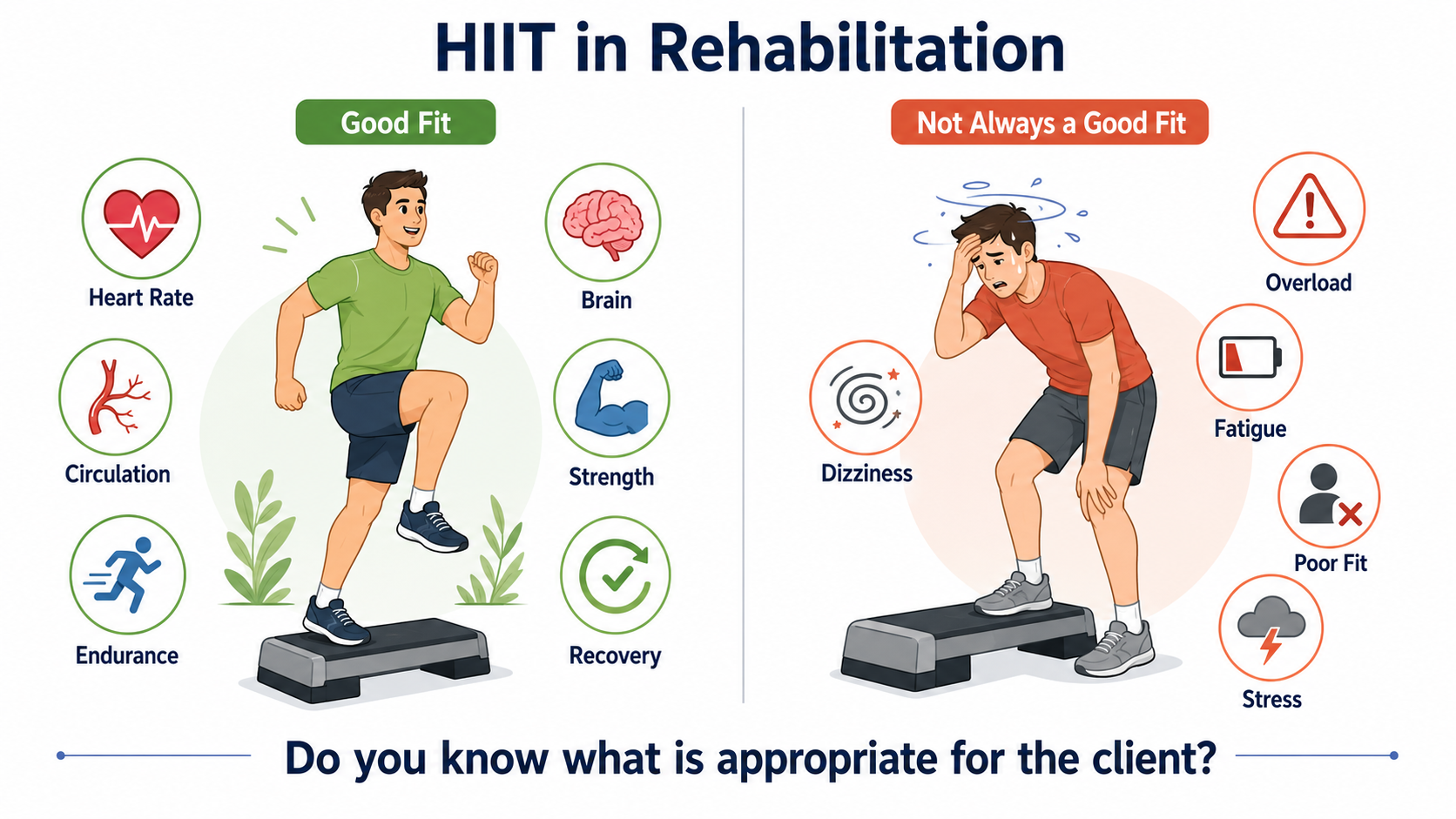
High-intensity exercise is everywhere in rehabilitation right now.
The basic idea makes sense. Raise the heart rate, increase circulation, challenge the nervous system, and support recovery.
There is also growing interest in combining physical exercise with cognitive tasks. A patient may walk while answering questions, complete balance activities while recalling information, or follow rapid commands while moving. [ This is also called Dual Tasking: Take the Course on Dual Tasking]
These activities can be useful.
However, I think we need to be careful about assuming that more physical intensity plus more cognitive demand automatically creates a better intervention.
Sometimes it does.
Sometimes it creates overload.
As therapists, our job is not simply to make an activity harder. Our job is to understand what we are challenging, why we are challenging it, and whether the patient is actually benefiting from the demand.
Helpful Resources:
Attention Requires Effort
Member Resource: Different Types of Attention Pyramid and Attention Patient Handout
Attention is the ability to focus on information that matters while filtering out information that does not.
That sounds simple, but attention requires effort.
The patient may need to:
- Listen to directions
- Ignore background noise
- Watch the therapist
- Monitor body position
- Remember the task
- Control movement
- Notice symptoms
- Correct errors
- Stay safe
Every additional demand requires the patient to divide, sustain, or shift attention.
This is especially important in neurological rehabilitation. Patients may already be experiencing slowed processing, cognitive fatigue, poor self-monitoring, visual-perceptual problems, reduced attention, or difficulty managing multiple demands.
A task that appears simple to the therapist may require a tremendous amount of mental effort from the patient.
Prolonged cognitive effort can contribute to mental fatigue. Depending on the person and the task, mental fatigue may be associated with increased perceived effort and changes in cognitive, gait, balance, or physical performance. These effects are not identical across every population or every type of balance task, which is another reason treatment must be individualized.
Member Resource: Patient Handout on Cognitive Load and Inhibition
Physical Intensity and Cognitive Load Are Not the Same Thing
Physical intensity describes how hard the body is working.
This may involve:
- Increased heart rate
- Faster movement
- Greater resistance
- Longer duration
- More repetitions
- Reduced rest
- Increased cardiovascular demand
Cognitive load describes how much mental processing the task requires.
This may involve:
- Remembering information
- Following multiple steps
- Making decisions
- Switching attention
- Inhibiting an automatic response
- Scanning the environment
- Solving a problem
- Responding quickly
- Performing two tasks at once
These are separate treatment variables.
A patient can complete a physically demanding activity with very little cognitive complexity. A patient can also complete a physically easy activity that requires a high level of attention, memory, planning, or executive functioning.
The concern arises when we increase both variables at the same time without considering the patient’s current capacity.
Why High-Intensity Exercise May Support Cognition
High-intensity interval training, commonly called HIIT, may support selected areas of cognitive performance.
Recent reviews have reported benefits involving executive function, working memory, attention control, cognitive flexibility, task switching, memory, and information processing. However, the size and consistency of these effects vary according to the population, protocol, intervention duration, and cognitive measure being used. (Checkout the helpful resource references at the end of this article).
HIIT may also influence peripheral levels of brain-derived neurotrophic factor, commonly called BDNF. BDNF is associated with neural adaptation and plasticity, but an increase in peripheral BDNF should not be treated as proof that every intense session directly produces functional neuroplastic change. Researchers are still working to determine the most effective protocols and the populations most likely to benefit.
This article is not an argument against high-intensity exercise.
The caution is that evidence supporting the long-term benefits of exercise does not mean the patient will perform better cognitively during every physically intense treatment session.
An intervention may support cognition over time while temporarily increasing fatigue, effort, or performance difficulty during the activity.
Both things can be true.
Acute Exercise and Long-Term Exercise Are Not the Same
The cognitive effects of one exercise session should not be treated as identical to the effects of a repeated exercise program.
Meta-analyses generally suggest that acute exercise can produce small cognitive benefits, but the response depends partly on when cognition is measured. Performance during exercise may differ from performance immediately afterward, and the effect may vary with the task being tested.
This matters clinically.
A patient may gain long-term benefit from a challenging exercise program while still demonstrating slower responses or poorer task performance during the most demanding portion of a session.
That does not automatically mean the exercise is harmful.
It also does not mean we should ignore the decline.
It means we need to decide what we are trying to accomplish at that moment:
- Are we primarily training cardiovascular capacity?
- Are we training the quality of a new movement?
- Are we teaching a cognitive strategy?
- Are we testing dual-task performance?
- Are we expecting the patient to retain new information?
The answer should influence how we dose the session.
Capacity Sharing and Cognitive-Motor Interference
Dual-task theories propose that tasks performed at the same time compete for limited processing capacity.
- When the combined demands remain within the patient’s current ability, performance may remain stable.
- When the combined motor and cognitive demands exceed that ability, performance in one or both tasks may decline. This is commonly called cognitive-motor interference.
For example, a patient may walk safely through a quiet hallway. The same patient may slow down, lose balance, shorten their steps, stop speaking, or forget information when asked to walk while scanning for signs and remembering directions. The patient did not suddenly lose the ability to walk.The combined task required more processing than the patient could effectively manage at that moment. That breakdown is not always a reason to discontinue the activity. It is clinical information. It helps us identify where the patient’s current capacity ends and which part of the activity needs to be graded.
When Challenge Becomes Overload
Therapists often aim to create the just-right challenge. That is appropriate.
However, sometimes we add so many demands that the patient is no longer practicing the intended skill. The patient is simply trying to survive the activity.
Consider a patient who is asked to:
- Stand on an unstable surface
- Maintain a narrow base of support
- Catch a ball
- Follow rapid commands
- Remember a sequence
- Scan for visual targets
- Carry on a conversation
- Monitor symptoms
- Avoid losing balance
That combination may be appropriate for a high-level patient with a very specific occupational goal.
For another patient, it may create complete cognitive-motor breakdown.
The patient may begin holding their breath, gripping with the toes, using excessive trunk movement, ignoring safety instructions, forgetting the task, or moving with poor quality.
The activity may look advanced. That does not automatically make it effective.
Signs the Combined Demand May Be Too High
The following signs do not form a diagnostic checklist. They are clinical observations that may indicate that the current task exceeds the patient’s capacity.
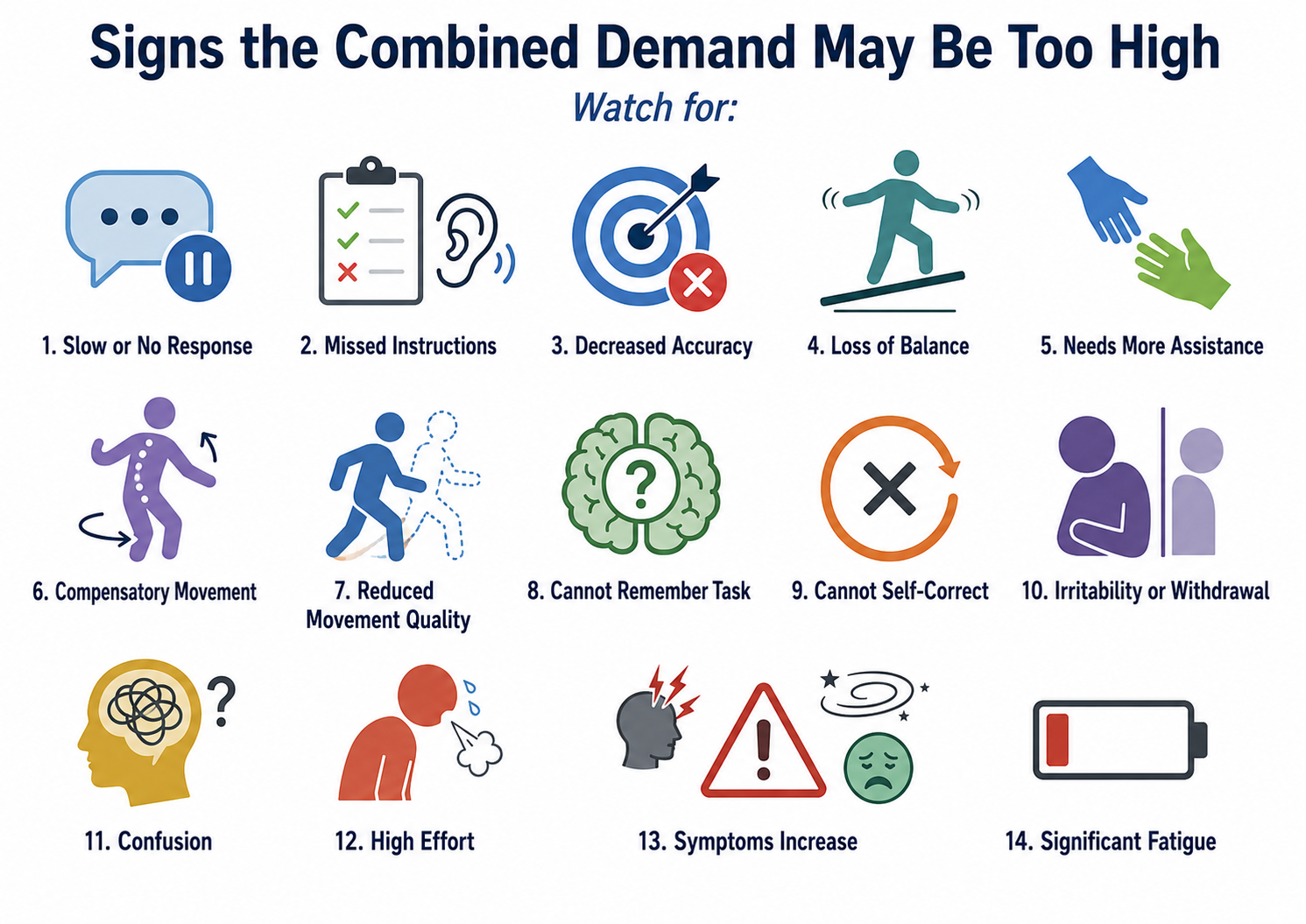
Watch for:
- Slower or absent responses
- Repeatedly missed instructions
- Decreased accuracy
- Increased loss of balance
- More physical assistance
- Increased compensatory movement
- Reduced movement quality
- Inability to remember the task
- Inability to self-correct
- Irritability or withdrawal
- Confusion
- Increased perceived effort
- Headache, dizziness, nausea, or symptom escalation
- Significant fatigue during or after treatment
Mental fatigue has been associated with increased perceived exertion and reduced performance in some physical and cognitive tasks. It has also been associated with increased gait variability during dual-task walking in older adults. However, some studies have not found meaningful effects on static balance, which reminds us that the response depends on the task and population.
The patient may technically finish the activity, but that does not tell us whether the dosage was appropriate.
We also need to ask:
- How quickly did the patient recover?
- Did symptoms remain elevated afterward?
- Could the patient describe the strategy?
- Did the patient retain the information?
- Did performance transfer into a meaningful activity?
- Was the patient learning or merely enduring?
Mental Fatigue Is Not the Brain Running Out of Fuel
It is tempting to explain cognitive fatigue by saying that the brain used up its glucose, oxygen, neurotransmitters, or mitochondrial energy.
The brain certainly requires metabolic energy, and neural activity depends on adequate physiological support.
However, ordinary mental fatigue should not be described as the brain simply running out of fuel.
Reviews have questioned whether the duration of cognitive activity commonly used in mental-fatigue research is sufficient to deplete brain energy or catecholamine resources in that straightforward way. Mental fatigue may also involve changes in motivation, perceived effort, attention allocation, and the value the person places on continuing the task.
For clinicians, the simpler and more useful explanation is this:
As cognitive effort increases, the patient may need to devote more attention and perceived effort to maintaining performance. When the total demand becomes too high, accuracy, movement quality, speed, or endurance may decline.
We do not need to prove that the mitochondria are failing to recognize that the patient is struggling.
Dual-Task Training Is Still Important
None of this means we should avoid dual-task training.
Real life is filled with situations in which cognitive and motor demands occur together.
People:
- Walk while talking
- Cook while planning the next step
- Carry laundry while navigating the home
- Cross streets while scanning traffic
- Shop while remembering a list
- Work while responding to interruptions
- Move through crowded spaces while making decisions
Dual-task training is highly relevant to occupational therapy because occupational performance rarely occurs under single-task laboratory conditions.
Systematic reviews suggest that dual-task training may improve selected cognitive, gait, and balance outcomes in some populations, including older adults with cognitive impairment, people with multiple sclerosis, and people after stroke. However, effects vary, and some bodies of evidence remain limited by study quality and intervention differences.
The answer is not to remove cognitive demands.
The answer is to dose them intentionally.
Member Resource
Four Ways to Combine Physical and Cognitive Demand
It can be helpful to think of treatment intensity using four broad combinations.
High Physical Demand and Low Cognitive Demand
This may be useful when the primary goal is cardiovascular conditioning, endurance, strength, or high-repetition motor practice.
Examples include:
- Fast walking along a clear path
- Repeated sit-to-stand
- Cycling with simple instructions
- High-repetition stepping
- Strengthening with minimal distraction
The patient can focus attention on physical output, breathing, symptoms, and movement quality.
Low Physical Demand and High Cognitive Demand
This may be useful when the primary goal is memory, executive function, attention, planning, or strategy use.
Examples include:
- Seated medication management
- Route planning
- Complex sequencing
- Visual scanning
- Problem-solving
- Functional memory tasks
The physical demand remains manageable so the patient can devote more attention to the cognitive process.
Moderate Physical and Moderate Cognitive Demand
This is often an appropriate starting point for functional dual-task training.
Examples include:
- Walking while remembering a short shopping list
- Standing during simple meal preparation
- Reaching while following two-step directions
- Folding laundry while sorting items
- Walking while discussing safety strategies
Both demands are present, but neither completely overwhelms the patient.
High Physical Demand and High Cognitive Demand
This may be appropriate for selected patients with higher-level occupational goals.
Examples include:
- Rapid obstacle navigation with changing directions
- Higher-intensity walking with decision-making
- Sport simulation
- Work simulation
- Complex community mobility
- Fast-paced cognitive-motor training
This level should be selected for a reason.
It should not be used simply because harder looks more skilled.
Think About the Person, Not Just the Diagnosis
The same intervention may affect two patients with the same diagnosis very differently.
A person after stroke may experience:
- Slowed processing
- Visual neglect
- Weakness
- Reduced postural reactions
- Aphasia
- Impaired motor planning
Member Resource: 7-page Clinician Stroke Resource
A person with Parkinson’s disease may experience:
- Freezing
- Reduced automatic movement
- Delayed postural responses
- Difficulty walking while thinking
- Reduced movement amplitude
A person with multiple sclerosis may experience:
- Cognitive fatigue
- Physical fatigue
- Heat sensitivity
- Slower processing
- Variable symptoms
A person with traumatic brain injury may experience:
- Headache
- Sensory overload
- Impulsivity
- Reduced attention
- Difficulty filtering distractions
Member Resource: Acquired Brain Injury Symptoms Guide
A person with dementia may experience:
- Difficulty retaining instructions
- Reduced ability to switch tasks
- Impaired judgment
- Difficulty adapting to changing rules
These examples can guide clinical reasoning, but diagnosis alone does not determine treatment dosage.
Two people with the same diagnosis may have entirely different goals, symptoms, strengths, and capacities.
The Timing of Cognitive Challenge Matters
Some patients perform cognitive work better at the beginning of a session while ohers become more alert after movement and perform better once the body has been activated.
Likewise, a patient may tolerate complex cognitive-motor work in the middle of a session but struggle after intense cardiovascular activity.
This means sequencing matters.
A therapist may choose to:
- Complete cognitive strategy training before intense exercise
- Use movement as a warm-up before cognitive work
- Alternate demanding and easier tasks
- Add structured rest
- Place dual-task activities before severe physical fatigue develops
- Reduce cognitive complexity as physical intensity increases
- Reassess cognition after the patient has recovered
There is no single correct order. The best order is the one that supports the patient’s current goal and response.
Progress One Variable at a Time
When possible, change one major demand at a time. For example, you may first increase physical intensity while keeping the cognitive task simple. Then, you may hold the physical task steady while increasing cognitive complexity.
Possible progressions include:
- One instruction to two instructions
- Slow responses to faster responses
- Quiet environment to mild distraction
- Familiar task to unfamiliar task
- Single task to dual task
- Fixed sequence to changing sequence
- Stable surface to variable surface
- Short duration to longer duration
- Therapist-directed strategy to independent strategy use
This helps the therapist determine what caused the change in performance.
When every variable changes at the same time, it becomes difficult to know whether the patient struggled because of:
- Balance
- Memory
- Language
- Processing speed
- Fatigue
- Vision
- Comprehension
- Motor planning
- Cardiovascular demand
Grading one variable at a time provides better clinical information.
Focus on Functional Carryover
The goal is to help the patient function in real life.
Ask:
- What does this person need or want to return to?
- Which physical and cognitive demands occur together?
- Which part of the activity causes performance to break down?
- What strategy improves performance?
- Can the person use that strategy outside therapy?
- Does the treatment resemble the demands of the occupation?
A patient who wants to return to grocery shopping may need to walk, scan shelves, remember a list, control a cart, avoid obstacles, and tolerate noise.
A patient returning to teaching may need to stand, move through a classroom, speak, monitor students, remember instructions, and shift attention quickly.
A patient preparing meals may need to stand, sequence steps, monitor safety, retrieve items, and manage interruptions.
That is where physical and cognitive training become occupationally meaningful.
Final Thoughts
High-intensity exercise and cognitive challenge can be separately valuable, and dual-task training is essential for many real-world occupations.
The caution is that more is not always better when every treatment demand is increased at the same time.
Physical intensity and cognitive load should be treated as separate variables. Both can be adjusted based on the patient’s goals, symptoms, safety, fatigue, diagnosis, environment, and stage of recovery. As therapists, we should ask whether the patient is learning, adapting, retaining, and improving function, or whether the activity has simply become too much.
A hard activity is not automatically a skilled intervention. A skilled intervention is intentionally selected, carefully graded, and clearly connected to the life the patient wants to return to.
About the Author
Michelle Eliason, MS, OTR/L is an occupational therapist, rehabilitation researcher, educator, and founder of BOT Portal and Buffalo Occupational Therapy. Her clinical and scholarly work focuses on neurological rehabilitation, functional cognition, cognitive-motor performance, aging, and the translation of rehabilitation science into practical occupational therapy evaluation, intervention, and clinical reasoning.
Learn more about : Michelle C. Eliason, MS, OTR/L
Continue Learning With Us
Did you find this information helpful? Please share this article with another occupational therapy practitioner, student, educator, or rehabilitation professional who may benefit from it.
Would you like access to the clinical resources discussed throughout this article? Explore our membership options to find the level of support that works best for you.
Looking for a more formal learning and mentorship experience? Learn more about the Functional Cognition Lab Mentorship Program.
You can also explore our AOTA-approved courses and clinical resource packages for additional education, treatment resources, and practical tools you can use in rehabilitation practice.
Interested in receiving free functional cognition education each week? Subscribe to the Functional Cognition Lab Newsletter.
Helpful References:
- Salihu, A. T., Hill, K. D., & Jaberzadeh, S. (2022). Neural mechanisms underlying state mental fatigue: a systematic review and activation likelihood estimation meta-analysis. Reviews in the neurosciences, 33(8), 889–917. https://doi.org/10.1515/revneuro-2022-0023
- Liu, K., Zhao, W., Li, C., Tian, Y., Wang, L., Zhong, J., Yan, X., Wang, Y., Wang, L., & Wang, H. (2024). The effects of high-intensity interval training on cognitive performance: a systematic review and meta-analysis. Scientific reports, 14(1), 32082. https://doi.org/10.1038/s41598-024-83802-9
- Zhang, W., Zeng, S., Nie, Y., Xu, K., Zhang, Q., Qiu, Y., & Li, Y. (2025). Meta-analysis of high-intensity interval training effects on cognitive function in older adults and cognitively impaired patients. Frontiers in physiology, 16, 1543217. https://doi.org/10.3389/fphys.2025.1543217
- Van Cutsem, J., Marcora, S., De Pauw, K., Bailey, S., Meeusen, R., & Roelands, B. (2017). The Effects of Mental Fatigue on Physical Performance: A Systematic Review. Sports medicine (Auckland, N.Z.), 47(8), 1569–1588. https://doi.org/10.1007/s40279-016-0672-0
- Lambourne, K., & Tomporowski, P. (2010). The effect of exercise-induced arousal on cognitive task performance: a meta-regression analysis. Brain research, 1341, 12–24. https://doi.org/10.1016/j.brainres.2010.03.091Youssef, H., Gönül, M. N., Sobeeh, M. G., Akar, K., Feys, P., Cuypers, K., & Vural, A. (2024). Is High-Intensity Interval Training More Effective Than Moderate Continuous Training in Rehabilitation of Multiple Sclerosis: A Comprehensive Systematic Review and Meta-analysis. Archives of physical medicine and rehabilitation, 105(8), 1545–1558. https://doi.org/10.1016/j.apmr.2023.12.012
- Liu, K., Zhao, W., Li, C., Tian, Y., Wang, L., Zhong, J., Yan, X., Wang, Y., Wang, L., & Wang, H. (2024). The effects of high-intensity interval training on cognitive performance: a systematic review and meta-analysis. Scientific reports, 14(1), 32082. https://doi.org/10.1038/s41598-024-83802-9
- Youssef, H., Gönül, M. N., Sobeeh, M. G., Akar, K., Feys, P., Cuypers, K., & Vural, A. (2024). Is High-Intensity Interval Training More Effective Than Moderate Continuous Training in Rehabilitation of Multiple Sclerosis: A Comprehensive Systematic Review and Meta-analysis. Archives of physical medicine and rehabilitation, 105(8), 1545–1558. https://doi.org/10.1016/j.apmr.2023.12.012