
Parkinson's Disease
"Working with Parkinson’s means helping people hold onto the rhythm of their life—one purposeful movement, one meaningful habit, one empowered day at a time."
CLICK HERE to Ask a Question [Easy Navigation]
Clinician Guide
This clinician resource is written with simple text to equip the practitioner with enough information to get them started when working with someone diagnosed with PD.
Patient Guide
This visually appealing packet of handouts is designed to improve understanding of PD and equip someone with strategies to maintain wellness.
Evaluation
Things to know before and during your evaluation.
Click Here for General Evaluation and Examination Information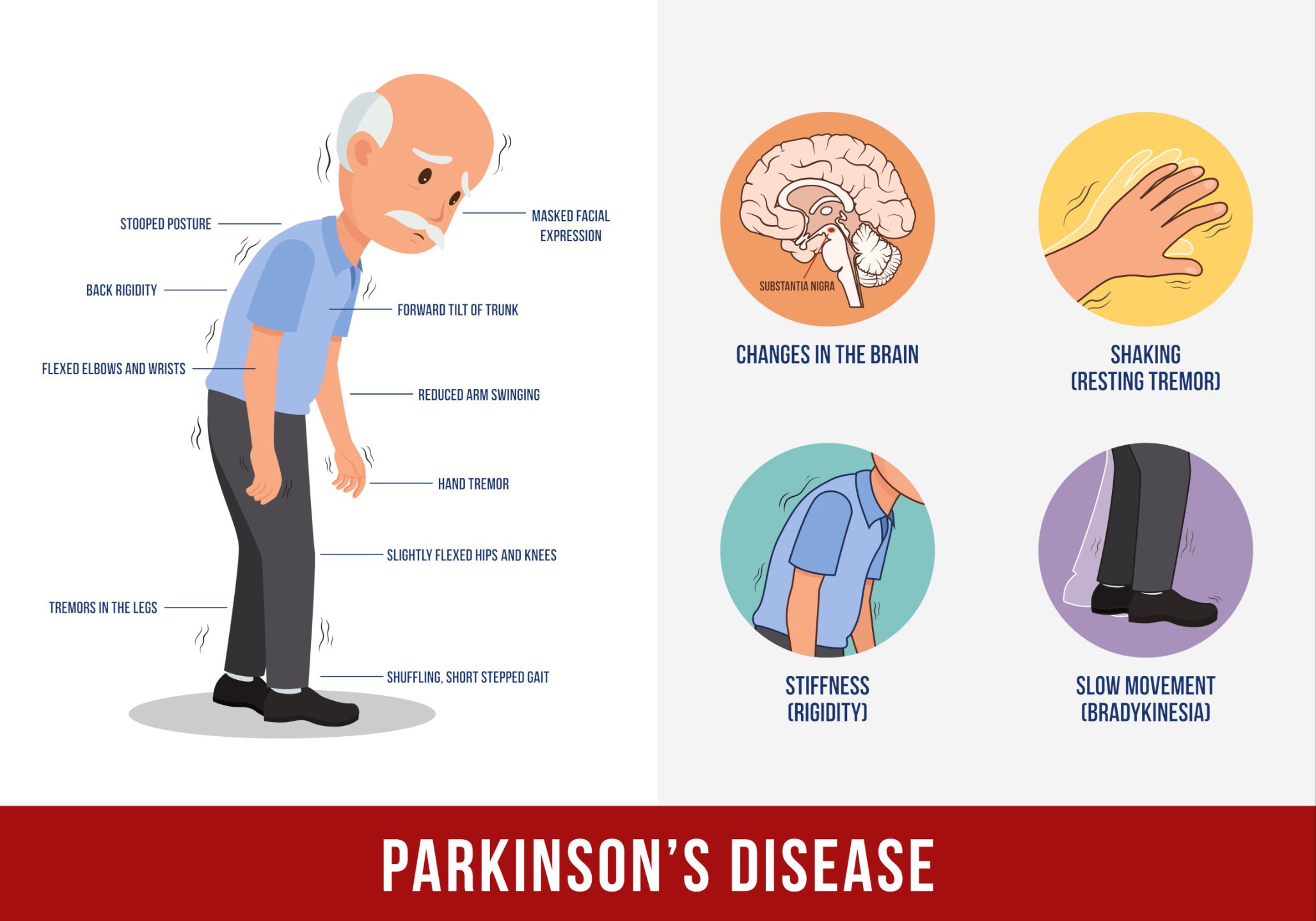
Overview
+ Parkinson’s Disease (PD) is a progressive neurological condition that affects both movement and cognition. It’s not terminal, but without proper management, it can become significantly disabling. PD impacts dopamine-producing neurons, primarily in the substantia nigra and basal ganglia—regions involved in complex movement and automatic body control.
+ Many individuals also develop Lewy Body clusters, which further disrupt motor coordination and executive function. As dopamine declines, patients experience difficulty with dual-tasking, affecting nearly every daily occupation.
+ Most patients beyond the early stages will be prescribed dopaminergic medications like levodopa to compensate for decreased dopamine.
+ Understanding PD’s neuroanatomy and its functional impact strengthens your clinical reasoning—and builds patient trust in your care.
Download Guide to PD Symptoms
The "Subjective"
This information is collected from interviews with the patient, as well as input from their professional and social support systems.

The "Objective"
This information is captured using objective Assessments and questionnaires. It is how you determine if you are making progress with your patient.

The "Assessment"
Use your clinical reasoning and evidence-based knowledge to interpret patient data and justify the need for OT services.

The "Plan"
Watch this 15-minute video on treatment planning for tips that apply to this process, regardless of diagnosis.
Evaluation Interview Questions
The interview is your chance to build rapport, answer questions, and gather meaningful information about your patient. Be prepared—don’t wing it. Time is valuable. Download this ready-to-use interview guide to streamline your evaluation.
Download an Interview for Parkinson's Disease
Symptoms & Other Impacts
Symptoms affect quality of life. We don’t treat symptoms directly, but we must acknowledge and talk about them to help clients manage them.

Symptoms
Note: As an occupational therapy practitioner, it is important to note that someone with Parkinson’s Disease will be impacted throughout the 9 dimensions of wellness. It is important to address those domains of wellness clinically through assessments and corresponding plan of care and treatment continuums to address the symptoms and dysfunction because caused from the diagnosis that does not have a cure.
Earliest symptoms are nonmotor symptoms and include loss of sense of smell, constipation, rapid eye movement (REM) behavior disorder (a sleep disorder), mood disorders, urinary urgency, and orthostatic hypotension (low blood pressure when standing up).
Tremor – “resting tremor” or “pill rolling” movements. During movements or sleep, the tremor subsides. Increased stress and emotion causes increased tremor.
Postural Instability – Rounded shoulders, forward head, “stooping position”, decreasing and eventual loss of postural reflex, decreased arm swing during ambulation
Bradykinesia is the only symptom that must be present for a PD diagnosis and is also known to be the most functionally debilitating symptom in PD. This is extreme slowness when initiating or performing desired movements.
Muscle rigidity and cramps – Tone is increased on a neuromuscular level and may lead to “cogwheel movement patterns’
Decreased productive muscle recruitment
-
During upper and lower movements, the patterns of muscle activity for the agonist and antagonist breaks down as a result of the mechanism of PD which directly affects bradykinesia
-
Neither dopaminergic medication nor deep brain stimulation of the subthalamic nucleus can normalize the abnormal agonist and antagonist muscle activation pattern observed in PD. So, even if your patient has greatly improved in their movements as a result of these interventions, they may still require therapy for balance and instability for the decreased relationship between synergistic muscles during functional movements! This causes mobility dysfunction (ambulation/transitional movement AND upper body participation in activity).
Gait disturbances in PD to watch for: shuffling (small amplitude steps), instability (asymmetry and variability between steps), freezing of gait (cessation of movement and difficulty with initiation), and general disfluencies in walking movements and posture.
Key Motor Symptoms
-
Tremor: Often a “resting tremor” or “pill-rolling” motion. It subsides during movement or sleep but increases with stress or emotion.
-
Postural Instability: Rounded shoulders, forward head, reduced arm swing, and loss of postural reflexes over time.
-
Bradykinesia: Required for diagnosis. It is the most functionally limiting symptom, presenting as extreme slowness in initiating or executing movement.
-
Rigidity & Muscle Cramps: Increased tone causes stiffness and “cogwheel” motion.
-
Poor Muscle Coordination: Disruption between agonist and antagonist muscles, especially during movement transitions.
Print Symptoms of PD

Longterm Life Effect
There are 5 stages of Parkinson’s Disease. You should know this to help your client live with this condition throughout the progression as well as to be able to observe approximately where they are in the progression of their condition to best meet their needs.
Stage one: Symptoms affect only one side of the body.
Stage two: Symptoms begin affecting both sides of the body, but balance is still intact.
Stage three: Symptoms are mild to moderate and balance is impaired, but the person can still function independently
Stage four: Symptoms cause severe disability, but clients can still walk or stand without assistance
Stage five: Symptoms cause the client to become wheelchair-bound or bedridden, unless assisted.
Print Stages of PDInterventions
Clinicians use knowledge, experience, research, judgment, and client input to guide effective interventions.
Build a Holistic Treatment Plan
Occupational therapy plays a critical role in helping individuals with Parkinson’s stay functional, independent, and empowered through every stage of the disease. Use the categories below to explore targeted interventions that support the brain, body, and daily life—each grounded in neurofunctional reasoning and client-centered care.