6 Tips for Stretching Spasticity post-Stroke
Aug 23, 2026
6 Tips for Stretching Spasticity post-Stroke for the Occupational Therapy Practitioner
by Michelle C. Eliason, MS, OTR/L
Resource: Checkout this helpful resource page on stroke.
Membership Resources: This article and its companion audio are free to read and listen to. Links throughout the article connect members of the Functional Cognition Lab to related printables, treatment tools, courses, and clinical resources that align with the topic being discussed. Membership also includes access to the full resource library and direct clinical support. Find out more about membership on the Membership Options Page
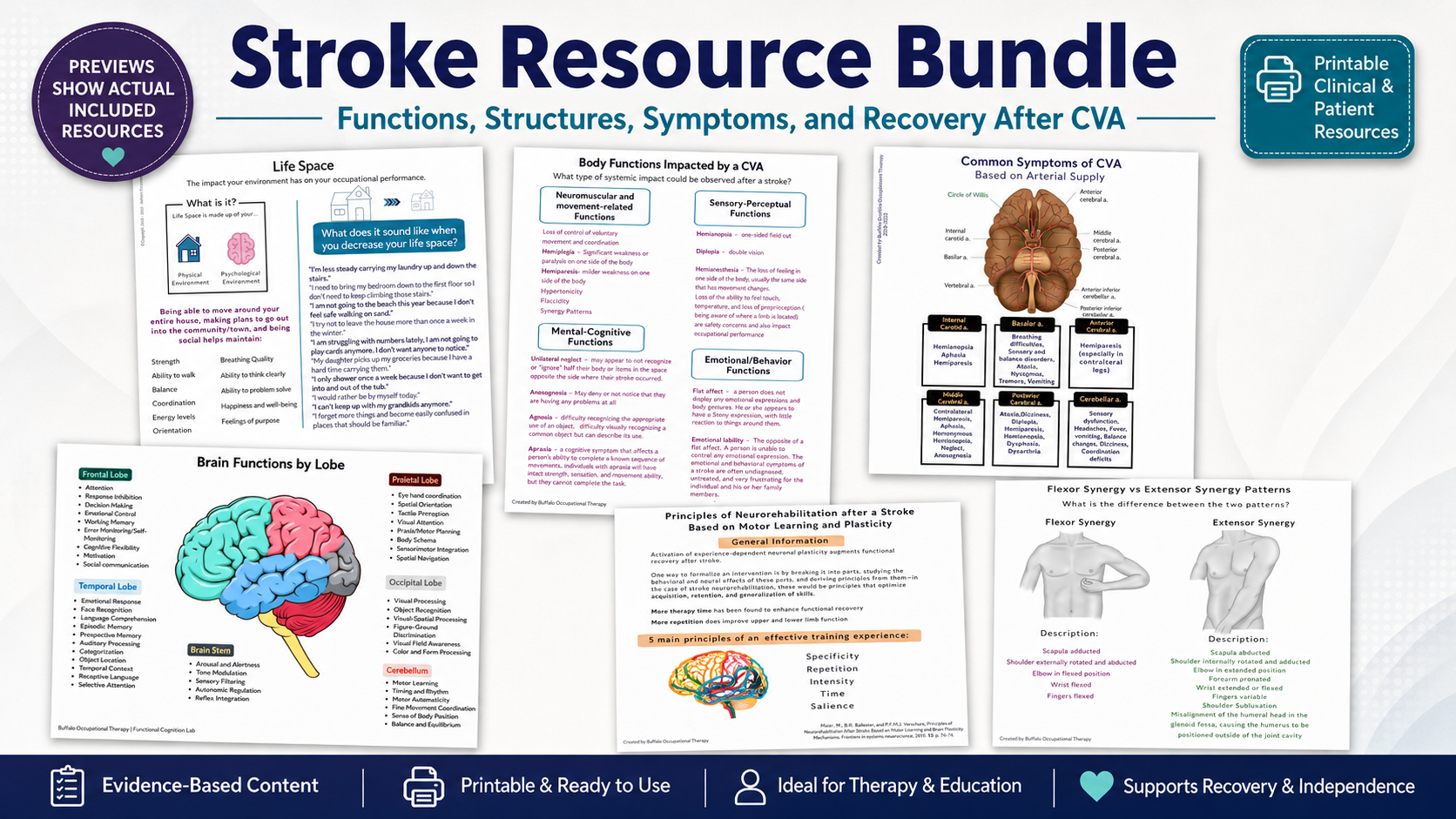
Just want the some of the resources mentioned in this article? Download the Stroke Resource Bundle:
This seems to be a hot topic in the current rehabilitation landscape, and it’s one worth discussing. What does the literature actually say about stretching and spasticity? More importantly, what is it not saying?
What the Evidence Says About Stretching Alone
Helpful blog article: Top 10 Strategies for Managing Spastic Hemiparesis
Member Resources:
- Stretching and Spasticity Clinician Resource ( 2 pages)
- Clinical Application of Stretching for Spasticity (2 pages)
- Patient-facing resource packet on stretching and spasticity (4 pages)
Let's start with the uncomfortable truth. When researchers look at passive stretching as a standalone intervention for reducing spasticity, the evidence is weak. A 2021 meta-analysis found that stretching alone showed no conclusive evidence for reducing spasticity or improving range of motion, with the authors noting that studies had significant heterogeneity in protocols and outcomes.[1] A 2020 systematic review of stretching and splinting interventions found low strength of evidence for manual stretching to address spasticity, and low strength of evidence for stretching devices.[2]
The 2024 best practice guidelines state it plainly: "A stretching intervention alone has not been proven to be effective; non-statistically significant results in favor of the intervention group were observed for the Modified Ashworth Scale."[3] So, for all practitioners feeling ‘on the fence’ about stretching and spasticity because of the evidence being cherry picked…I get it! Passive stretching in isolation, measured against spasticity reduction scales, doesn't pack the punch we might hope for.
But, I hope you will take a moment to breathe and consider the full picture.
What Stretching Actually Does
Spasticity is not a simple problem, and stretching is not a simple solution. Recent evidence describes spasticity as multidimensional, involving three distinct components: abnormal voluntary motor control, involuntary muscle overactivity, and structural changes in passive tissue.[4] This matters because stretching primarily addresses the structural and tissue component. It does not directly change the velocity-dependent hyperreflexia or motor control deficits that define spasticity. Expecting passive stretching to reduce spasticity scores on the Modified Ashworth Scale is like expecting a knee brace to fix quadriceps weakness. It's the wrong tool for that specific job.
What stretching does do well is prevent contractures and maintain range of motion. This is not a small thing. Contractures represent permanent structural changes that cannot be reversed. Once they develop, they limit participation, increase caregiver burden, and worsen long-term functional prognosis. Stretching is the primary intervention for preventing this cascade. The literature supports this: early mobilization and weight-bearing interventions, which include stretching integrated into movement patterns, receive the highest evidence ratings in current clinical practice guidelines.[4]
The Critical Early Window Changes Everything
Here's the game changer: timing matters enormously. The first three months after stroke represent a critical window of heightened neuroplasticity. This is when the nervous system is most capable of reorganization and recovery. Early, aggressive intervention during this period produces better outcomes than late intervention.[4] When stretching is performed during this window and integrated into functional training, the evidence improves substantially.
A 2018 randomized controlled trial found that functional stretching exercises (stretching integrated into purposeful movement and functional tasks) produced significant improvements in spasticity scores, range of motion, and functional walking outcomes compared to control.[5] The key difference is that the stretching was not passive isolation; it was embedded within task-specific movement training. This distinction appears throughout the literature and explains why functional stretching shows promise while purely passive approaches do not.
Stretching Must Be Part of a Comprehensive Approach
The evidence clearly suggests that stretching works better when it works alongside other interventions. A 2020 systematic review examining occupational therapy practice found moderate strength of evidence for stretching when "used in conjunction with interaction with a skilled occupational therapy practitioner" and when combined with other hands-on interventions.[2] Stretching and splinting performed in isolation showed weak evidence. Stretching plus task-specific training, motor re-education, and functional movement showed moderate evidence.[2]
The 2024 best practice guidelines state that passive stretching "could be carried out periodically but must be performed in conjunction with other rehabilitation treatments."[3] The statement is emphatic: stretching in isolation is insufficient. But stretching as part of comprehensive rehabilitation is essential.
How to Use Stretching Effectively
If you're using stretching with your stroke population, current evidence supports these practices:
- Start early. The critical window is the first three months, when neuroplasticity is highest and outcomes are most favorable.[4]
- Integrate stretching into functional movement. Stretching embedded in task-specific training and purposeful activity shows stronger evidence than passive stretching alone.[5]
- Use frequent, short, intense repetitions rather than prolonged static holds. The evidence suggests shorter, more frequent bouts produce better outcomes and carry less risk of pain than extended stretching sessions.[3]
- Combine stretching with active motor control training. Address the neuromotor components of spasticity through task practice while using stretching to maintain tissue length.[4]
- Keep stretching going. The evidence emphasizes that stretching must be ongoing for maximum benefit. Stopping stretching interventions results in return of spasticity and increased risk of contracture development.[2]
- Avoid exceeding 2.5 hours of cumulative daily stretching to minimize pain risk.[3]
What the Literature Is Not Saying
Weak evidence for reducing spasticity scores does not mean weak evidence for clinical benefit. It means stretching is not the right intervention for that specific outcome. Spasticity is one problem among many in stroke recovery. Contracture prevention, range of motion maintenance, and tissue remodeling are equally important problems, and stretching has stronger evidence for addressing those issues.
The literature is not saying to abandon stretching. It is saying that stretching alone, performed passively and in isolation from other rehabilitation, has not demonstrated strong effects on spasticity reduction. Stretching combined with functional training, early intervention, and comprehensive rehabilitation shows much stronger evidence.
My best advice for every OT practitioner is to stay evidence-informed. Be specific about what stretching can and cannot do. And continue doing what you do: use stretching strategically, early, and as part of comprehensive occupational therapy practice aimed at maximizing participation and independence in your clients with post-stroke spasticity.
About the Author
Michelle Eliason, MS, OTR/L is an occupational therapist, rehabilitation researcher, educator, and founder of BOT Portal and Buffalo Occupational Therapy. Her clinical and scholarly work focuses on neurological rehabilitation, functional cognition, cognitive-motor performance, aging, and the translation of rehabilitation science into practical occupational therapy evaluation, intervention, and clinical reasoning.
Learn more about : Michelle C. Eliason, MS, OTR/L
Did you find this information helpful? Please share this article with another occupational therapy practitioner, student, educator, or rehabilitation professional who may benefit from it.
Would you like access to the clinical resources discussed throughout this article? Explore our membership options to find the level of support that works best for you.
Looking for a more formal learning and mentorship experience? Learn more about the Functional Cognition Lab Mentorship Program.
You can also explore our AOTA-approved courses and clinical resource packages for additional education, treatment resources, and practical tools you can use in rehabilitation practice.
Interested in receiving free functional cognition education each week? Subscribe to the Functional Cognition Lab Newsletter.
References
[1] Gomez-Cueresma, L., Lucena-Anton, D., Gonzalez-Medina, G., Martin-Vega, F. J., Galan-Mercant, A., & Luque-Moreno, C. (2021). Effectiveness of stretching in post-stroke spasticity and range of motion: Systematic review and meta-analysis. Journal of Personalized Medicine, 11(10), 1074. https://doi.org/10.3390/jpm11101074
[2] Kerr, L., Jewell, V. D., & Jensen, L. (2020). Stretching and splinting interventions for poststroke spasticity, hand function, and functional tasks: A systematic review. American Journal of Occupational Therapy, 74(5), 7405205050. https://doi.org/10.5014/ajot.2020.029454
[3] Suputitada, A., Chatromyen, S., Chen, C. P. C., & Simpson, D. M. (2024). Best practice guidelines for the management of patients with post-stroke spasticity: A modified scoping review. Toxins, 13(2), 98. https://doi.org/10.3390/toxins16020098
[4] Bandela, S., McPherson, L., Harvey, R. L., Awosika, O., Agarwal, D., Lis, Y. C., Raghavan, M., Goldberg, P., & Delbane, H. (2026). Early recognition and intervention for poststroke spasticity: A scientific statement from the American Heart Association. Stroke, 57(4), e146-e159. https://doi.org/10.1161/STR.0000000000000515
[5] Ghasemi, E., Khademi-Kalantari, K., Khalkhali-Zavieh, M., Rezasoltani, A., Akbarzadeh Baghban, M., & Ghasemi, M. (2018). The effect of functional stretching exercises on functional outcomes in spastic stroke patients: A randomized controlled clinical trial. Journal of Bodywork and Movement Therapies, 22(4), 1004-1012. https://doi.org/10.1016/j.jbmt.2018.01.009
[6] Monaghan, K., Horgan, F., Blake, C., Cornall, C., Hickey, P. P. M., Lyons, B. E., & Langhorne, P. (2017). Physical treatment interventions for managing spasticity after stroke. Cochrane Database of Systematic Reviews, 2, CD009188. https://doi.org/10.1002/14651858.CD009188.pub2
[7] Salazar, A. P., Pinto, C., & Borba, L. A. (2017). Manual therapy and rehabilitation for poststroke spasticity. In Neurological rehabilitation (pp. 245-258). Springer, Cham.
[8] Zhang, L., Xiao, Y., Ge, H., Zhang, H., & He, X. (2022). Extracorporeal shock wave therapy for post-stroke spasticity: A systematic review and meta-analysis. Archives of Physical Medicine and Rehabilitation, 103(7), 1386-1395.
[9] Francisco, G. E., Boake, C., & Ivanhoe, C. B. (1997). Botulinum toxin management of limb spasticity. NeuroRehabilitation, 9(3), 185-194. https://doi.org/10.3233/NRE-1997-9304