
Simple Ways to Add Dual Tasking to Occupational Therapy Treatment
Jan 21, 2025
Simple Ways to Add Dual Tasking to Occupational Therapy Treatment
In rehabilitation, treatment should prepare patients for the actual demands of everyday life. Daily occupations rarely happen one task at a time. People walk while talking, prepare meals while listening for a timer, carry groceries while navigating stairs, and manage medications while remembering instructions. Dual-task training allows occupational therapy practitioners to bring these combined demands into treatment in a structured and measurable way.
A true dual task involves performing two separate tasks at the same time, with each task having its own goal. This may include combining a motor task with a cognitive task or performing two independent motor tasks simultaneously. Some activities, such as carrying laundry while walking, may be better described as complex functional tasks because both actions work toward one shared goal. Both types of activities are useful, but understanding the difference helps the therapist identify exactly what is being challenged.
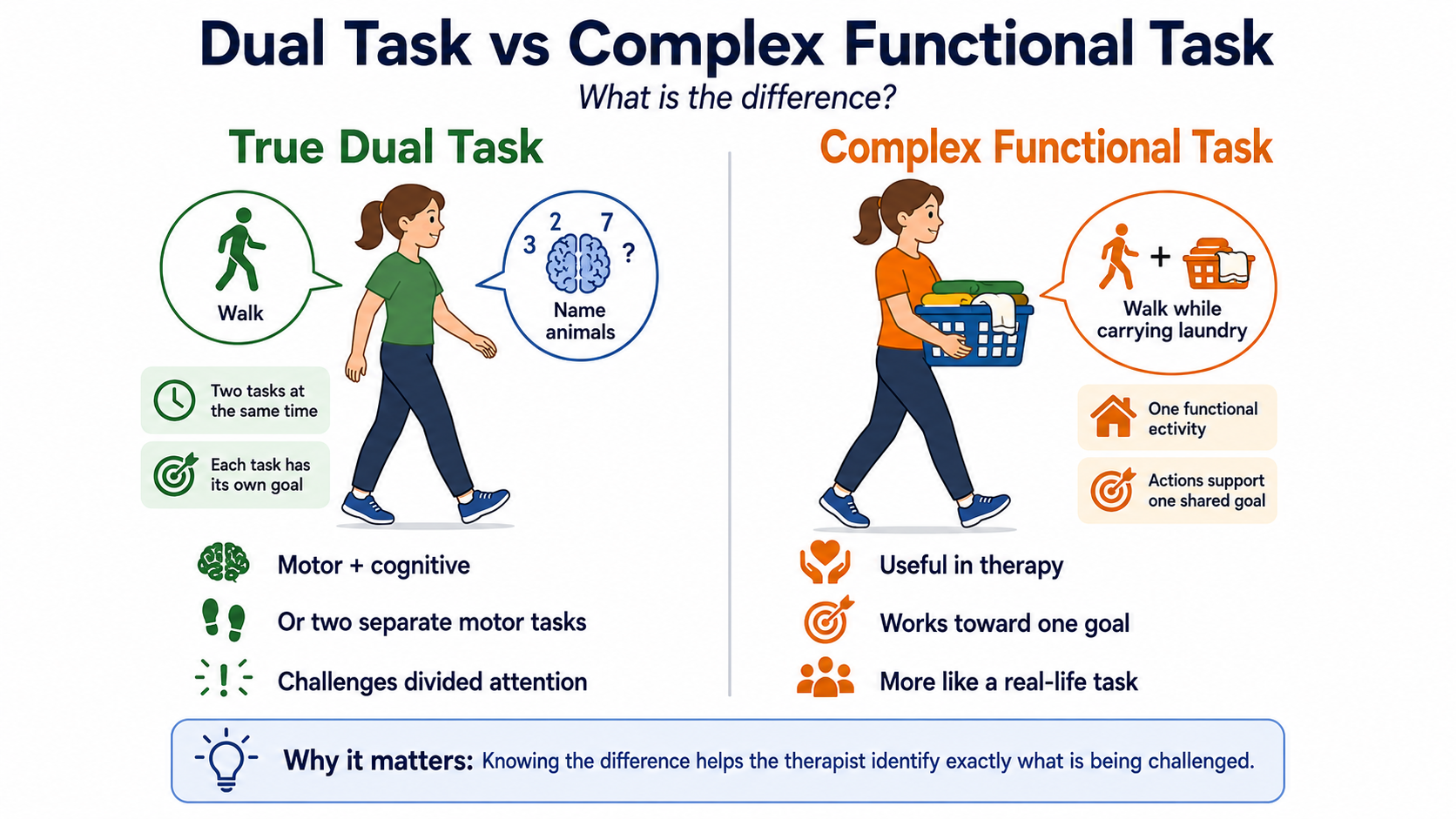
Why Dual Tasking Matters in Rehabilitation
A patient may walk safely in a quiet hallway but become unstable when asked a question. Another patient may accurately organize medication while seated but begin making errors when required to stand, retrieve supplies, listen for a timer, or respond to an interruption. Someone may complete each step of meal preparation separately but lose track of the sequence when several demands occur together. These situations reveal problems that may not appear during isolated testing.
Dual-task training allows therapists to observe how movement, attention, memory, executive function, sensory processing, and environmental demands interact. It also gives patients an opportunity to practice these combined demands before facing them independently at home or in the community. The purpose is not to make every activity more difficult. The purpose is to identify where occupational performance breaks down and create an appropriate opportunity to improve it.
Simple Ways to Embed Dual Tasking Into Treatment
Adding dual tasking does not require complicated equipment or an entirely new intervention plan. A therapist can begin with an activity already being used and add one carefully selected demand. The secondary task should relate to the patient’s goals, provide useful clinical information, or reflect the demands of an actual occupation. The examples below can be adapted across diagnoses, settings, and levels of function.
Laminated Number and Alphabet Targets
Member Resource: Numbers and Letters - Circle Cutouts to Laminate
Place laminated letters, numbers, colors, words, or pictures on a wall, table, or floor. The patient can locate or respond to the targets while reaching, shifting weight, stepping, standing, walking, or completing upper-extremity movement. The therapist may ask the patient to identify letters in order, locate even numbers, alternate between numbers and letters, or remember a short sequence of targets.
This simple setup can address visual scanning, processing speed, attention, working memory, balance, coordination, and motor planning. The task can be modified by changing the distance between targets, response speed, movement pattern, or rule being followed. It can also be made more functional by using words or images related to the patient’s home, work, medication routine, or daily responsibilities.
Load and Carry With Conversation
Ask the patient to transport a household item while participating in a conversation or responding to questions. The patient might carry laundry, groceries, a lightweight box, kitchen items, or simulated work supplies. The cognitive component may involve recalling the destination, explaining the next step, answering questions, or identifying where each object belongs.
The added conversation should not be random unless the goal is specifically to test distraction. Ideally, the task should reflect situations the patient is likely to encounter in daily life. For example, a parent may need to move safely while listening to a child, while an employee may need to carry materials and respond to a coworker at the same time.
Digit Span Reversals During Movement
Provide the patient with a short number sequence and ask them to repeat it backward while completing a movement task. This can be paired with seated upper-extremity exercise, reaching, stepping, weight shifting, repetitive movement, or selected spasticity-management activities. Repeating digits backward challenges working memory because the patient must hold the information, mentally reorganize it, and produce a new response.
Begin with short sequences and increase the length only when the patient can maintain both movement quality and cognitive accuracy. If the patient stops moving, loses balance, forgets the sequence, or begins using significant compensation, the combined demand may be too high. That breakdown is still useful clinical information because it shows how much cognitive demand the patient can currently manage during movement.
Balance With Categorization
While the patient completes a safe standing or balance activity, ask them to name items within a category. Categories may include animals, foods, cities, clothing, tools, occupations, or objects found in a specific room. The task can be progressed by adding rules, such as naming foods that begin with a particular letter, alternating between two categories, or avoiding repeated responses.
The motor activity should be safe and reasonably stable before the cognitive component is added. A patient may begin by standing on a firm surface and later progress to reaching, stepping, turning, or standing on a more challenging surface when appropriate. The goal is to observe how the added language and executive-function demands affect posture, balance, response time, and movement quality.
Memory Recall With Three-Step Commands
Provide the patient with a short paragraph, set of directions, or three-step sequence. The patient then completes a functional motor activity while holding the information in mind. Activities may include folding towels, organizing supplies, retrieving objects, stacking household items, preparing a workspace, or completing part of a cleaning routine.
After the motor activity, ask the patient to recall the information, complete the remembered sequence, or explain what should happen next. This can address focused attention, working memory, delayed recall, sequencing, and task completion. The activity becomes more difficult when the delay is increased, environmental distractions are added, or the patient must resume the original task after an interruption.
Medication Management Simulation While Standing
Medication-management simulations can be paired with standing or mobility demands when those demands reflect the patient’s actual routine. Beads, buttons, colored objects, empty containers, or other simulated materials can represent medications. The patient may sort items into a weekly organizer, match colors to a written schedule, retrieve containers from different locations, respond to a timer, or identify a simulated medication error.
Medication accuracy must remain the priority. A patient with significant balance impairment, cognitive fatigue, or poor error awareness should begin seated. Standing, reaching, and mobility demands can be added later when they reflect how the patient manages medication at home and can be completed without sacrificing safety or accuracy.
Member Resource:
Medication Management Bead Simulation Activity
Medication Management Worksheets - Problem Solving Activity
Dual Tasking During ADL and IADL Training
Dual-task training becomes most meaningful when it is integrated into actual occupations. A patient may practice dressing while remembering which item comes next, prepare a snack while monitoring a timer, or fold laundry while sorting clothing by person and room. Someone preparing to return to community mobility may walk through a simulated store while remembering a short shopping list and scanning for specific products.
The therapist should identify which physical and cognitive demands naturally occur together during the occupation. Randomly adding backward counting to every activity does not automatically make treatment functional or skilled. The secondary task should either reproduce a real-life demand, target an identified area of impairment, or help the therapist understand why performance deteriorates under increased complexity.
Examples of occupation-based dual-task activities include:
- Walking through a simulated store while recalling shopping items
- Preparing food while monitoring time and remembering the next step
- Folding laundry while organizing items by room or family member
- Dressing while responding to an interruption and returning to the correct step
- Navigating the clinic while remembering a destination or set of directions
- Organizing a work area while following changing instructions
Consider the Patient’s Current Capacity
Before combining tasks, determine whether the patient can complete each task separately. Can the patient safely perform the movement? Can they complete the cognitive activity with reasonable accuracy? Once the tasks are combined, observe what changes rather than focusing only on whether the patient finishes.
Possible signs of dual-task interference include:
- Slower movement or responses
- Increased cognitive errors
- Loss of balance
- Reduced movement quality
- Missed instructions
- Increased compensatory movement
- Confusion or frustration
- Abandonment of one task
- Increased fatigue
- Headache, dizziness, or other symptom escalation
These responses are not automatically failures. They show where the patient’s current capacity begins to break down. The therapist can then reduce the cognitive demand, simplify the movement, provide a strategy, change the environment, or alter which task the patient should prioritize.
Member Resources:
A Short Clinical Example
Consider a patient with stage 4 kidney disease and type 2 diabetes who receives dialysis three days each week. The patient reports severe fatigue, muscle weakness, cognitive fog, and difficulty managing transfers and medication routines. The patient’s capacity may also vary significantly depending on the timing of dialysis, sleep, nutrition, and general medical status.
Treatment might begin with seated upper-extremity movement while the patient recalls important health-management information, such as appointment times, fluid restrictions, transportation plans, or symptoms that should be reported. Medication simulation could initially be completed while seated using colored beads or other objects, then progress to standing at a counter, retrieving simulated containers, organizing a weekly schedule, and responding to a timer. Once transfers are safe and familiar, a controlled secondary demand might be added, such as identifying the next safety step or resuming the sequence after a brief interruption.
The goal is not to make the session cognitively exhausting. The goal is to understand how fatigue, movement, memory, and attention interact during the patient’s actual routines. Treatment intensity and complexity should be adjusted according to the patient’s dialysis schedule and response on that particular day.
Main Takeaways
Dual-task training is not about adding a random question to every exercise. It is about identifying the cognitive and physical demands that naturally occur together in the patient’s daily life and practicing those demands at an appropriate level. Simple materials such as laminated targets, beads, household objects, written directions, simulated medications, and everyday conversation can create meaningful and measurable treatment activities.
Begin with tasks the patient can perform safely. Add one demand at a time and observe what changes. The strongest dual-task interventions are not necessarily the hardest ones. They are the activities that help the therapist identify performance breakdown, provide the right strategy, and build toward the occupations the patient needs or wants to complete independently.
Member Resource: Attention Resource and How Alternating Attention Feels Under Cognitive Load
Helpful Resource Page: Trouble Multi-Tasking
Continue Learning With Us
Did you find this information helpful? Please share this article with another occupational therapy practitioner, student, educator, or rehabilitation professional who may benefit from it.
Would you like access to the clinical resources discussed throughout this article? Explore our membership options to find the level of support that works best for you.
Looking for a more formal learning and mentorship experience? Learn more about the Functional Cognition Lab Mentorship Program.
You can also explore our AOTA-approved courses and clinical resource packages for additional education, treatment resources, and practical tools you can use in rehabilitation practice.
Interested in receiving free functional cognition education each week? Subscribe to the Functional Cognition Lab Newsletter.
Helpful Dual Tasking References
- Norman, D. A. (1975). On data-limited and resource-limited processes. Cognitive Psychology, 7(1), 44–64.
- McIsaac, T. L., Lamberg, E. M., & Muratori, L. M. (2015). Building a framework for a dual task taxonomy. BioMed Research International, 2015, Article 591475. https://doi.org/10.1155/2015/591475
- Pashler, H. (1994). Dual-task interference in simple tasks: Data and theory. Psychological Bulletin, 116(2), 220–244.
- Bruya, B., & Tang, Y.-Y. (2018). Is attention really effort? Revisiting Daniel Kahneman's influential 1973 book Attention and Effort. Frontiers in Psychology, 9, Article 1133. https://doi.org/10.3389/fpsyg.2018.01133
- Wickens, C. D. (2008). Multiple resources and mental workload. Human Factors, 50(3), 449–455. https://doi.org/10.1518/001872008X288394
- Brüning, J., Mückstein, M., & Manzey, D. (2020). Multitasking strategies make the difference: Separating processing-code resources boosts multitasking efficiency when individuals prefer to interleave tasks in free concurrent dual tasking. Journal of Experimental Psychology: Human Perception and Performance, 46(12), 1411–1433. https://doi.org/10.1037/xhp0000865
- Friedman, N. P., Miyake, A., Corley, R. P., Young, S. E., DeFries, J. C., & Hewitt, J. K. (2006). Not all executive functions are related to intelligence. Psychological Science, 17(2), 172-179.
- Ruthruff, E., Pashler, H. E., & Klaassen, A. (2001). Processing bottlenecks in dual-task performance: Structural limitation or strategic postponement? Psychonomic Bulletin & Review, 8(1), 73-80.
- Toba, M. N., Seidel Malkinson, T., Howells, H., Mackie, M.-A., & Spagna, A. (2024). Same, same but different? A multi-method review of the processes underlying executive control. Neuropsychology Review, 34, 418–454. https://doi.org/10.1007/s11065-023-09577-4
- de Barros, G. M., Melo, F., Domingos, J., Oliveira, R., Silva, L., Fernandes, J. B., & Godinho, C. (2021). The effects of different types of dual tasking on balance in healthy older adults. Journal of Personalized Medicine, 11(9), Article 933. https://doi.org/10.3390/jpm11090933
- Miyake, A., & Friedman, N. P. (2012). The nature and organization of individual differences in executive functions: Four general conclusions. Current Directions in Psychological Science, 21(1), 8–14. https://doi.org/10.1177/0963721411429458
- Friedman, N. P., & Miyake, A. (2004). The relations among inhibition and interference control functions: A latent-variable analysis. Journal of Experimental Psychology: General, 133(1), 101–135. https://doi.org/10.1037/0096-3445.133.1.101
- Ehsani, H., Mohler, M. J., O'Connor, K., Zamrini, E., Tirambulo, C., & Toosizadeh, N. (2019). The association between cognition and dual-tasking among older adults: The effect of motor function type and cognition task difficulty. Clinical Interventions in Aging, 14, 659–669.
- Norman, D. A. (1968). Toward a theory of memory and attention. Psychological Review, 75(6), 522–536.
- Strobach, T., Wendt, M., & Janczyk, M. (2018). Editorial: Multitasking: Executive functioning in dual-task and task switching situations. Frontiers in Psychology, 9, Article 108. https://doi.org/10.3389/fpsyg.2018.00108