
Functional Cognition Pattern
Problem: Can't Multi-Task
They can do one thing… but everything falls apart when there’s more than one demand.
What this really is...
A breakdown in the brain’s ability to manage multiple demands at once.
→ Dual Task Interference
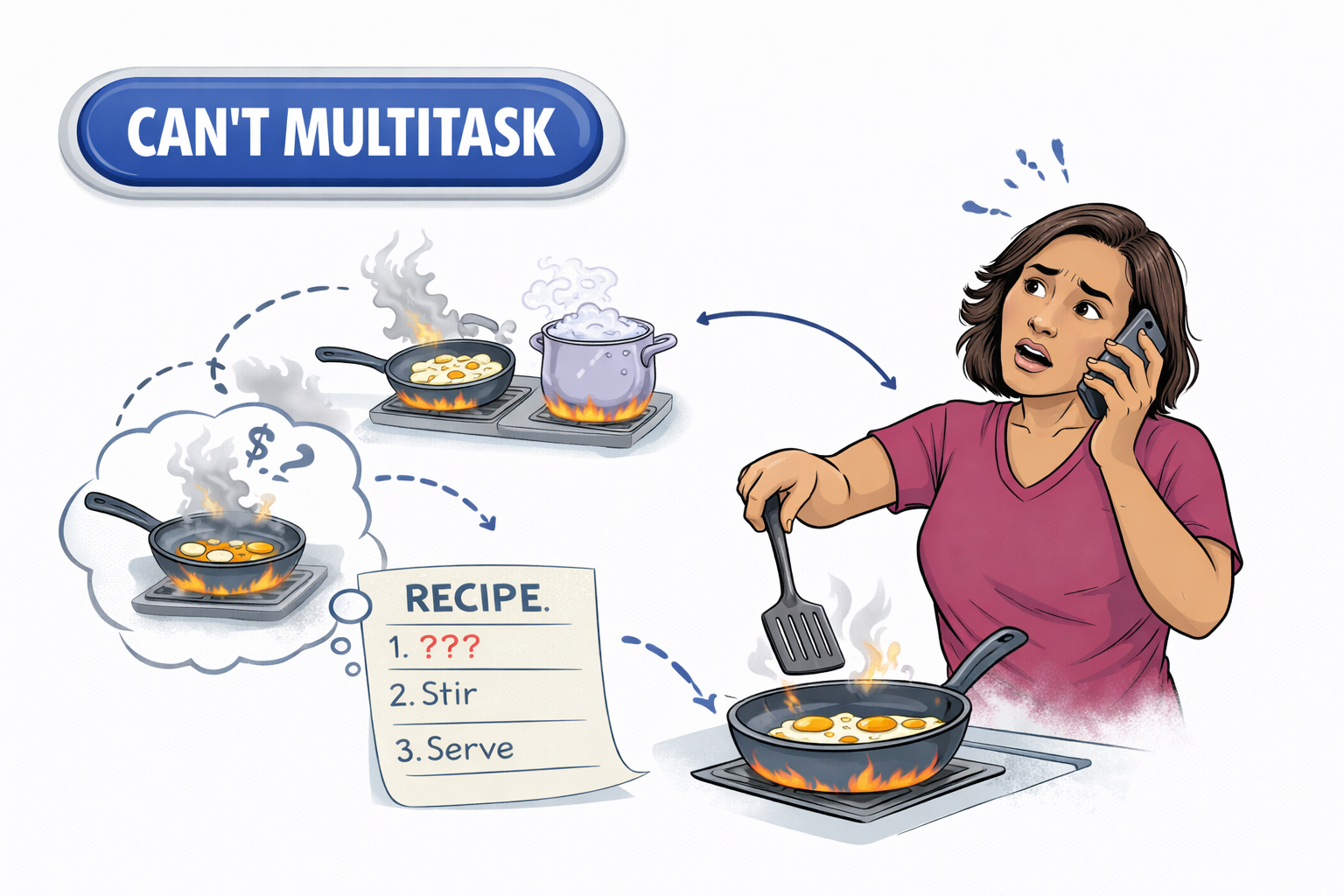
What You Are Seeing
- They can perform tasks individually
- But when tasks combine, they:
- slow down
- stop one task completely
- make errors
- lose track of what they’re doing
Everything changes when there’s more than one demand.
What Is Actually Happening
The brain has limited capacity.
When two tasks compete:
- attention must be divided
- processing must be shared
- priorities must be selected in real time
- walking + talking
- cooking + remembering steps
- carrying items + navigating space
👉 The system becomes overloaded.
Performance breaks down—not because of strength or skill,
but because of cognitive demand.
🔎 Real Clinical Example
Patient walks independently with normal strength and balance.
But when asked to:
- walk while talking
- carry something while moving
- follow directions while performing a task
They:
- slow down significantly
- stop walking to think
- lose track of instructions
- make safety errors
→ Single-task performance is intact
→ Dual-task performance reveals the breakdown
⛓️💥 Skills Breakdown
- Walks fine → stops when talking
- Can cook → forgets steps when distracted
- Can follow directions → loses track during action
- Moves safely → becomes unsafe under cognitive load
Why This Gets Missed
- Strength and balance look normal
- Tasks are often tested in isolation
- The problem only appears under combined demand
We assume:
“If they can do each task, they can do them together.”
But that’s not how the brain works.
What To Do About It
- Start with single-task mastery
- Introduce a second task gradually
- Control complexity (one variable at a time)
- Train in real-world situations
The goal is not just doing tasks—
it’s doing them together safely and effectively.
These are starting points—not full intervention.
Treating this effectively requires structured progression, task grading, and real-world application.
This is where most clinicians get stuck.
How This Fits Into Clinical Practice
Standardized tests may not fully capture dual-task performance.
- Tests measure isolated skills
- Functional tasks reveal performance under combined demand
Dual task performance can be:
- observed
- measured (time, errors, safety)
- tracked across conditions
This is critical for safety, mobility, and independence.
If they can’t do it together, they can’t do it safely.
Want to Go Deeper
This is one of the most clinically important—and most overlooked—problems in practice.
Learn how to:
- assess dual task performance
- structure progression
- apply it to real-world tasks