5 Must-Dos to Personalize Occupational Therapy Treatment
Jun 07, 2024

5 Must-Dos to Personalize Occupational Therapy Treatment:
The First Step Toward Precision Rehabilitation
by Michelle C. Eliason, MS, OTR/L
Dear Members, check out your Membership Library where you have access to the Resource Bundles with your membership. I would also like to encourage you to leave a Marco Polo message for asynchronous discussion about how this content may currently relate to your clinical practice or education!
Membership Resources: This article and its companion audio are free to read and listen to. Links throughout the article connect members of the Functional Cognition Lab to related printables, treatment tools, courses, and clinical resources that align with the topic being discussed. Membership also includes access to the full resource library and direct clinical support. Find out more about membership on the Membership Options Page
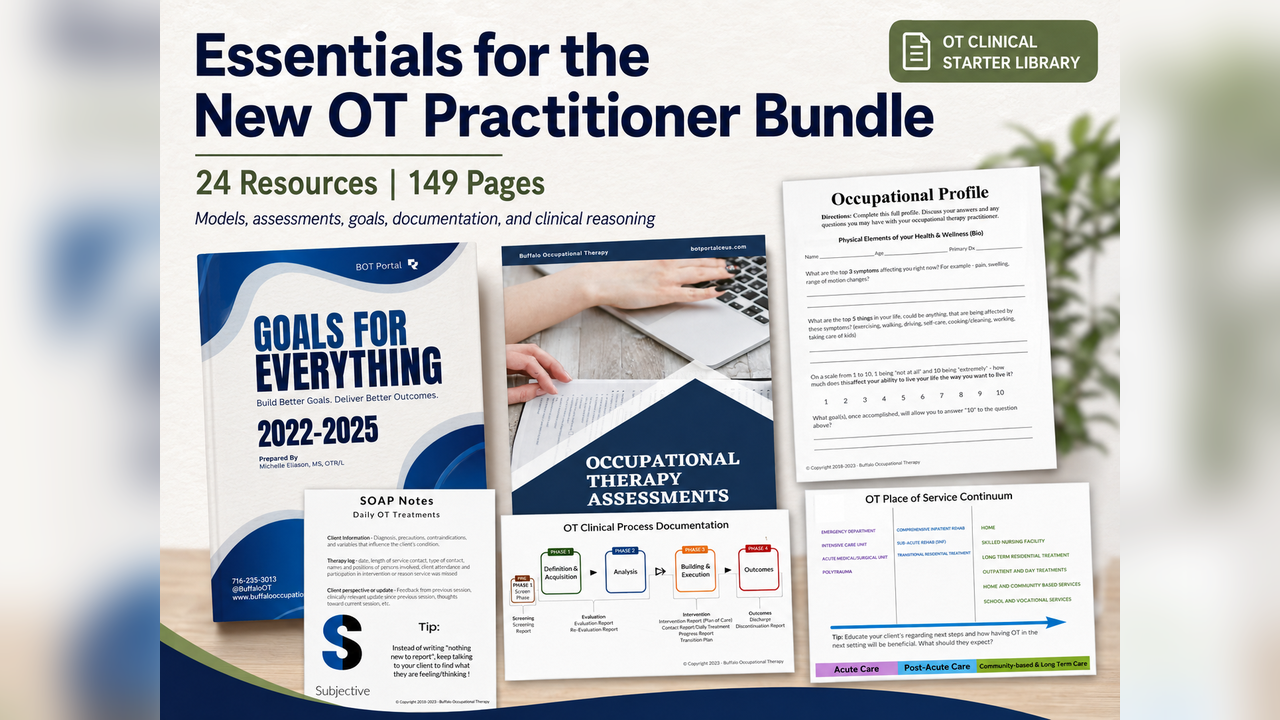
Just want the resources mentioned in this article?: Download the Essential Resources for New OT Practitioner Bundle
Precision rehabilitation is moving rehabilitation away from standardized, diagnosis-only treatment and toward intervention that is increasingly matched to the individual patient—their impairments, preserved abilities, environment, response to treatment, and functional goals. Occupational therapy is already well positioned for this shift because individualized evaluation, activity analysis, and adaptation are fundamental to how we practice.
Personalization, however, requires more than choosing an activity a patient enjoys. It requires identifying what is different about this patient, determining which variables are actually influencing occupational performance, and allowing those findings to shape treatment.
Here are five things occupational therapy practitioners can begin doing now.
1. Build an Individual Patient Profile Before You Build the Treatment Plan
Two people can have the same diagnosis and require very different rehabilitation.
A stroke diagnosis does not tell you whether the primary limitation is weakness, apraxia, visual-perceptual dysfunction, impaired attention, sensory loss, fatigue, emotional dysregulation, or some combination of these factors. Likewise, two people with Parkinson's disease may differ substantially in motor symptoms, cognition, endurance, environmental demands, occupational roles, and treatment priorities.
The first step toward personalized rehabilitation is therefore to understand the individual pattern of impairment and preserved function.
Your evaluation should help answer questions such as:
- What functions are impaired?
- What functions remain relatively preserved?
- Which limitations are actually interfering with occupational performance?
- What environmental or contextual factors amplify the problem?
- What activities matter most to this individual?
- Which abilities can be leveraged during rehabilitation?
This is where the occupational profile and clinical profile become especially important. Diagnosis gives you one part of the story. The patient's daily life tells you what the diagnosis actually means.
Put It Into Practice
Before selecting an intervention, write one sentence that summarizes the patient's unique rehabilitation profile.
For example:
Patient demonstrates reduced working memory and divided attention with relatively preserved procedural learning, resulting in difficulty managing multistep meal preparation and medication routines.
Helpful Resource: Evaluation and Diagnoses Page
Member Resources:
- Evaluation Occupational Profile Template
- Occupational Therapy Functional Continuum
- Clinical Profile vs Occupational Profile
2. Identify the Specific Cognitive and Motor Systems Affecting Performance
Personalization becomes much easier when you stop treating cognition or movement as single categories.
If someone is struggling cognitively, determine what aspect of cognition is contributing to the problem. Is it sustained attention? Working memory? Initiation? Cognitive flexibility? Processing speed? Error awareness? Visual scanning?
The same principle applies to motor performance. Difficulty using an upper extremity may reflect weakness, reduced range of motion, altered tone, impaired motor planning, poor proximal stability, decreased sensation, pain, fatigue, or impaired coordination.
Detailed profiling allows the intervention to target the system that actually needs rehabilitation.
For example, a patient with memory difficulties following neurological injury may benefit from recall activities, but only if impaired memory encoding or retrieval is truly contributing to occupational performance. Another patient who appears forgetful may actually have difficulty sustaining attention long enough to encode information in the first place.
Similarly, repeatedly practicing buttoning may not solve a dressing problem if the primary barrier is inadequate shoulder range of motion or impaired motor planning.
Put It Into Practice
When an activity fails, ask:
What component of this task is breaking down?
Then observe the task through several lenses:
- Motor
- Cognitive
- Sensory
- Visual-perceptual
- Emotional
- Environmental
- Task-specific
That single question can turn a generic treatment session into a much more targeted intervention.
Member Resources:
Helpful Resource Pages:
- Functional Cognition Scenarios for Clinical Practice
- Dual Tasking in Occupational Therapy Blog Article
- AOTA-Approved Course in Dual Tasking
- Functional Cognition Newsletters
3. Match the Intervention to the Functional Problem
Task-specific training is valuable, but simply performing an occupation does not automatically make an intervention individualized.
The task must correspond to the patient's actual performance problem.
If someone needs to improve hand use for medication management, treatment might include in-hand manipulation, container management, visual scanning, sequencing, or divided attention depending on what the evaluation reveals.
If someone has difficulty preparing a meal, the treatment may need to address standing tolerance, upper-extremity mobility, working memory, organization, visual attention, or safe mobility within the kitchen.
Sometimes the complete occupation is the appropriate intervention. Other times, the patient does not yet have the capacity to perform the entire activity safely or effectively.
Occupational therapy practitioners need to know when to put the task together and when to take it apart.
Put It Into Practice
Consider this progression:
Identify the occupation → analyze the performance breakdown → isolate the limiting component when necessary → remediate or compensate → reintegrate the skill into the functional task.
For example:
A patient cannot independently prepare coffee. Instead of simply practicing coffee preparation repeatedly, determine why. Perhaps the patient cannot remember the sequence. You might first address sequencing using progressively structured tasks and external strategies, then return to actual coffee preparation. Perhaps the patient cannot manipulate the container because of reduced grasp strength. That may require therapeutic exercise before the complete occupation becomes an effective training activity. The occupation remains the destination, but the route to it should be individualized.
4. Account for Psychological, Social, and Environmental Variables
People do not perform occupations in a laboratory where they can control for every possible variable that could confound the root of the dysfunction they are experiencing.
Motivation, anxiety, depression, confidence, caregiver support, environmental accessibility, fatigue, social roles, financial resources, and personal priorities can all influence whether rehabilitation strategies succeed outside the clinic. These variables are not peripheral to occupational therapy. They are part of the performance problem.
A perfectly designed home exercise program is not personalized if the patient does not understand it, cannot fit it into their routine, does not believe it will help, or cannot physically access the environment required to complete it. Likewise, a patient may technically possess the motor capacity to participate in the community but stop leaving home because of fear of falling, cognitive overload, embarrassment, or fatigue.
Put It Into Practice
Ask questions that extend beyond impairment:
- Where does this problem occur?
- Who is usually present?
- What makes the activity easier?
- What makes it harder?
- What has the patient stopped doing?
- What is the patient avoiding?
- What would make the patient willing to attempt it again?
- What environmental change could immediately improve performance?
This is where occupational therapy's consideration of the person, environment, occupation, and performance becomes especially powerful.
Member Resource: Environmental Factors to Consider during Evaluation
5. Re-Evaluate Frequently and Let the Patient's Response Change the Plan
Precision rehabilitation cannot be completely determined during the initial evaluation.
The patient's response to treatment is itself useful clinical information.
A personalized rehabilitation plan should therefore be iterative. Intervention is selected, performance is observed, outcomes are measured, and the treatment plan changes according to what happens next.
- If a patient improves quickly with one type of cueing, that matters.
- If increasing task complexity causes performance to collapse, that matters.
- If strength improves but occupational performance does not, that matters.
- If a compensatory strategy produces immediate functional improvement while remediation does not, that matters too.
Personalization requires practitioners to continually ask whether the intervention is producing the result they expected.
Put It Into Practice
Build one or more measurable variables into your treatment sessions.
You might track:
- Completion time
- Number of errors
- Number or type of cues required
- Assistance level
- Repetitions completed
- Accuracy
- Distance
- Resistance
- Dual-task performance
- Number of dropped objects
- Patient-reported difficulty
- Functional independence
- Carryover between sessions
Once you know which measure you will be using to track progress, use those findings to decide whether to continue, progress, regress, modify, or replace the intervention. Developing structure, implementing it, and maintaining this consistency is is much more informative than simply documenting that the patient “tolerated treatment well.”
Personalization Is the Beginning of Precision Rehabilitation
Precision rehabilitation does not mean that every occupational therapy practitioner needs advanced imaging, artificial intelligence, or sophisticated biomarkers before treatment can become more individualized.
The shift begins with better clinical reasoning.
Understand the patient's individual profile. Identify the systems contributing to occupational dysfunction. Match treatment to the actual performance problem. Consider the psychological, social, and environmental context. Measure the patient's response and allow that response to change what you do next.
Occupational therapy has always emphasized individualized, occupation-centered care. Precision rehabilitation pushes us to go one step further: to become increasingly specific about which intervention, for which patient, targeting which mechanism, at which point in recovery, for which functional outcome.
About the Author
Michelle Eliason, MS, OTR/L is an occupational therapist, rehabilitation researcher, educator, and founder of BOT Portal and Buffalo Occupational Therapy. Her clinical and scholarly work focuses on neurological rehabilitation, functional cognition, cognitive-motor performance, aging, and the translation of rehabilitation science into practical occupational therapy evaluation, intervention, and clinical reasoning.
Learn more about : Michelle C. Eliason, MS, OTR/L
Continue Learning With Us
Did you find this information helpful? Please share this article with another occupational therapy practitioner, student, educator, or rehabilitation professional who may benefit from it.
Would you like access to the clinical resources discussed throughout this article? Explore our membership options to find the level of support that works best for you.
Looking for a more formal learning and mentorship experience? Learn more about the Functional Cognition Lab Mentorship Program.
You can also explore our AOTA-approved courses and clinical resource packages for additional education, treatment resources, and practical tools you can use in rehabilitation practice.
Interested in receiving free functional cognition education each week? Subscribe to the Functional Cognition Lab Newsletter.