
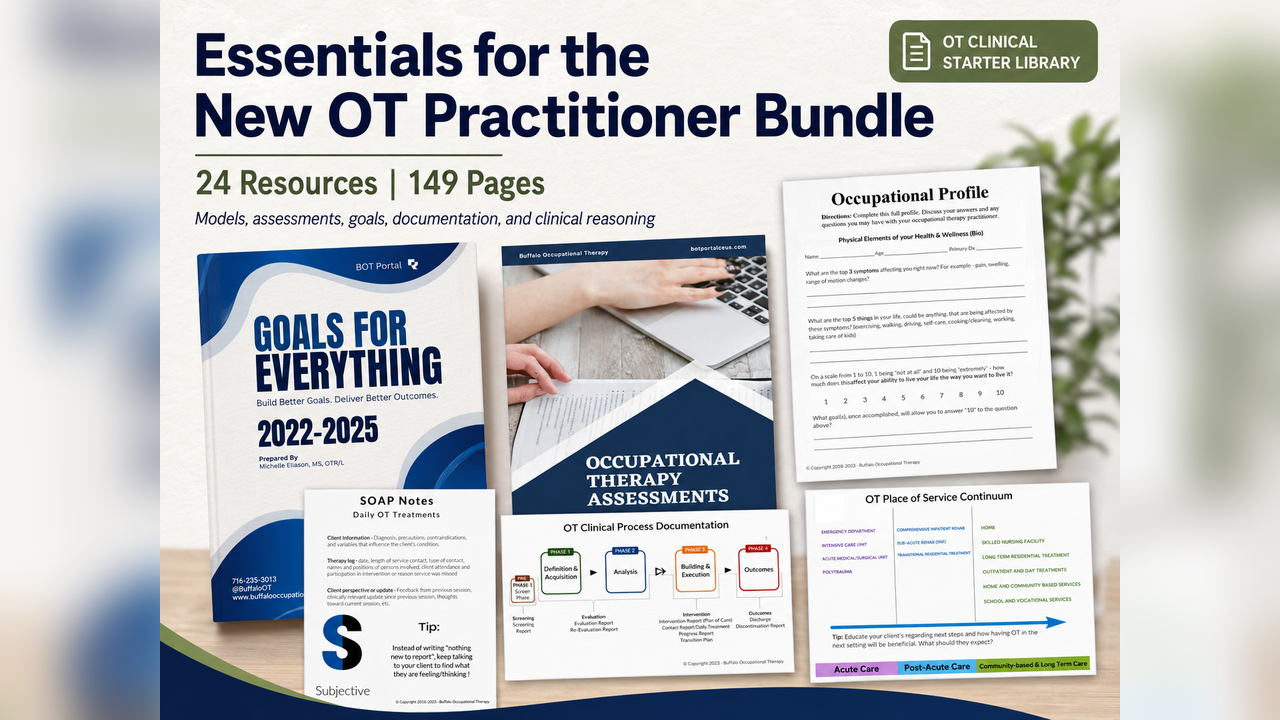
Essentials for the New OT Practitioner Bundle
Product Description
24 Resource: 149 pages
The Essentials for the New OT Practitioner Bundle is a comprehensive clinical starter library designed to help occupational therapy practitioners connect foundational OT knowledge with real-world evaluation, treatment planning, documentation, and clinical reasoning.
This bundle brings together resources on occupational therapy identity, models of practice, activity analysis, occupational profiling, assessment selection, goal writing, treatment planning, documentation, interprofessional practice, and core rehabilitation concepts. Rather than focusing on one diagnosis or treatment technique, the collection is designed to help new practitioners understand how occupational therapy practice fits together from evaluation through discharge.
OT Foundations, Identity & Models of Practice
These resources help practitioners understand the profession itself, the theoretical foundations behind OT, and the models used to interpret occupational performance.
- Occupation Under Pressure: A Sociopolitical History of Disability, Power, and the Occupational Therapy Profession
A 45-page resource tracing the development of occupational therapy alongside disability rights, rehabilitation medicine, healthcare policy, professional identity, and major sociopolitical movements. - Canadian Model of Occupational Performance and Engagement (CMOP-E)
A visual reference illustrating how person, occupation, and environment interact, including cognitive, affective, physical, spiritual, social, cultural, institutional, and environmental factors. - Model of Human Occupation (MOHO)
A visual introduction to volition, habituation, performance capacity, participation, occupational identity, occupational competence, adaptation, and environment. - Person–Environment–Occupation (PEO) Model
A visual depiction of the relationship among intrinsic person factors, environmental influences, occupation, and occupational performance. - Person–Environment–Occupation–Performance (PEOP) Model
A clinical reference connecting person factors, environment, occupation, performance, and participation. - Biopsychosocial Practitioners: What Does OT Address?
A visual explanation of how occupational therapy considers biological, psychological, social, and environmental factors when evaluating and treating occupational performance. - Understanding Supporting Structure of OT Practice
A visual flowchart connecting diagnosis and chart review with theory, models of practice, frames of reference, assessment, goals, evidence-based intervention, reevaluation, and discharge.
Evaluation, Occupational Profiling & Clinical Reasoning
These resources support the process of figuring out what is actually limiting occupational performance and how to organize an OT evaluation.
- Occupational Therapy Assessments Master List
A 22-page reference organizing assessments by clinical area and diagnosis, including vision, cognition, executive function, balance, tone, movement disorders, upper and lower extremity function, pain, psychosocial performance, and more. - Clinical Profile & Occupational Profile
A three-page reference distinguishing clinical and medical information from occupational history, roles, routines, values, environmental factors, support systems, and collaborative goal setting. - Occupational Profile Worksheet
A five-page patient-facing profile examining physical health, social participation, life space, home accessibility, adaptive equipment, and client-defined goals. - Activity Analysis: Occupational Therapy Clinical Process
A visual guide connecting occupations, body functions, body structures, performance skills, activities, values, beliefs, spirituality, context, and performance patterns. - Top-Down vs. Bottom-Up Occupational Therapy
A visual clinical reasoning tool showing how practitioners may begin with occupation and client perspective or with diagnosis, body structures, and body functions while ultimately integrating both perspectives. - Levels of Assistance and Quality Indicators for Occupational Performance
A four-page reference covering independence through total assistance, along with quality indicators such as safety, efficiency, adaptability, task completion, independence, satisfaction, and progression. - Range of Motion Application
A clinical reasoning reference outlining progression from AROM screening to goniometry, end-feel assessment, documentation, prognosis, therapeutic potential, and treatment planning.
Occupation, Participation & Functional Performance
These resources reinforce the distinctly occupational therapy part of practice: understanding what people need and want to do and how performance changes across their daily lives.
- 9 Categories of Occupation Planning Sheet
A two-page planning resource organized around ADLs, IADLs, health management, rest and sleep, education, work, play, leisure, and social participation. - Life Space
A one-page educational resource illustrating how physical and psychological environments can influence mobility, community participation, cognition, balance, energy, purpose, and occupational performance. - NeuroRehab Periodic Table™
A visual reference organizing common neurological rehabilitation concepts across movement, neurological impairment, neuroanatomy, cognition, functional performance, treatment approaches, modalities, and diagnoses. - Multi-Modal Interventions in Occupational Therapy
A visual guide demonstrating how one intervention may simultaneously address cognition, vision, coordination, endurance, strength, trunk stability, balance, agility, motor planning, and other performance components.
Goal Writing, Treatment Planning & Intervention
These resources help the practitioner move from evaluation findings into a defensible, individualized plan of care.
- Goals for Occupational Therapy / Goals for Everything
A 47-page goal-writing reference with examples across cognition, neuromuscular re-education, low vision, ADLs/IADLs, functional mobility, therapeutic exercise, pain, medication management, and other areas of practice. - Treatment Protocol Worksheet
A structured planning worksheet for organizing diagnosis, comorbidities, assessments, models or frames of reference, rehabilitation potential, and continuum of healing before developing treatment.
Documentation & the OT Clinical Process
These resources help new practitioners understand what should be documented, when it should be documented, and how documentation demonstrates skilled occupational therapy.
- OT Clinical Process Documentation
A visual reference organizing screening, evaluation, intervention, progress reporting, transition, outcomes, discharge, and discontinuation across the OT process. - SOAP Notes: Daily OT Treatments
A four-page guide explaining subjective, objective, assessment, and plan documentation, including client perspective, objective measures, clinical reasoning, medical necessity, treatment progression, and home programming.
Interprofessional Practice & Continuum of Care
These resources help new practitioners understand where OT fits within rehabilitation teams and how services change across settings.
- Interprofessional Value: Occupational Therapy, Physical Therapy, and Speech Therapy
A visual comparison highlighting areas of distinct expertise and overlap among OT, PT, and speech-language pathology. - OT Place of Service Continuum
A visual reference showing occupational therapy across emergency care, acute care, inpatient rehabilitation, subacute rehabilitation, home care, outpatient care, skilled nursing, community-based services, and vocational settings.