Occupational Therapy Cognitive Tests for Functional Cognition
Mar 18, 2024

Occupational Therapy Cognitive Tests
Cognitive Tests Useful in Functional Cognition
by Michelle C. Eliason, MS, OTR/L
Dear Members, check out your Membership Library where you have access to the Resource Bundles with your membership. I would also like to encourage you to leave a Marco Polo message for asynchronous discussion about how this content may currently relate to your clinical practice or education!
Membership Resources: This article and its companion audio are free to read and listen to. Links throughout the article connect members of the Functional Cognition Lab to related printables, treatment tools, courses, and clinical resources that align with the topic being discussed. Membership also includes access to the full resource library and direct clinical support. Find out more about membership on the Membership Options Page
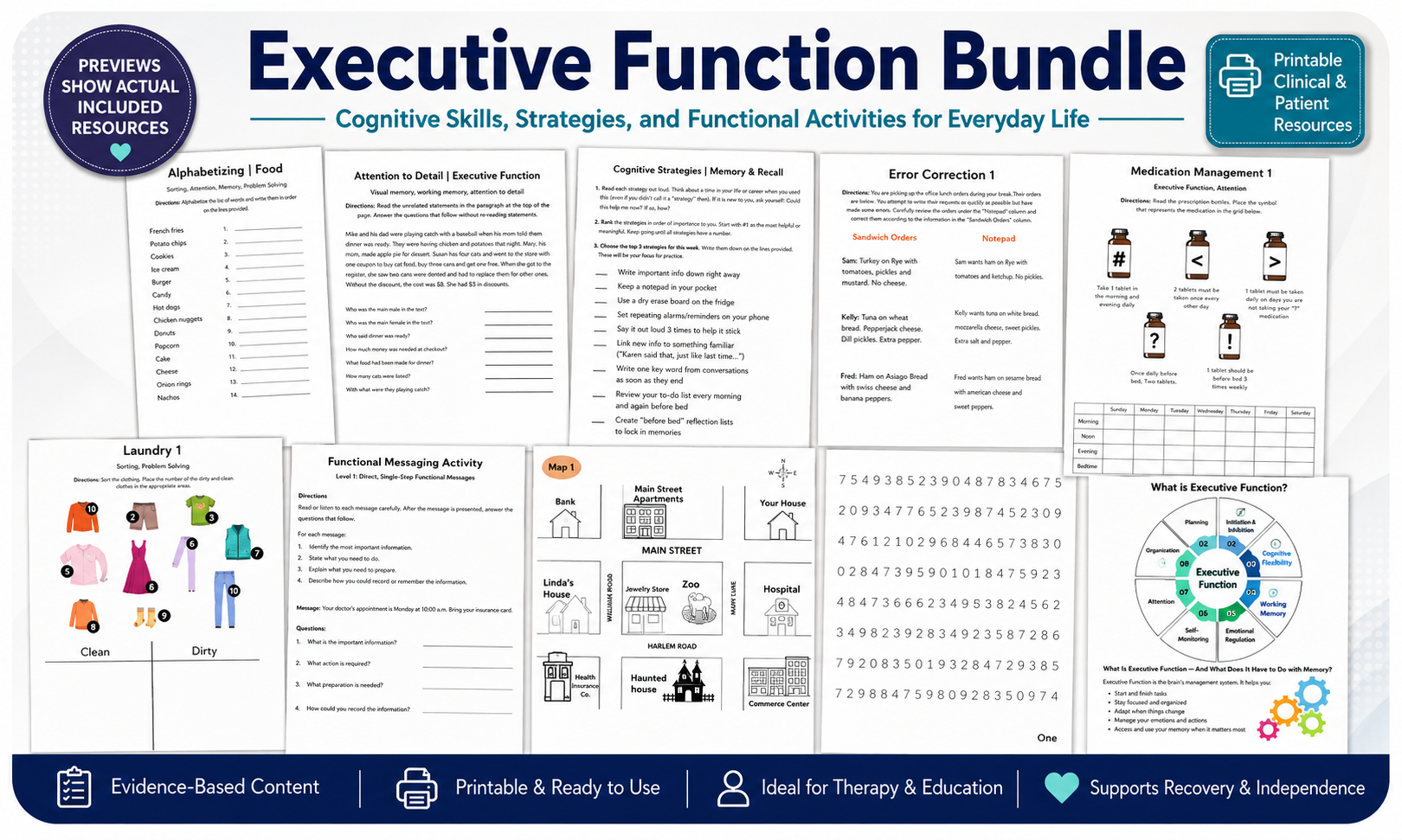
Just want the resources mentioned in this article?: Download the Executive Function Bundle
Cognitive functioning plays a fundamental role in our ability to engage in daily activities, interact with others, and navigate the world around us. For occupational therapy practitioners and students, understanding and assessing cognitive abilities with cognitive tests are paramount in providing effective interventions for clients with various cognitive impairments or challenges.
Helpful Resources for Functional Cognition:
- Resource Page all about Functional Cognition
- Interventions for Cognition
- Most Common Functional Cognition Patient Presentations
- Sign up for the FREE e-mailed Functional Cognition Newsletter
Assessment:
Standardized assessments cover a range of cognitive domains such as memory, attention, executive function, and language skills. By administering cognitive tests, therapists can gain insight into a client's cognitive functioning, which forms the basis for developing tailored intervention plans.
Helpful resource: Page on the Occupational Therapy Evaluation and Diagnoses Process
Member Resource: Master List of Assessments and Screening Tools for Occupational Therapy PDF Resource
Treatment Planning:
Understanding cognitive test results allows occupational therapists to design individualized intervention plans that address specific cognitive needs. By targeting areas of cognitive weakness identified through testing, therapists can implement evidence-based interventions aimed at improving cognitive functioning and enhancing participation in daily activities. Cognitive tests play a crucial role in guiding treatment decisions and monitoring progress over time.
Communication and Collaboration:
Cognitive test results provide a common language for communication among interdisciplinary team members. Whether it's physicians, neuropsychologists, educators, or other healthcare professionals, cognitive tests facilitate collaboration in developing comprehensive care plans for clients with cognitive impairments. This interdisciplinary approach ensures continuity of care and maximizes support for clients across various settings.
Occupational Therapy Cognitive Tests
It is important to note that although occupational therapy practitioners use the following tests/screening tools, they are not only used by OT practitioners. Furthermore, this is not an inclusive list. It is always best to develop an understanding of your patient's clinical and occupational profile before choosing an appropriate cognitive test.
Word Finding and Verbal Fluency:
Word-finding and verbal-fluency assessments can help us understand how efficiently a person retrieves and organizes language. These abilities may affect conversation, following a train of thought, communicating needs, making lists, and participating in socially or cognitively demanding activities.
- Controlled Oral Word Association Test (COWAT)
- The COWAT examines how many words a person can quickly generate according to specific letter-based rules. An occupational therapy practitioner may use it to explore verbal initiation, cognitive flexibility, processing speed, and the ability to organize information under time pressure.
- Boston Naming Test (BNT)
- The Boston Naming Test asks the person to name pictured objects that generally become less familiar as the test progresses. It can help the practitioner determine whether word-retrieval difficulty may be affecting communication, object identification, medication discussions, or participation in daily routines.
- Semantic Fluency Test
- A semantic-fluency task asks the person to name as many items as possible from a category, such as animals, within a limited period. It provides information about language retrieval, semantic organization, initiation, and processing speed that may influence functional communication and problem-solving.
Memory and Learning:
Memory testing should go beyond asking whether someone can remember a few words. Occupational therapy practitioners are often interested in how the person learns new information, whether repetition helps, how quickly information is lost, and whether recognition is stronger than unaided recall.
- Hopkins Verbal Learning Test (HVLT)
- The HVLT evaluates verbal learning and memory by asking the person to learn and later recall a short list of words. It can help an OTP consider whether the person is likely to remember instructions, appointments, safety information, or newly taught strategies.
- Rey Auditory Verbal Learning Test (RAVLT)
- The RAVLT examines learning across repeated word-list trials, delayed recall, recognition, and the effects of competing information. An OTP may select it when trying to understand whether difficulty with daily learning comes from poor initial encoding, rapid forgetting, interference, or inefficient retrieval.
- California Verbal Learning Test (CVLT)
- The CVLT provides a detailed examination of how a person learns, organizes, recalls, and recognizes verbal information. It is useful when the practitioner needs more than a total memory score and wants to understand the learning strategies or error patterns that may affect everyday functioning.
- Digit Span (DGS)
- Digit Span asks the person to repeat sequences of numbers in the same order, in reverse order, or according to additional sequencing rules, depending on the version used. It gives the OTP information about immediate attention and working memory, which are needed when following multistep directions, completing calculations, managing medication, or keeping track of an activity.
Executive Function and Attention:
Executive-function tests examine how a person manages competing information, shifts between rules, plans ahead, inhibits an automatic response, and monitors performance. These are often the abilities that determine whether a person can complete a task independently, especially when the environment is unfamiliar or something unexpected happens.
- Stroop Color and Word Test
- The Stroop requires the person to suppress an automatic reading response and instead respond according to the color of the printed ink. An OTP may use it to examine inhibition and selective attention when impulsivity, distractibility, or difficulty resisting an automatic response is affecting activity performance.
- Trail Making Test (Parts A and B)
- Part A primarily examines visual scanning, sequencing, and processing speed, while Part B adds the demand of switching between numbers and letters. Comparing performance across the two parts can help an OTP explore whether slowed task completion reflects general speed and visual-search difficulty or an additional challenge with cognitive flexibility.
- Wisconsin Card Sorting Test (WCST)
-
The WCST asks the person to determine and adapt to changing sorting rules using feedback. It can help an OTP identify difficulty with abstract reasoning, strategy shifting, learning from errors, and abandoning an approach that is no longer effective.
-
- Delis-Kaplan Executive Function System (D-KEFS)
- The D-KEFS is a collection of tests that examines several aspects of executive functioning, including inhibition, switching, fluency, planning, and problem-solving. It allows the OTP to select specific subtests that match the clinical question rather than relying on one broad executive-function score.
- Tower of London Test (TOL)
- The Tower of London requires the person to plan and complete a sequence of moves while following specific rules. An OTP may use it to examine planning, working memory, sequencing, and the ability to think ahead before beginning a multistep task.
- Behavioural Assessment of Dysexecutive Syndrome (BADS)
- The BADS uses structured activities designed to resemble the planning and problem-solving demands encountered outside traditional testing situations. It may be especially helpful when a person performs reasonably well on brief cognitive screens but continues to demonstrate executive-function difficulties in daily life.
Visuospatial Skills:
Visuospatial testing examines how a person understands spatial relationships, organizes visual information, copies designs, and recognizes how parts relate to a whole. These abilities may influence navigation, dressing, constructional tasks, driving-related skills, locating objects, and safely moving through the environment.
- Clock Drawing Test
- The Clock Drawing Test asks the person to construct a clock face and place the hands at a specified time. Although brief, it can reveal concerns involving visuospatial organization, planning, comprehension, sequencing, and awareness of errors.
- Rey-Osterrieth Complex Figure Test (ROCFT)
- The ROCFT asks the person to copy a complex geometric figure and later reproduce it from memory. It can help an OTP examine visuospatial construction, organization, planning, visual memory, and the strategy used to approach complex information.
- Judgment of Line Orientation (JLO)
- The JLO requires the person to match the direction or angle of lines without relying heavily on a motor response. It can help the practitioner explore spatial-perception difficulty that may affect positioning, navigation, object use, or interpretation of visual relationships.
- Block Design subtest of the Wechsler Adult Intelligence Scale (WAIS)
- Block Design asks the person to arrange colored blocks so they match increasingly complex visual patterns. It provides information about visuospatial analysis, constructional ability, processing speed, and problem-solving that may help explain difficulty assembling, organizing, or reproducing visual information.
Visual Perception:
Visual-perception assessments help distinguish problems with interpreting visual information from difficulties caused primarily by weakness, coordination, or limited hand use. This distinction matters because two people may fail the same functional task for very different reasons.
- Motor-Free Visual Perception Test (MVPT)
- The MVPT examines visual-perceptual abilities through tasks that require little or no motor drawing response. An OTP may use it when the person has motor limitations and the therapist wants to explore visual discrimination, spatial relationships, visual memory, closure, or figure-ground perception more directly.
- Developmental Test of Visual Perception (DTVP)
- The DTVP evaluates several visual-perceptual and visual-motor abilities, with the specific structure depending on the version and age group. It is particularly useful in pediatric practice when visual-perceptual or visual-motor difficulties may be affecting handwriting, school participation, play, or self-care.
General Cognitive Screening:
General cognitive screens are often used to identify whether additional evaluation may be needed. They can help describe a broad pattern of strengths and weaknesses, but they should not be treated as stand-alone measures of a person’s ability to live safely or complete everyday activities.
- Montreal Cognitive Assessment (MoCA)
- The MoCA is a brief cognitive screen that samples areas such as memory, attention, language, executive function, visuospatial ability, and orientation. An OTP may use it to identify possible cognitive concerns and determine which areas require deeper assessment or functional observation.
- Mini-Mental State Examination (MMSE)
-
The MMSE is a brief screening measure that examines orientation, registration, attention, recall, language, and simple constructional performance. It can provide a general cognitive snapshot, but an OTP should recognize that it may not capture subtle executive dysfunction or predict how the person performs complex daily activities.
-
- Addenbrooke's Cognitive Examination (ACE)
- The ACE provides a broader cognitive examination across attention, memory, verbal fluency, language, and visuospatial abilities. It may be useful when the OTP wants a more detailed cognitive profile than a very brief screen can provide.
- Repeatable Battery for the Assessment of Neuropsychological Status (RBANS)
- The RBANS evaluates immediate memory, visuospatial and constructional abilities, language, attention, and delayed memory through multiple subtests. Its alternate forms and domain scores can help an OTP describe cognitive patterns and monitor change while connecting the results to observed occupational performance.
Motor and Processing Skills:
The next group requires an important distinction. These tools are not all cognitive tests, but they can provide valuable information about how motor, perceptual, organizational, and processing abilities influence task completion.
- Assessment of Motor and Process Skills (AMPS)
- The AMPS evaluates the quality of a person’s motor and process skills while the person completes familiar activities of daily living. It is highly relevant to functional cognition because it examines how effectively the person organizes, adapts, sequences, and completes meaningful tasks in context.
- Bruininks-Oseretsky Test of Motor Proficiency (BOT-2)
- The BOT-2 is a pediatric assessment of motor proficiency that examines areas such as coordination, balance, strength, agility, and fine-motor control. Although it is not a cognitive test, an OTP may use it to determine whether motor limitations are contributing to difficulty with school, play, self-care, or cognitively demanding motor activities.
- Purdue Pegboard Test
-
The Purdue Pegboard measures fine-motor dexterity, hand coordination, and performance during timed peg-placement tasks. It can help the OTP determine whether slow or inaccurate task performance is related partly to motor speed and dexterity rather than cognition alone.
-
Functional Performance and Participation:
Functional assessments bring cognition back into the activities that matter. They help answer the question that a brief screen often cannot answer: What happens when this person must use cognitive abilities to complete a real or simulated daily task?
- Canadian Occupational Performance Measure (COPM)
- The COPM is a client-centered interview that identifies activities the person wants, needs, or is expected to perform and captures self-ratings of performance and satisfaction. It does not directly test cognition, but it helps the OTP connect cognitive concerns to the person’s priorities and measure whether intervention produces meaningful occupational change.
- Performance Assessment of Self-Care Skills (PASS)
- The PASS examines independence, safety, and adequacy as the person completes functional activities involving personal care and instrumental daily living. It allows the OTP to observe where breakdowns occur and what type or amount of cueing is required for successful performance.
- Executive Function Performance Test (EFPT)
- The EFPT examines the executive-function support a person requires while completing structured tasks such as cooking, medication management, telephone use, and bill payment. It is especially useful for determining whether the person can initiate, organize, sequence, judge safety, and complete functional activities without assistance.
- The Dynamic Lowenstein Occupational Therapy Cognitive Assessment (DLOTCA)
- The DLOTCA examines several cognitive areas while also using a structured dynamic approach to determine how performance changes with graded cues or mediation. This helps the OTP look beyond what the person cannot do independently and identify the type of assistance or learning support that improves performance.
- The Test of Every Day Attention
- The Test of Everyday Attention uses tasks designed to represent common attention demands, including selective attention, sustained attention, switching, and divided attention. An OTP may use it to understand how specific attention limitations could interfere with conversations, mobility, meal preparation, community navigation, work, or other daily activities.
Using Test Results in Functional Cognition
Helpful Resources:
- Functional Cognition in Clinical Practice - Billing, Medical Necessity, and CMS Standards
- Common Patient Profiles in Functional Cognition Clinical Practice
The most important point is that a cognitive score does not interpret itself. Two people can receive similar scores while demonstrating very different levels of safety, independence, insight, strategy use, and response to cueing.
Occupational therapy practitioners bring a distinct perspective because we can compare standardized findings with task performance, occupational priorities, environmental demands, and the supports available to the person. A memory test may tell us that delayed recall is impaired, but functional assessment helps us determine whether the person can manage medication using a written system. An executive-function test may reveal difficulty switching strategies, but observation shows us whether that difficulty affects cooking, transportation, finances, work, or caregiving.
The strongest functional-cognition evaluation therefore does not depend on one cognitive test. It combines the occupational profile, standardized assessment, skilled observation, functional activity analysis, information from the client and care partners, and clinical reasoning. The purpose is not simply to determine whether cognition is impaired. The purpose is to understand how cognition influences occupational performance and what can be done to improve participation, safety, and independence.
About the Author
Michelle Eliason, MS, OTR/L is an occupational therapist, rehabilitation researcher, educator, and founder of BOT Portal and Buffalo Occupational Therapy. Her clinical and scholarly work focuses on neurological rehabilitation, functional cognition, cognitive-motor performance, aging, and the translation of rehabilitation science into practical occupational therapy evaluation, intervention, and clinical reasoning.
Learn more about : Michelle C. Eliason, MS, OTR/L
Continue Learning With Us
Did you find this information helpful? Please share this article with another occupational therapy practitioner, student, educator, or rehabilitation professional who may benefit from it.
Would you like access to the clinical resources discussed throughout this article? Explore our membership options to find the level of support that works best for you.
Looking for a more formal learning and mentorship experience? Learn more about the Functional Cognition Lab Mentorship Program.
You can also explore our AOTA-approved courses and clinical resource packages for additional education, treatment resources, and practical tools you can use in rehabilitation practice.
Interested in receiving free functional cognition education each week? Subscribe to the Functional Cognition Lab Newsletter.