

Somebody is going to look at this activity and think you're joking.
Let them.
That's it.
👉 That's the activity.
And yes — you can bill a 45-minute session on it.
Not because it looks impressive.
👉 Because what it's asking the brain to do is.
One note before we get into it: this is the third activity in a row built from materials that cost less than $10 combined. That's not a coincidence. The generalization argument holds here too — your patient has coins. They have binder clips. The motor map transfers.
What the activity actually is
Setup:
- A handful of coins
- Binder clips (various sizes — this is your grading tool)
- A receptacle: a cup, a box, a bowl — placed anywhere in the space
The task: patient picks up a coin using their target pinch pattern, picks up a binder clip, connects them into a two-part unit, and deposits the completed unit into the receptacle.
That's one unit. Two parts.
👉 Start with 5.
👉 Long-term goal: 25 units without tremor, fatigue, or compensatory movement.
The patient sets the number. You give them the framework. They fill it in.
👉 That's self-efficacy built into the objective measure.
Why this is a cognitive flexibility intervention
This is the cognitive hook most clinicians miss.
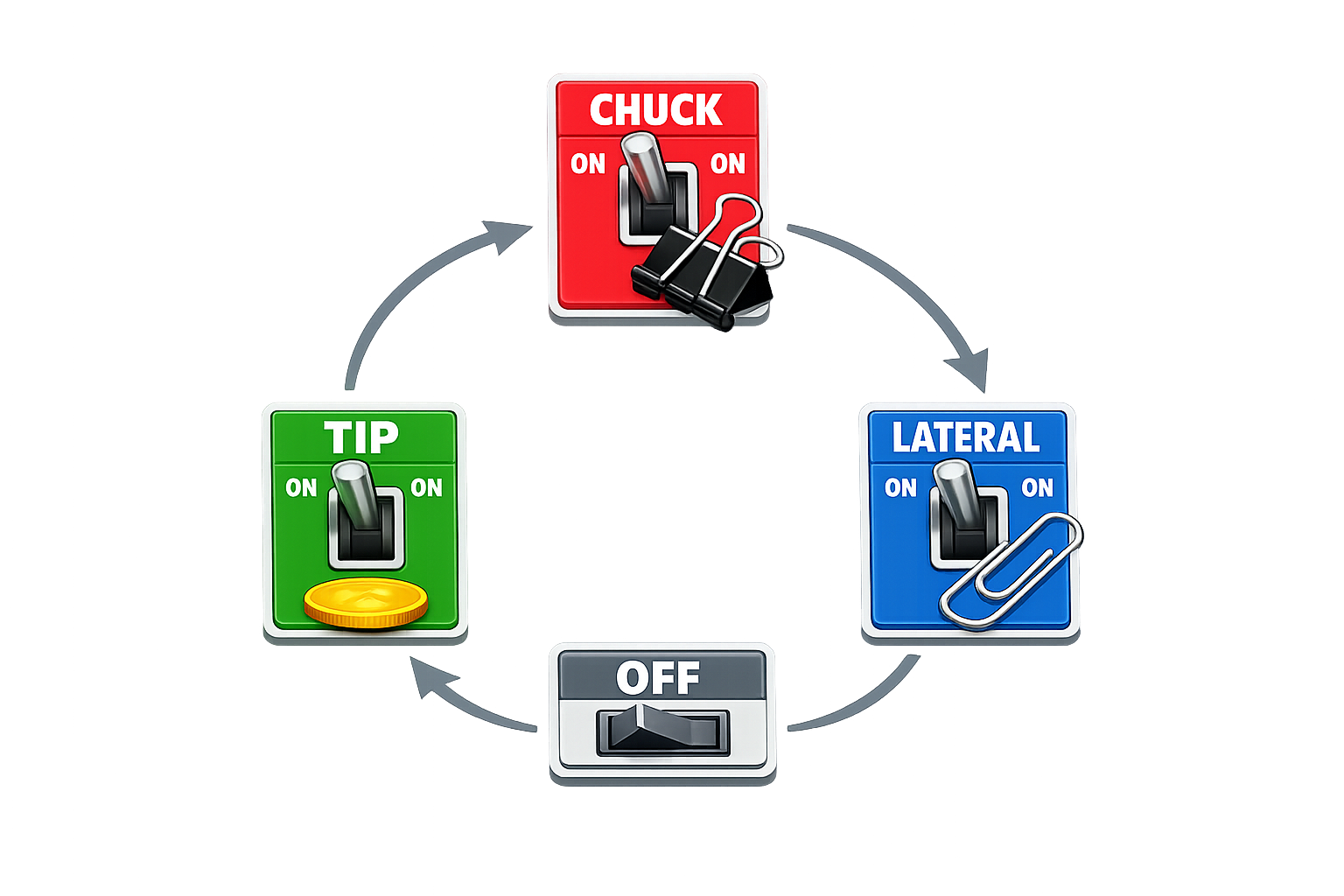
The activity is not just about pinch strength.
👉 It's about switching.
Tip pinch to pick up the coin. Chuck pinch to grip the binder clip. Lateral pinch to manipulate it open. Back to tip pinch to place it.
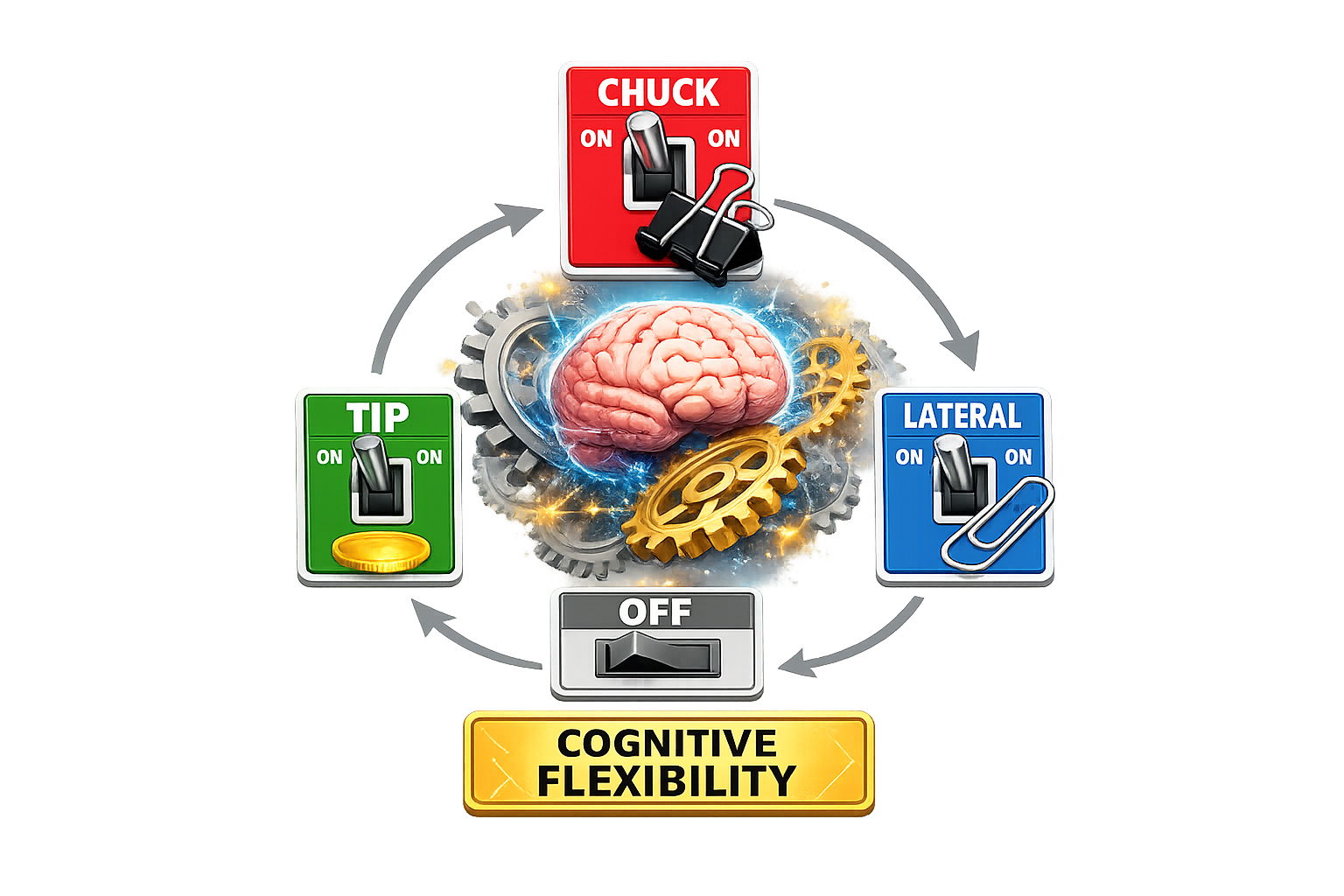
Every transition between pinch patterns requires the brain to:
— disengage the current motor program
— update the movement plan
— recruit a different set of intrinsic and extrinsic muscles
— execute the new pattern with control
👉 That is cognitive flexibility.
The same executive function that allows your patient to switch between tasks at home, change their plan when something unexpected happens, or adapt their movement when the context changes.
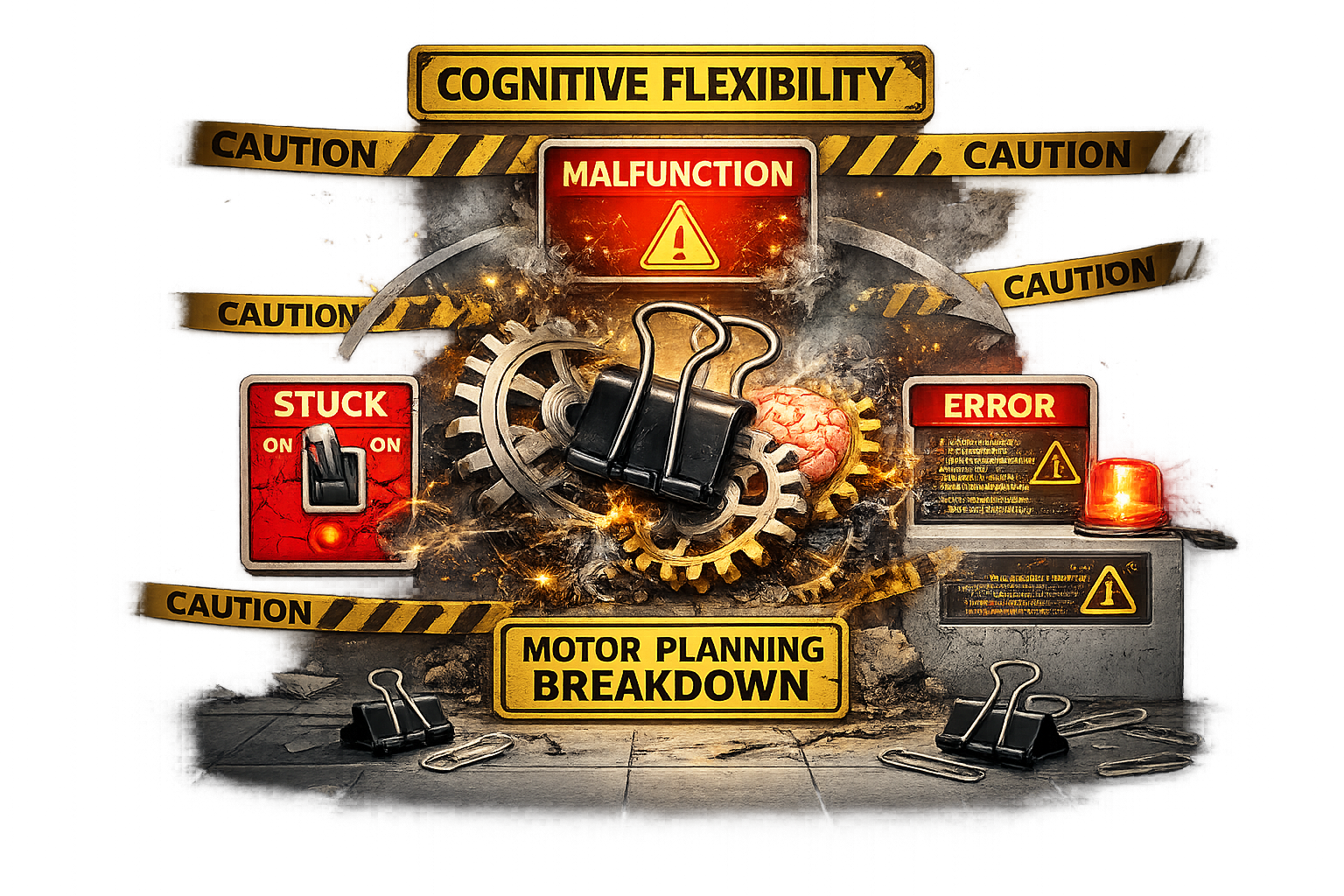
When cognitive flexibility breaks down:
— patients get stuck in one grip pattern regardless of the object
— they cannot update their motor plan mid-task
— they compensate with the whole hand instead of the right fingers
👉 That's not a strength problem.
👉 That's a motor planning and cognitive flexibility problem.
And binder clips — because they require a specific sequence of grip, compress, and release — are one of the most efficient ways to train it.
Why this is a spatial planning intervention
Where you put the receptacle is a clinical decision.
👉 Not a setup preference.
Receptacle directly in front: baseline reaching in the sagittal plane.
Receptacle to the affected side: crossing midline, visual scanning toward the neglected field.
Receptacle behind the patient: trunk rotation required to reach and deposit — full axial movement integrated into the task.
Receptacle on the floor: trunk flexion, forward reach, postural challenge.
[Modify standing suface + receptacle] Patient on a balance disc : postural control under concurrent fine motor demand.
👉 Each one is a different spatial working memory and motor planning demand.
👉 Each one requires the brain to plan the movement trajectory before executing it.
That is anticipatory motor planning — prefrontal executive function embedded in a coin and a binder clip.

How to Treat This (Real Sessions)
🤏 Choose the pinch pattern deliberately. Don't default to whatever is easiest. Identify the functional pinch the patient needs for their daily life and target that one. Tip pinch for medication management. Lateral pinch for keys. Chuck pinch for utensils. Make it mean something before the session starts.
📎 Grade by binder clip size, not repetition count alone. Smaller clips require more precise motor planning and more intrinsic muscle recruitment. Larger clips require more force and gross grip engagement. Alternate sizes within a session to force cognitive flexibility — the hand has to update its motor plan with every clip.
🎯 Move the receptacle every session. Changing its location changes the spatial planning demand. If the receptacle is always in the same place, the patient builds a context-dependent motor map. Move it to build a flexible one.
🪙 Start without the placement task. Run the pinch-and-connect movement first without reaching to a receptacle. Establish the two-part unit before adding the spatial demand. Do not add trunk rotation or the balance disc until the basic unit is clean and consistent.
💺 Add postural challenge last. Balance disc, trunk rotation, floor-level receptacle — these are progressions, not starting points. Introduce them only when the fine motor pattern is consistent without postural challenge.
📊 Count the units. Document the number. How many units can the patient complete without tremor, fatigue, or compensatory movement? That is your objective measure. Track it across sessions. It is a functional cognitive-motor outcome, not just a strengthening metric.
Across Disciplines (Same System, Different Look)
This is OT-led — but the principles apply everywhere.
PT: trunk rotation to a receptacle placed behind the patient is not just a mobility task. It requires the patient to hold the spatial location of the target in working memory, plan the rotation, execute the reach, and return — all while maintaining postural stability. That is a dual-task postural-cognitive intervention with a $0 setup cost.
SLP: rapid switching between motor programs is the same cognitive process underlying conversational turn-taking, topic switching, and adapting language output mid-conversation. Cognitive flexibility deficits show up in both hand function and communication. Same system. Different channel.
👉 One activity. One cognitive system. Different functional presentations.
How to Grade and Adapt this Activity
🤏 Choose the pinch pattern deliberately.
Don't default to whatever is easiest. Identify the functional pinch the patient needs for their daily life and target that one. Tip pinch for medication management. Lateral pinch for keys. Chuck pinch for utensils. Make it mean something before the session starts.
📎 Grade by binder clip size, not repetition count alone.
Smaller clips require more precise motor planning and more intrinsic muscle recruitment. Larger clips require more force and gross grip engagement. Alternate sizes within a session to force cognitive flexibility — the hand has to update its motor plan with every clip.
🎯 Move the receptacle every session.
Changing its location changes the spatial planning demand. If the receptacle is always in the same place, the patient builds a context-dependent motor map. Move it to build a flexible one.
🪙 Start without the placement task.
Run the pinch-and-connect movement first without reaching to a receptacle. Establish the two-part unit before adding the spatial demand. Do not add trunk rotation or the balance disc until the basic unit is clean and consistent.
💺 Add postural challenge last.
Balance disc, trunk rotation, floor-level receptacle — these are progressions, not starting points. Introduce them only when the fine motor pattern is consistent without postural challenge.
📊 Count the units. Document the number.
How many units can the patient complete without tremor, fatigue, or compensatory movement? That is your objective measure. Track it across sessions. It is a functional cognitive-motor outcome, not just a strengthening metric.
Author Information:
Michelle Eliason, MS, OTR/L
Occupational Therapist & Functional Cognition Educator
Owner, Buffalo Occupational Therapy
PhD Candidate, Rehabilitation Science
Founder of BOT Portal — a clinical system for real-world cognition

Member Resource: Coins, Binder Clips & Fine Motor Cognitive Pack
What's included:
- Handout 1: Synergies of Hand Grasp — the full grasp pattern reference guide for identifying and documenting target pinch patterns
- Handout 2: Fine Motor Assessment Record — your session-to-session tracking sheet for tip pinch, 3-point/jaw pinch, lateral pinch, gross grasp, and 9-hole peg test
- Clinical application guide below — how to use each resource to set up, grade, document, and progress the coins and binder clips activity
Handout 1 — Synergies of Hand Grasp
This is your activity grading reference. Before you place a single coin on the table, identify which pinch pattern your patient is working toward and why it matters for their daily life. The coins and binder clips activity can target tip pinch, chuck/3-point pinch, or lateral pinch depending on the patient's functional goals — and the binder clip size determines the resistance and motor plan required for each.
Best used for: Identifying the target pinch pattern before the session, documenting the specific synergy being trained, connecting the activity to a meaningful functional destination before the first repetition.
Clinical tip: Show the patient their target grasp on the chart before the session starts. Name the everyday object that uses it — a key for lateral pinch, a pen for tip pinch, a sandwich bag for chuck pinch. Now the coin and binder clip have a functional destination. That's not just motivation — it's encoding. The brain learns faster when the movement has meaning attached to it before practice begins.
Synergies of Hand Grasp Resource
Handout 2: Graded Tap Sequence Bank
This is your objective measurement tool. The record tracks tip-to-tip pinch, 3-point/jaw pinch, lateral pinch, grip/gross grasp, and 9-hole peg test across sessions, with left and right columns, trial-by-trial entries, average calculation, and a previous session comparison field.
The coins and binder clips activity generates two trackable measures that map directly onto this form: pinch strength for the target pattern used in the activity, and 9-hole peg test as a functional fine motor speed and coordination baseline before and after a treatment block.
Best used for: Establishing a baseline before starting the activity protocol, tracking change across sessions, generating objective data for medical necessity justification and discharge planning.
Clinical tip: Run the relevant pinch measurement at the start of the session before any activity — not at the end when fatigue has already set in. Record it every session. The unit count from the activity and the pinch dynamometer number together give you two objective measures in one session: functional cognitive-motor endurance and isolated pinch force. Both belong in your note. Both justify continued skilled care.
Clinical Application Guide: Matching the Breakdown to Your Treatment
Before the session — identify the target pinch and establish baseline
Pull Handout 1. Identify the target pinch pattern for this patient's functional goals. Pull Handout 2. Run the corresponding pinch measurement before any activity. Record it. This takes two minutes and gives you the objective anchor for the entire session.
Setting up the activity — choose your binder clip sizes deliberately
Start with one clip size. Identify whether you are targeting tip, chuck, or lateral pinch using Handout 1. Set the receptacle directly in front of the patient at baseline. Remove bilateral upper extremity support at the elbows if postural control is a goal — do not wait until the end of the session to introduce this demand.
Grading the cognitive flexibility layer
Once the basic two-part unit is clean and consistent — no tremor, no compensation, no fatigue in the first five repetitions — introduce a second binder clip size. Now the patient must switch motor plans between clips. Refer back to Handout 1 to confirm which synergy each clip size is recruiting and document both. That is your first cognitive flexibility demand. Do not add spatial complexity until the motor plan switching is accurate.
Adding spatial planning — move the receptacle
Move the receptacle one session after the basic unit is established. Ipsilateral side first, then contralateral, then behind the patient with trunk rotation, then floor level with trunk flexion. Each position is a different spatial planning demand. Document the position used in every session — it is a functional variable, not a setup preference.
Tracking progress across sessions
Use Handout 2 to record pinch measurements at the start of each session. Track unit count across sessions as your functional endurance measure. When pinch dynamometry scores plateau but unit count continues to improve — or vice versa — you have identified a dissociation between isolated strength and functional cognitive-motor endurance. That dissociation is a skilled clinical finding. Document it and use it to justify continued care.
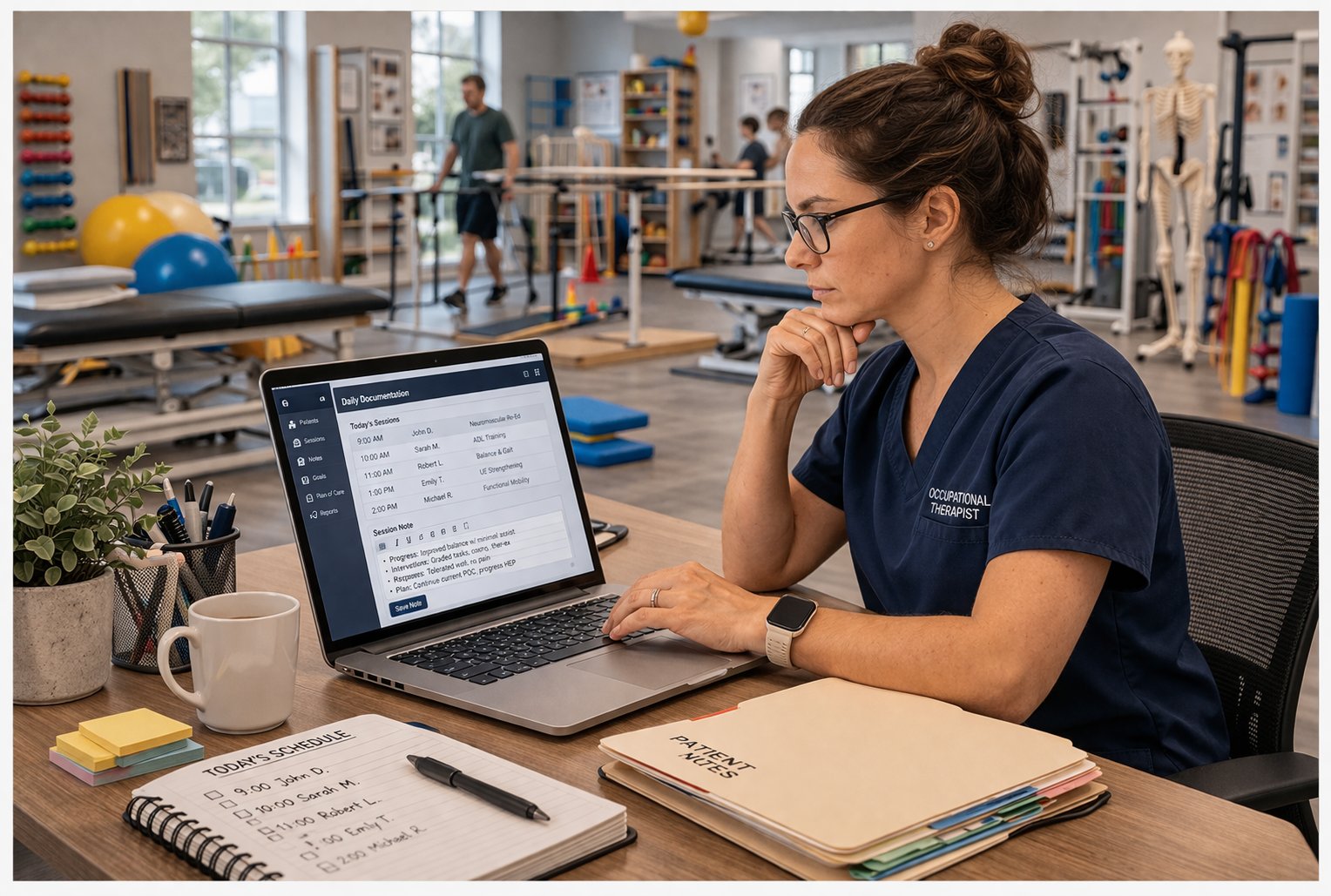
Documentation Language
✏️ Name the deficit: Patient demonstrated decreased cognitive flexibility for functional pinch pattern switching with compensatory gross grasp activation, limiting isolated fine motor task performance and functional hand use across daily contexts.
🔗 Link to function: Deficits impacted ability to perform tasks requiring rapid pinch pattern transitions and sustained fine motor endurance including utensil use, key manipulation, medication management, and object retrieval.
🔥 Skilled intervention: Clinician identified target pinch pattern using grasp synergy reference, established pinch dynamometry and 9-hole peg test baseline, and implemented graded fine motor activity with progressive cognitive flexibility and spatial planning demands targeting functional hand use generalization.
⚕️ Medical necessity: Skilled intervention required to grade cognitive-motor task demands, identify functional pinch pattern deficits, progress spatial planning complexity, and ensure context-independent generalization — clinical judgment required at each stage of progression.
One-Line Clinical Reasoning Starters
Use these when documenting medical necessity or justifying continued skilled care:
- Cognitive flexibility for motor program switching between functional pinch patterns is a prerequisite for independent daily hand use across contexts — deficits require skilled remediation beyond repetitive strengthening.
- Dissociation between pinch dynamometry score and functional unit count indicates a cognitive-motor endurance deficit not captured by isolated strength measurement — skilled intervention required to address the functional gap.
- Progressive spatial target complexity requires skilled clinical judgment to grade anticipatory motor planning demands safely and systematically across sessions.
- Generalization of pinch patterns across object sizes and environmental contexts requires skilled design of varied practice conditions not achievable through home exercise or unskilled instruction alone.

Responses