
What Does Occupational Therapy Do?
Jan 19, 2026
What Does Occupational Therapy Do? Beyond ADLs and IADLs
by Michelle C. Eliason, MS, OTR/L
Dear Members, check out your Membership Library where you have access to the Resource Bundles with your membership. I would also like to encourage you to leave a Marco Polo message for asynchronous discussion about how this content may currently relate to your clinical practice or education!
Membership Resources: This article and its companion audio are free to read and listen to. Links throughout the article connect members of the Functional Cognition Lab to related printables, treatment tools, courses, and clinical resources that align with the topic being discussed. Membership also includes access to the full resource library and direct clinical support. Find out more about membership on the Membership Options Page
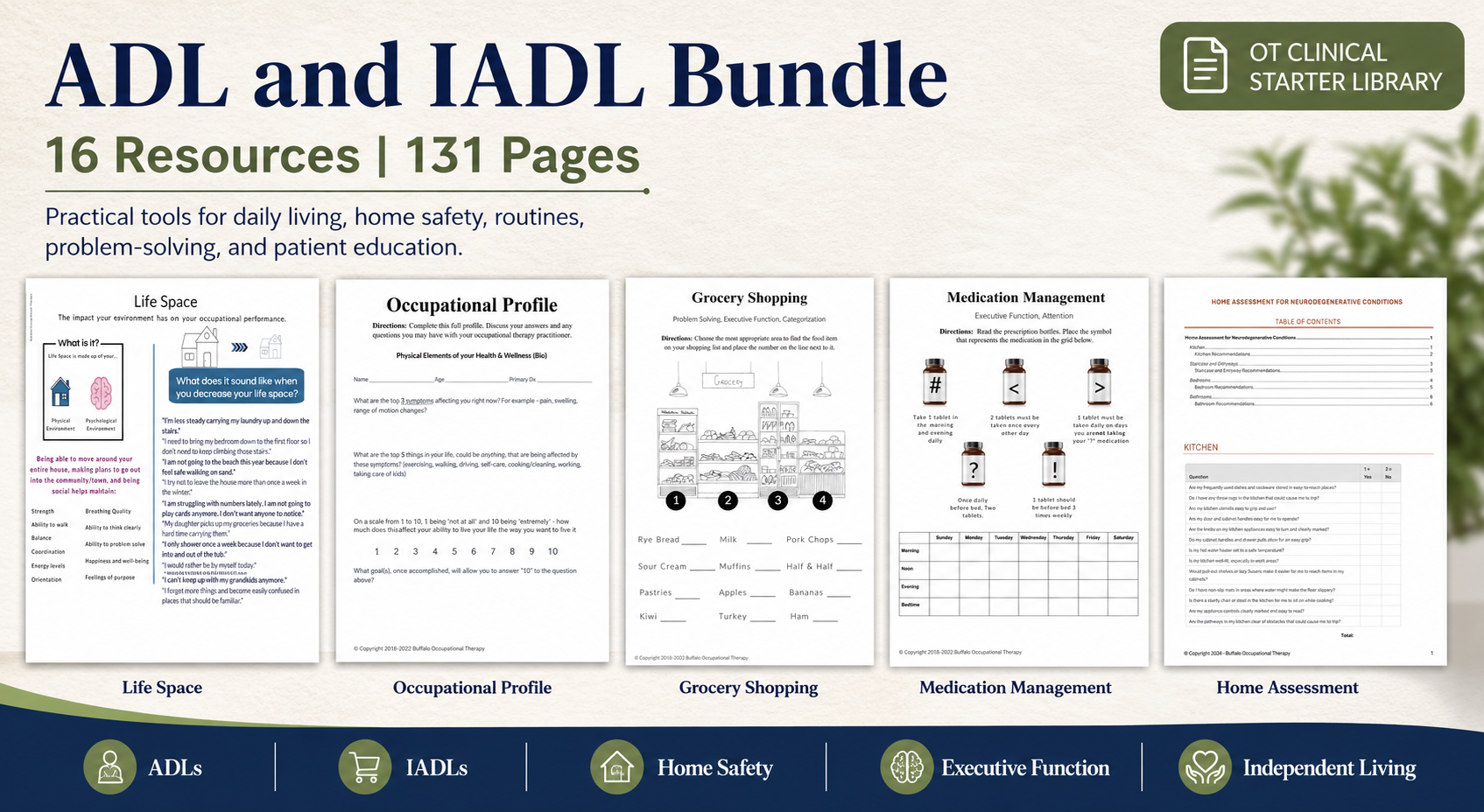
Just want the resources mentioned in this article?: Download the ADL and IADL Bundle
Activities of daily living and instrumental activities of daily living are at the center of occupational therapy practice. These occupations are often the reason a person is referred to therapy in the first place. They may be unable to dress without assistance, complete toileting safely, prepare a meal, manage medication, maintain their home, or return to an important family or work role.
_______________________________________________
Occupational therapy is far more than helping people bathe, dress, or manage medications. Activities of Daily Living (ADLs) and Instrumental Activities of Daily Living (IADLs) are essential components of occupational therapy practice, particularly across rehabilitation and aging, but they represent only one part of a much larger occupational picture.
At its core, occupational therapy is a holistic rehabilitation profession centered on a person’s ability to participate in meaningful everyday life. Treatment is not defined by a collection of tasks. Occupational therapy practitioners consider values, habits, routines, roles, physical and cognitive abilities, environmental demands, social relationships, medical conditions, and the activities a person needs or wants to perform.
Occupation is the medium through which all of those pieces come together.
The Occupational Therapy Practice Framework, Fourth Edition (OTPF-4), reflects that breadth. Occupational therapy addresses activities of daily living, instrumental activities of daily living, health management, rest and sleep, education, work, play, leisure, and social participation (American Occupational Therapy Association [AOTA], 2020).
Bathing is an occupation. So is parenting. Managing finances, returning to work, sleeping through the night, preparing a meal, volunteering, playing with a grandchild, attending church, caring for a pet, maintaining friendships, and pursuing a hobby can all fall within the occupational therapy domain.
Reducing occupational therapy to ADLs and IADLs misses much of what the profession is actually designed to address.
What Are ADLs and IADLs in Occupational Therapy?
Activities of Daily Living are the activities involved in caring for one’s own body. These include areas such as bathing and showering, toileting and toilet hygiene, dressing, eating and swallowing, feeding, functional mobility, personal hygiene and grooming, and sexual activity.
Instrumental Activities of Daily Living are generally more complex activities that support participation in home and community life. Depending on the task, they may require planning, organization, judgment, memory, physical mobility, communication, problem-solving, and the ability to manage several pieces of information at once. Common examples include financial management, home management, shopping, meal preparation and cleanup, caregiving, communication management, community mobility, and safety and emergency maintenance.
One important change in the OTPF-4 is that health management is now its own occupation category, rather than simply being placed under IADLs. Medication management, symptom and condition management, nutrition management, communication with the healthcare system, physical activity, and personal device management are part of this broader health management domain (AOTA, 2020).
ADLs and IADLs remain central to occupational therapy because they tell us a great deal about how successfully a person is functioning in everyday life. Difficulty with bathing, preparing food, managing finances, navigating the community, or keeping track of health needs can affect independence, safety, caregiver demand, and a person's ability to remain engaged in the environment they have chosen.
However, simply determining whether someone can complete an ADL or IADL rarely tells us the whole story.
Why IADL Changes Can Be Clinically Important
More complex daily activities often require substantial cognitive organization. Managing money is not simply a matter of being able to write a check or use a computer. The person has to recognize that a bill needs attention, understand what is being requested, locate the correct information, sequence the necessary steps, detect errors, inhibit distractions, remember what has already been completed, and follow through.
The same is true of scheduling appointments, shopping, preparing meals, navigating transportation, or managing household responsibilities.
Subtle changes in these activities can sometimes emerge before a person loses the ability to complete basic self-care. A systematic review examining people with mild cognitive impairment found IADL difficulties across areas such as financial management, medication use, keeping appointments, telephone use, finding items, and everyday technology. More cognitively demanding IADLs were particularly vulnerable (Jekel et al., 2015).
This is one reason occupational therapy practitioners should pay close attention when a family member says, “She is still bathing and dressing herself, but something is different.”
The difference may appear in efficiency, organization, initiation, accuracy, judgment, or the amount of support required. A person may technically complete an activity but take considerably longer, make more errors, abandon portions of the task, require repeated reminders, or fail to recognize that the task needs to occur at all.
Occupational performance is not binary. Independent versus dependent is often far too crude a way to describe what is happening.
Functional Cognition and Everyday Performance
ADLs and IADLs are deeply connected to cognition. Attention, memory, executive function, visuospatial processing, language, praxis, awareness, and problem-solving all influence the way everyday activities are performed.
This intersection is often described through functional cognition, or cognition as it occurs during the performance of real-world activity. Rather than asking only whether someone can complete a cognitive test at a desk, occupational therapy examines how cognitive abilities influence cooking, dressing, transportation, medication routines, financial management, work, caregiving, leisure, and other meaningful occupations.
A patient may have enough strength and range of motion to dress independently but repeatedly put clothing on in the wrong order. Another person may physically be able to prepare a meal but leave burners on, lose track of ingredients, or become unable to organize several steps simultaneously. Someone may know exactly how to manage medication when asked about it in the clinic but fail to initiate the routine consistently at home.
The underlying problem is different in each situation, even though all three could eventually be documented as difficulty with an ADL or IADL.
Occupational therapy allows us to analyze why performance is changing.
That analysis may reveal a motor limitation, sensory loss, impaired sequencing, reduced attention, executive dysfunction, environmental barriers, poor endurance, pain, visual-perceptual changes, depression, disrupted routines, caregiver dynamics, or several interacting factors.
What Does an Occupational Therapy Evaluation Look At?
An occupational therapy evaluation begins with much more than a checklist of tasks a person can or cannot complete.
The occupational profile helps the therapist understand who the person is, how daily life is organized, which roles and routines are important, what has changed, what the person wants to return to, and which environmental or social factors influence performance. Medical history is relevant, but so are habits, responsibilities, previous abilities, family expectations, cultural context, home setup, work demands, interests, and the person's own priorities.
Assessment selection should then follow the clinical question.
A therapist concerned about basic self-care may use a measure such as the Barthel Index or another performance-based ADL assessment. Concerns about community independence may lead to more detailed evaluation of IADLs, executive function, functional mobility, safety, or cognition. When cognitive decline is suspected, direct observation of task performance can reveal information that may not appear on a general cognitive screen.
Performance-based assessment is particularly valuable because knowing what someone knows and observing what someone actually does are not always the same thing.
A person may verbally describe every step required to make coffee while becoming completely disorganized when asked to make it. Another may score reasonably well on a brief cognitive screen yet repeatedly miss appointments, mismanage finances, or become overwhelmed by routine household decisions.
The occupational therapy evaluation connects impairment to everyday performance.
Occupational Therapy Intervention Goes Beyond Practicing Tasks
Once the therapist understands why performance is changing, intervention can be much more specific than repeatedly practicing an ADL.
A person who struggles with dressing because of weakness may require strengthening, motor retraining, positioning, adaptive equipment, or graded task practice. Someone whose dressing difficulty is related to apraxia may need a completely different approach involving cueing, environmental organization, error reduction, sequencing, or repeated practice within a consistent context.
A person who cannot prepare meals because of fatigue may benefit from pacing, task simplification, environmental modification, and energy conservation. Someone with executive dysfunction may need external structure, visual supports, task segmentation, strategy training, or environmental cues. A patient with sensory loss may require sensory retraining and compensatory techniques. Another may need fall prevention, mobility retraining, pain management, visual-perceptual intervention, caregiver education, or modification of daily routines.
The activity may look the same on paper, but the treatment is driven by the mechanism interfering with performance.
Occupational therapy practitioners may work on restoration when a capacity can be improved, compensation when another strategy is needed, environmental modification when the context is creating barriers, prevention when a person is at risk for decline, and adaptation when the task itself needs to change.
Evidence also supports occupational therapy interventions aimed at maintaining or improving IADL performance in community-dwelling older adults, including cognitive, preventive, self-management, and home-based approaches (Hunter & Kearney, 2018).
Occupation Is Broader Than Self-Care
ADLs and IADLs receive enormous attention in healthcare because they are easy to connect to safety, discharge planning, caregiver burden, and independence. They are also relatively easy for other disciplines and payers to recognize.
But people do not live solely in the world of bathing, toileting, meal preparation, and medication schedules.
They work. They learn. They rest. They sleep. They play. They worship. They volunteer. They care for other people. They pursue relationships. They create things. They participate in communities. They develop routines that give structure to their days and activities that help them understand who they are.
The OTPF-4 recognizes that occupational therapy includes ADLs, IADLs, health management, rest and sleep, education, work, play, leisure, and social participation (AOTA, 2020).
A therapist working with an adult after stroke may address dressing in the morning and returning to gardening in the afternoon. A person living with Parkinson’s disease may need intervention for handwriting, work performance, community mobility, sleep routines, exercise habits, and participation with family. Someone with cognitive decline may need support for financial management while also working to preserve a volunteer role that has been central to their identity for twenty years.
All of these can be legitimate occupational therapy goals.
The common thread is not the activity category. It is the relationship between the person, the demands of the occupation, and the context in which performance occurs.
Why Occupational Therapy Cannot Be Reduced to ADLs
When occupational therapy becomes synonymous with “ADL training,” we risk narrowing both how other professionals understand the profession and how we understand our own clinical role.
An occupational therapist is not uniquely valuable because we know how to teach someone to put on a shirt.
Our value comes from understanding why that person can no longer put on the shirt, what abilities are required to perform the task, how those abilities interact with the environment, whether remediation or compensation is appropriate, how performance connects to the person's larger roles, and what intervention will allow that individual to participate as fully as possible.
The same reasoning applies to work, school, sleep, leisure, social participation, health management, community mobility, caregiving, and every other occupation within our domain.
A person may technically be independent in every basic ADL and still have a substantial occupational therapy need.
They may no longer be able to manage a household after a brain injury. They may be unable to return to work because of impaired executive function. They may stop participating socially because a neurological condition makes conversation and community environments overwhelming. They may be physically capable of completing a morning routine but lack the initiation, organization, or awareness necessary to begin it without support.
Functional independence is more complicated than the ability to bathe and dress.
A Broader View of Occupational Therapy Practice
Broadening our view of occupation does not require abandoning ADLs or IADLs. It requires placing them back into the larger context from which occupational therapy was built.
Self-care is important. So is the ability to manage a home, maintain health, sleep, work, learn, play, rest, participate socially, and remain connected to activities that provide identity and purpose.
Some patients need help getting dressed.
Others need help becoming a parent again after a brain injury, returning to a classroom after concussion, organizing a household after cognitive decline, maintaining friendships while living with Parkinson’s disease, returning to meaningful work after stroke, or finding ways to participate in hobbies despite progressive disability.
Often, the same patient needs several of those things at once.
Occupational therapy is uniquely positioned to connect changes in body function, cognition, emotion, environment, habits, and social context to the lived experience of everyday performance. We use occupation not because every intervention has to look like an everyday task, but because participation in everyday life is ultimately where rehabilitation has to lead.
ADLs and IADLs are an important part of occupational therapy.
They are not the boundaries of occupational therapy.
The profession is concerned with something much larger: helping people maintain, regain, adapt, and reshape the occupations that allow them to participate in their own lives.
About the Author
Michelle Eliason, MS, OTR/L is an occupational therapist, rehabilitation researcher, educator, and founder of BOT Portal and Buffalo Occupational Therapy. Her clinical and scholarly work focuses on neurological rehabilitation, functional cognition, cognitive-motor performance, aging, and the translation of rehabilitation science into practical occupational therapy evaluation, intervention, and clinical reasoning.
Learn more about : Michelle C. Eliason, MS, OTR/L
Continue Learning With Us
Did you find this information helpful? Please share this article with another occupational therapy practitioner, student, educator, or rehabilitation professional who may benefit from it.
Would you like access to the clinical resources discussed throughout this article? Explore our membership options to find the level of support that works best for you.
Looking for a more formal learning and mentorship experience? Learn more about the Functional Cognition Lab Mentorship Program.
You can also explore our AOTA-approved courses and clinical resource packages for additional education, treatment resources, and practical tools you can use in rehabilitation practice.
Interested in receiving free functional cognition education each week? Subscribe to the Functional Cognition Lab Newsletter.
References
American Occupational Therapy Association. (2020). Occupational therapy practice framework: Domain and process (4th ed.). American Journal of Occupational Therapy, 74(Suppl. 2), 7412410010. https://doi.org/10.5014/ajot.2020.74S2001
Hunter, E. G., & Kearney, P. J. (2018). Occupational therapy interventions to improve performance of instrumental activities of daily living for community-dwelling older adults: A systematic review. American Journal of Occupational Therapy, 72(4), 7204190050. https://doi.org/10.5014/ajot.2018.031062
Jekel, K., Damian, M., Wattmo, C., et al. (2015). Mild cognitive impairment and deficits in instrumental activities of daily living: A systematic review. Alzheimer’s Research & Therapy, 7, 17. https://doi.org/10.1186/s13195-015-0099-0