
12 Executive Functioning Activities for Occupational Therapy
Jul 21, 2026
12 Executive Functioning Activities for Occupational Therapy
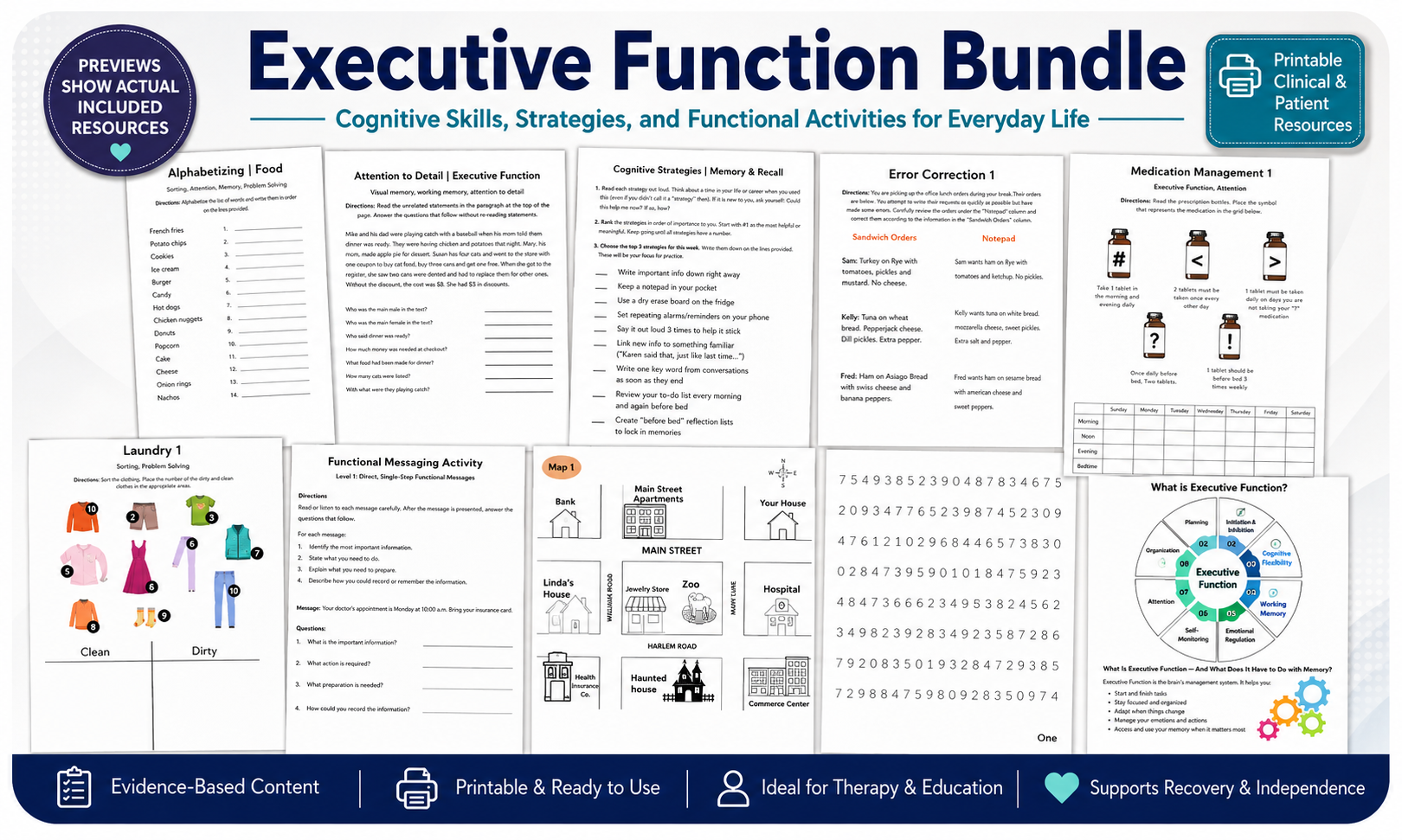
Not a member, but would like to purchase some of the resources seen in this article? Check out the Executive Functions Bundle
Executive functioning is often described as a collection of higher-level cognitive skills. In everyday life, however, it is what allows a person to decide what needs to be done, organize the steps, begin the task, respond when something changes, and recognize whether the outcome was successful.
Executive dysfunction may appear when a person:
- knows what they need to do but cannot get started
- begins a task without gathering the necessary materials
- completes steps in an unsafe or inefficient order
- becomes stuck when the original plan does not work
- overlooks important details
- struggles to divide or shift attention
- acts before considering the consequences
- cannot estimate how long an activity will take
- has difficulty recognizing or correcting errors
These difficulties can affect medication management, meal preparation, finances, household organization, work, school, appointments, health management, and social participation. Learn more about ADLs and IADLs on the ADL and IADL Resource Page
Member Resources for Home Activity Program | Priming :
- Laundry Sorting Worksheets
- Calendar Planning Packet
- Meal Preparation naming activity worksheets
- Medication Management Worksheets
- Grocery Shopping Worksheets
Occupational therapy intervention should therefore move beyond isolated “brain games.” The task should help the therapist understand how executive demands affect the participant’s ability to manage meaningful activities.
What Is Executive Functioning?
Member Resource: What is Executive Functioning Patient Education Handout
Executive functioning is not one skill. It involves several interacting processes, including:
- initiation
- planning
- organization
- sequencing
- working memory
- inhibition
- self-monitoring
- problem solving
- cognitive flexibility
- time management
- prioritization
- error recognition
A participant may perform well in one area and struggle in another.
For example, someone may accurately explain all the steps required to prepare a meal but fail to initiate the task without prompting. Another person may begin quickly but act impulsively, omit steps, and fail to recognize errors.
For this reason, documenting that a participant had “difficulty with executive functioning” is usually too broad. The therapist should identify the specific task demand and describe where performance broke down.
1. The A–Z Challenge
Member Resources:
Ask the participant to generate one item for each letter of the alphabet within a selected category.
Possible categories include:
- household items
- foods
- occupations
- places
- animals
- items found in a grocery store
- things needed for travel
- activities completed during a morning routine
This activity can address initiation, semantic retrieval, mental organization, persistence, working memory, processing speed, and strategy use.
Make the activity more functional
Instead of selecting an arbitrary category, connect the task to an upcoming occupation.
For example:
- identify items needed for a vacation
- generate foods that could be used in meal planning
- list tasks involved in moving to a new apartment
- identify supplies needed for a work or school project
The participant can then organize the generated items into groups, prioritize them, or place them into a sequence.
Observe more than the final score
Document:
- time required to begin
- number of items generated
- letters skipped
- repetition of responses
- use of categories or other strategies
- frequency of prompts
- signs of frustration or cognitive fatigue
- ability to detect missing or repeated answers
A participant who generates 20 items independently using an organized strategy presents differently from someone who also generates 20 items but requires frequent redirection and produces them in a disorganized manner.
2. Main-Idea Identification and Information Prioritization
Member Resources:
- Attention to Detail Level 1
- Attention to Detail Level 2
- Attention to Detail Level 3
- Attention to Detail Level 4
- Attention to Detail Level 5
- Attention to Detail Level 6
Give the participant a short article, message, paragraph, set of instructions, or functional scenario.
Ask them to identify:
- the main idea
- the most important details
- information that is interesting but not essential
- the action that should occur next
- possible consequences of overlooking a detail
This activity addresses prioritization, abstraction, information organization, reasoning, and the ability to separate relevant from irrelevant information.
Functional examples
A therapist might use:
- discharge instructions
- a workplace email
- an appointment reminder
- an apartment notice
- a recipe
- a school assignment
- written directions for completing a home task
The goal is not simply to summarize the paragraph. The participant must determine what matters and what should be done with the information.
Grade the activity
To simplify the task:
- reduce the amount of text
- highlight important words
- provide answer choices
- read the information aloud
- ask one question at a time
To increase complexity:
- add irrelevant details
- require the participant to explain their reasoning
- present two competing priorities
- introduce a time limit
- ask the participant to make a written action plan
3. Planning a Multistep Activity
Select an occupation that is meaningful to the participant and ask them to plan it before performing it.
Examples include:
- preparing a simple meal
- packing for an appointment
- completing a morning routine
- organizing a small event
- setting up a weekly pill organizer
- preparing materials for work or school
- completing a household cleaning task
Ask the participant to identify:
- the goal
- required materials
- the order of steps
- possible barriers
- safety concerns
- how they will know the task is complete
This provides richer information than asking the person to complete a generic sequencing worksheet.
Compare the plan with performance
Planning ability and task execution are not always the same.
A participant may create an accurate verbal plan but fail to follow it during the activity. Another may struggle to describe the plan but perform successfully when interacting with familiar objects.
The therapist can compare:
- predicted versus actual time
- planned versus completed steps
- anticipated versus unexpected barriers
- verbal knowledge versus real-world execution
- independent corrections versus therapist-directed corrections
4. Calendar Planning
Member Resource: Calendar Planning Home Activity Program
Provide a blank weekly or monthly calendar and several written or verbal events.
Examples might include:
- a therapy appointment Tuesday at 10:00
- a recurring class every Monday
- a bill due on the 15th
- a family event on Saturday
- transportation that must be scheduled two days in advance
- medication that must be refilled before Friday
Ask the participant to place the events accurately and then answer questions such as:
- Which days have more than one commitment?
- When should transportation be arranged?
- Is there enough time between the two appointments?
- What must be completed first?
- Which event could be moved if a conflict occurs?
Expand beyond placing dates
Simply entering events onto a calendar primarily assesses interpretation and organization. Executive demands increase when the participant must also:
- anticipate conflicts
- estimate travel time
- prioritize responsibilities
- create reminders
- determine what preparation is necessary
- update the plan when circumstances change
Use the participant’s actual system
Whenever appropriate, practice with the system the participant will use outside therapy:
- paper calendar
- planner
- phone calendar
- digital reminders
- written checklist
- family-shared calendar
Success with a large clinic calendar does not automatically mean the strategy will transfer to the participant’s daily routine.
5. Medication-Management Simulation
Member Resources:
Medication management can involve substantial executive demands, including interpreting directions, sorting information, sequencing, monitoring completion, and recognizing risk.
A simulated activity might require the participant to:
- interpret several medication labels
- identify the correct time of day
- sort simulated pills into a weekly organizer
- detect duplicate or conflicting instructions
- explain what they would do after missing a dose
- determine when a refill should be requested
- establish a reminder system
Important distinction
Successful pill sorting during one structured session does not independently establish medication-management safety.
The therapist should consider:
- visual access to labels
- literacy and health literacy
- hand function
- memory
- initiation
- consistency across days
- awareness of errors
- ability to respond to changes
- environmental distractions
- availability of support
The intervention may ultimately focus on modifying the environment or routine rather than repeatedly practicing unsupported sorting.
Grade the task
To simplify:
- use one medication
- present one instruction at a time
- use a large-print label
- provide color coding
- remove irrelevant information
To increase complexity:
- include several medications
- vary times and frequencies
- add conditional instructions
- introduce a schedule change
- include a distracting conversation
- require the participant to detect an intentionally created error
6. Serial Subtraction and Mental Manipulation
Member Resources:
Ask the participant to count backward or subtract at a consistent interval.
Examples include:
- count backward from 50
- subtract two from each number
- count backward by threes
- alternate adding and subtracting
- perform calculations while scanning a visual array
These activities place demands on sustained attention, working memory, rule maintenance, processing speed, and error monitoring.
However, arithmetic itself may not be the participant’s occupational goal. The therapist should be clear about why the task is being used.
It may function as:
- a brief probe of mental manipulation
- an interference condition during delayed recall
- a way to examine performance under divided attention
- preparation for managing quantities or financial information
Document the pattern of errors
Rather than writing only that the participant had “moderate difficulty,” record:
- starting number
- subtraction interval
- total responses
- number of errors
- self-corrections
- loss of task rule
- time to completion
- cueing required
- change across trials
7. Trail-Making Activities
Member Resource: Mock Trail Making Test
Create a trail of numbers, letters, words, images, or functional steps on paper, a whiteboard, a table, or throughout the room.
A simpler version might require the participant to connect numbers in sequence.
A more complex version might require alternating between:
- numbers and letters
- two colors
- categories
- household steps and safety checks
- appointments and preparation tasks
For example:
1, A, 2, B, 3, C
Alternating trails address visual search, rule maintenance, divided or alternating attention, sequencing, working memory, and cognitive flexibility.
Make it occupation-centered
A functional trail might ask the participant to alternate between:
- a meal-preparation step and its required object
- an appointment and its transportation plan
- a household task and its safety consideration
- an item and the room where it belongs
The task can also be completed on a wall or around the treatment space when safe mobility is relevant.
Observe search behavior
Document:
- systematic versus disorganized scanning
- loss of the alternating rule
- perseveration
- omitted targets
- self-correction
- need for visual or verbal cues
- time required
- effect of environmental clutter
8. Stroop-Inspired Inhibition Activities
Present information in which the automatic response conflicts with the required response.
A familiar example is displaying a color word in a mismatched color and asking the participant to name the ink color rather than read the word.
The activity can address inhibitory control, selective attention, processing speed, and the ability to maintain a rule despite competing information.
Functional alternatives
Inhibition can also be explored through tasks that resemble daily situations.
Examples include:
- respond only when a specific instruction is heard
- ignore irrelevant items while locating needed supplies
- pause before acting on a multistep direction
- review a written message before sending it
- stop and check safety before beginning a transfer or household task
- sort items using a rule that changes midway through the activity
Avoid equating inhibition with speed alone
Slower performance may represent deliberate self-monitoring rather than failure. The therapist should examine the balance between speed, accuracy, and impulsivity.
9. Rule-Switching and Cognitive Flexibility
Begin an activity using one sorting or response rule, then change the rule.
For example:
- Sort cards by color.
- Change to sorting by number.
- Change again to sorting by category.
- Ask the participant to explain the current rule before each response.
Other options include:
- alternate between naming and describing objects
- switch from alphabetical to size-based organization
- change a meal plan when an ingredient is unavailable
- revise a schedule after an appointment is cancelled
- develop a second route when transportation changes
This helps the therapist observe how the participant responds when the original plan no longer applies.
Look for signs of reduced flexibility
These may include:
- continuing to use the previous rule
- becoming distressed by the change
- requiring repeated explanation
- slowing significantly
- abandoning the task
- failing to generate alternatives
- recognizing the problem but being unable to adapt
10. Error-Detection Activities
Member Resource: Error Correction Recipe Worksheets
Set up a familiar task with one or more intentional errors.
Examples include:
- missing an ingredient from a recipe
- placing an appointment on the wrong date
- putting one simulated medication in the wrong section
- arranging steps in the wrong order
- leaving an unsafe object in a walkway
- creating an incorrect grocery total
Ask the participant to review the task and identify what needs to be corrected.
This can address self-monitoring, reasoning, safety awareness, and error recognition.
Distinguish detection from correction
A participant may recognize that something is wrong but not know how to fix it. Another may correct an error only after the therapist directs attention to the relevant area.
Document:
- whether the error was independently detected
- time required to recognize it
- whether the participant understood its significance
- whether a correction was generated
- cueing needed
- whether the same error recurred
11. Time Estimation and Task Completion
Ask the participant to estimate how long a task will take before beginning it.
After the task, compare the estimate with the actual time.
Possible activities include:
- getting ready to leave the clinic
- organizing a bag
- completing a written form
- preparing a snack
- gathering materials
- locating several objects
- creating a short schedule
Then discuss:
- Was the estimate accurate?
- Which part took longer than expected?
- What could be prepared in advance?
- When should the task be started next time?
- Would a timer or reminder help?
This addresses prospective planning and time awareness rather than simply asking whether the participant can read a clock.
12. Functional Problem-Solving Scenarios
Present a realistic problem with more than one possible response.
Examples include:
- transportation does not arrive
- a medication refill runs out early
- two appointments are scheduled at the same time
- a planned meal ingredient is missing
- a bill is higher than expected
- the participant forgets a password
- an appliance does not work as anticipated
Member Resource: IADL and ADL Problem Solving Questions
Ask the participant to:
- identify the problem
- explain why it matters
- generate possible responses
- compare the advantages and risks
- select an action
- identify when assistance should be requested
The response should not be scored only as right or wrong. The therapist should examine reasoning, safety, flexibility, and the ability to anticipate consequences.
How to Grade Executive-Functioning Activities
Executive tasks can be modified across 9 dimensions.
- Structure: Increase or decrease the number of instructions, visible boundaries, templates, and organizational supports.
- Familiarity: Begin with familiar routines before introducing novel tasks.
- Number of steps: Use fewer steps initially, then increase the sequence length.
- Competing information: Add irrelevant details, distractions, or secondary demands only when appropriate.
- Time pressure: Remove time limits when accuracy and strategy development are the priority. Add time demands when speed is functionally relevant.
- Rule complexity: Use one consistent rule before requiring alternating or changing rules.
- Choice demands: Provide limited choices initially, then ask the participant to generate options independently.
- Error visibility: Make errors obvious before introducing subtler problems.
- Environmental support: Compare performance with checklists, visual models, labels, timers, alarms, or organizational systems.
Track whether the participant requires:
- general encouragement
- verbal redirection
- leading questions
- visual cues
- step-by-step instruction
- physical setup
- error correction
What Should Be Documented?
Helpful Resources:
- Documentation and BIling for Occupational Therapy
- Functional Cognition in Clinical Practice - Billing, Medical Necessity, and CMS Standards
Strong documentation should identify the executive demand, observable performance, assistance, and occupational implication.
Useful variables include:
- initiation time
- number of steps completed
- sequencing errors
- omitted or repeated steps
- rule violations
- impulsive responses
- self-corrections
- time-estimation accuracy
- strategy use
- cueing level
- response to unexpected changes
- error awareness
- cognitive fatigue
- safety judgment
- transfer to the functional task
Sample Objective Documentation
The participant completed a simulated weekly scheduling task involving six appointments, two recurring responsibilities, and one transportation requirement. The participant entered five of six events accurately but initially scheduled two activities during overlapping time periods. With one verbal prompt to review the calendar for conflicts, the participant identified and corrected one overlap but required a direct cue to recognize the second. The participant independently entered phone reminders for three time-sensitive events. Performance indicates improving use of external organizational strategies, with continued difficulty independently monitoring for scheduling conflicts that may affect appointment and household management.
Another Sample: Medication Management
The participant completed a simulated medication-management activity involving three written medication schedules and a seven-day organizer. The participant accurately interpreted morning and evening instructions for two medications but omitted the midday medication on four of seven days. After using a written time-of-day checklist, the participant corrected all omissions without additional cueing. The participant did not independently detect one intentionally misplaced item during final review. Continued intervention will address systematic error checking and use of an external checklist to support health-management safety.
From Executive Exercise to Occupational Performance
A person may complete a card sort, trail-making activity, or planning worksheet successfully and still struggle to organize medications, arrive at appointments, or complete a household routine.
This does not make the preparatory activity useless. It means that the activity must be connected to transfer.
After an executive-functioning task, ask:
- Where does this same problem happen in daily life?
- Does the participant recognize the similarity?
- Can the strategy be applied during the actual occupation?
- What environmental support is needed?
- Does the participant use the strategy without therapist prompting?
- Will the strategy still work when the routine changes?
Executive-functioning intervention becomes occupational therapy when the cognitive demand, therapeutic method, and participation goal are deliberately connected. The goal is to help the person plan, begin, adapt, monitor, and complete the activities that organize everyday life.
Continue Learning With Us
Did you find this information helpful? Please share this article with another occupational therapy practitioner, student, educator, or rehabilitation professional who may benefit from it.
Would you like access to the clinical resources discussed throughout this article? Explore our membership options to find the level of support that works best for you.
Looking for a more formal learning and mentorship experience? Learn more about the Functional Cognition Lab Mentorship Program.
You can also explore our AOTA-approved courses and clinical resource packages for additional education, treatment resources, and practical tools you can use in rehabilitation practice.
Interested in receiving free functional cognition education each week? Subscribe to the Functional Cognition Lab Newsletter.