
Executive Function Bundle
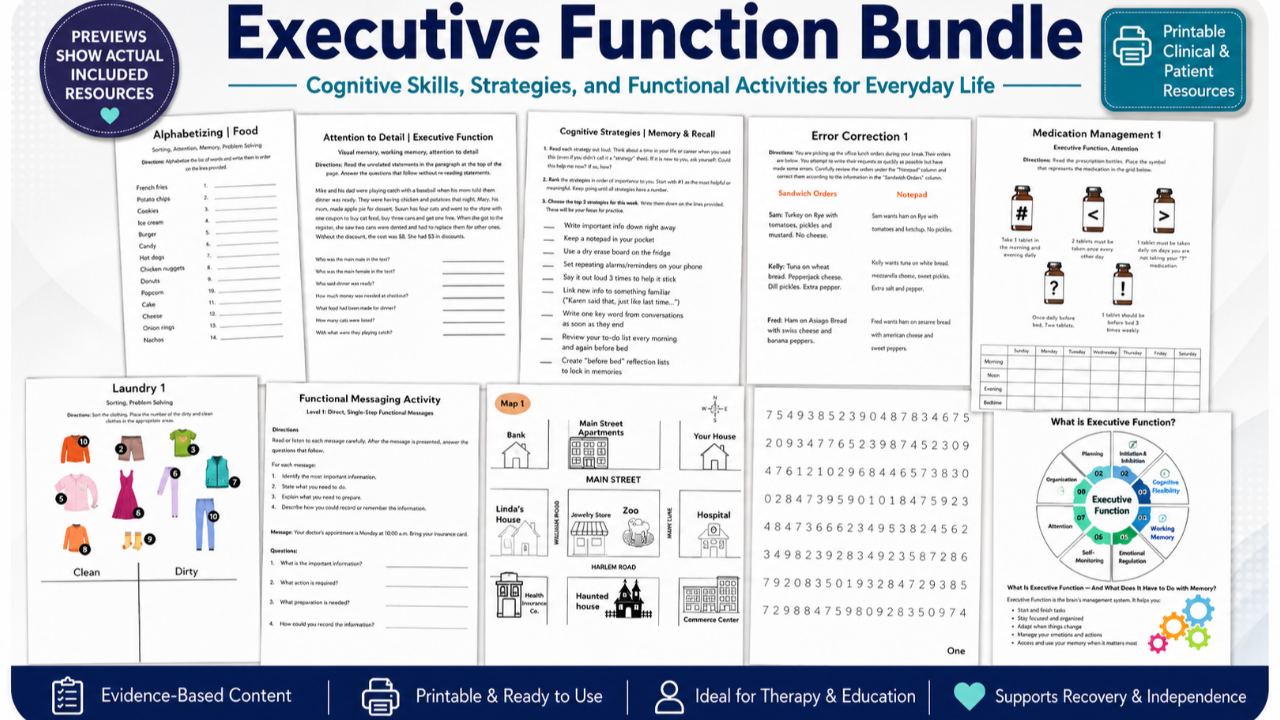
The Executive Function Bundle gives occupational therapy practitioners a large collection of ready-to-use resources for addressing executive function and functional cognition across a variety of treatment needs. Rather than focusing on a single cognitive skill, the bundle includes foundational education, cognitive strategy training, structured remediation activities, and increasingly functional tasks involving medication management, communication, household activities, visual attention, problem solving, organization, and community navigation. The materials can be selected and graded according to the participant's abilities, goals, and occupational demands, allowing practitioners to work on both cognitive remediation and compensatory strategy development within the OT plan of care. The included executive function education specifically connects skills such as initiation, inhibition, cognitive flexibility, working memory, emotional regulation, self-monitoring, attention, organization, and planning with everyday performance.
Included Resources
1. Alphabetizing Workbook
A 30-page cognitive activity workbook using alphabetization and categorization tasks to address sorting, attention, memory, organization, sequencing, and problem solving. Activities provide a structured way to increase cognitive demands while working with familiar information.
2. Attention to Detail Workbook
A 20-page collection of activities targeting visual memory, working memory, attention to detail, information retention, and accurate retrieval. Participants read and process information and then respond to questions designed to challenge how effectively important details were encoded and retained.
3. Cognitive Strategies Worksheets
A 9-page strategy resource that helps participants identify, prioritize, and practice compensatory cognitive strategies for areas including memory and recall, visual scanning and spatial awareness, planning and sequencing, attention, and focus. Each section encourages participants to select strategies that are personally relevant and choose specific strategies to practice during the week.
4. Coping Strategies Master List
A 7-page strategy resource addressing areas such as cognitive flexibility, balancing emotion and reasoning, self-awareness, wellness, and participation. Activities encourage reflection, adaptation, self-monitoring, and selection of practical strategies that can be incorporated into everyday routines.
5. Error Correction Workbook
A 12-page functional cognitive workbook requiring participants to locate discrepancies, compare information, identify errors, and make corrections. Tasks use everyday situations such as reviewing incorrectly recorded lunch orders to target attention to detail, working memory, problem solving, self-monitoring, and error detection.
6. Executive Functions Introduction
A patient- and clinician-friendly introduction explaining how executive functions contribute to problem solving and critical thinking. The resource discusses initiation, planning and organization, working memory, cognitive shifting, emotional control, inhibition, and self-monitoring while connecting these skills to occupational therapy assessment and intervention.
7. Functional Messaging Activity – Level 1
An 11-page functional cognition activity using realistic everyday messages involving appointments, prescriptions, transportation, errands, household tasks, and other daily responsibilities. Participants identify the important information, determine the required action, identify necessary preparation, and select an appropriate strategy for remembering or completing the task.
8. Laundry Workbook
A 7-page functional activity workbook using laundry-related tasks to address sorting, categorization, problem solving, visual attention, and executive functioning within a familiar IADL context.
9. Cognitive Functions in Occupational Performance Reference Guide
A 4-page reference guide defining a broad range of cognitive functions that may influence occupational performance. The guide includes concepts such as attention shifting, attention to detail, cognitive flexibility, cognitive mapping, contextual reasoning, decision-making, memory, and numerous additional cognitive processes practitioners may observe during treatment.
10. Maps for Worksheet Activities
Three illustrated community maps that can be incorporated into navigation, route planning, visual scanning, spatial reasoning, problem solving, memory, direction-following, and other functional cognition activities. Locations include homes, businesses, a hospital, bank, apartments, community destinations, and intersecting streets.
11. Medication Management Workbook
A 16-page functional cognitive workbook centered on understanding and organizing simulated medication instructions. Activities require participants to interpret prescription information and place medications into appropriate schedules, creating opportunities to address attention, executive function, sequencing, organization, working memory, and medication-management reasoning.
12. Numbers Activity
An 8-page visual number activity that can be incorporated into interventions targeting sustained attention, visual scanning, processing speed, selective attention, accuracy, and other cognitive-perceptual demands.
13. What Is Executive Function?
A 3-page educational handout explaining executive function as the brain's “management system” and illustrating the relationship among initiation and inhibition, cognitive flexibility, working memory, emotional regulation, self-monitoring, attention, organization, and planning. It also helps explain why difficulties that appear to be purely memory-related may involve how information is attended to, organized, encoded, and retrieved.
14. Map Activities
A 19-page functional cognition workbook using three community-based maps to address navigation, route planning, spatial reasoning, attention, problem solving, inference, sequencing, and executive function. Activities progress from direct navigation questions to inferential reasoning and more complex real-world scenarios requiring the participant to organize multiple errands, consider time constraints, adjust plans, and respond to unexpected changes. Answer keys are included for clinician reference.
15. Navigation Abilities Introduction
A 4-page educational resource explaining the cognitive processes involved in topographical organization and everyday navigation. The handout reviews the roles of sensory input, attention, perception, memory, mental mapping, route planning, decision-making, and spatial awareness, while also introducing the involvement of the hippocampus, parietal lobe, and prefrontal cortex in navigation. Practical examples help connect these concepts to real-world activities such as navigating a new city, moving through familiar environments, and using GPS.
I would also replace the earlier “Maps for Worksheet Activities” listing with these two listings on the offer page. The three-page Maps PDF is really the supporting map set, while Map Activities is the actual interven