When Rehab Isn’t “High Intensity", Is It Still Enough?
Feb 12, 2026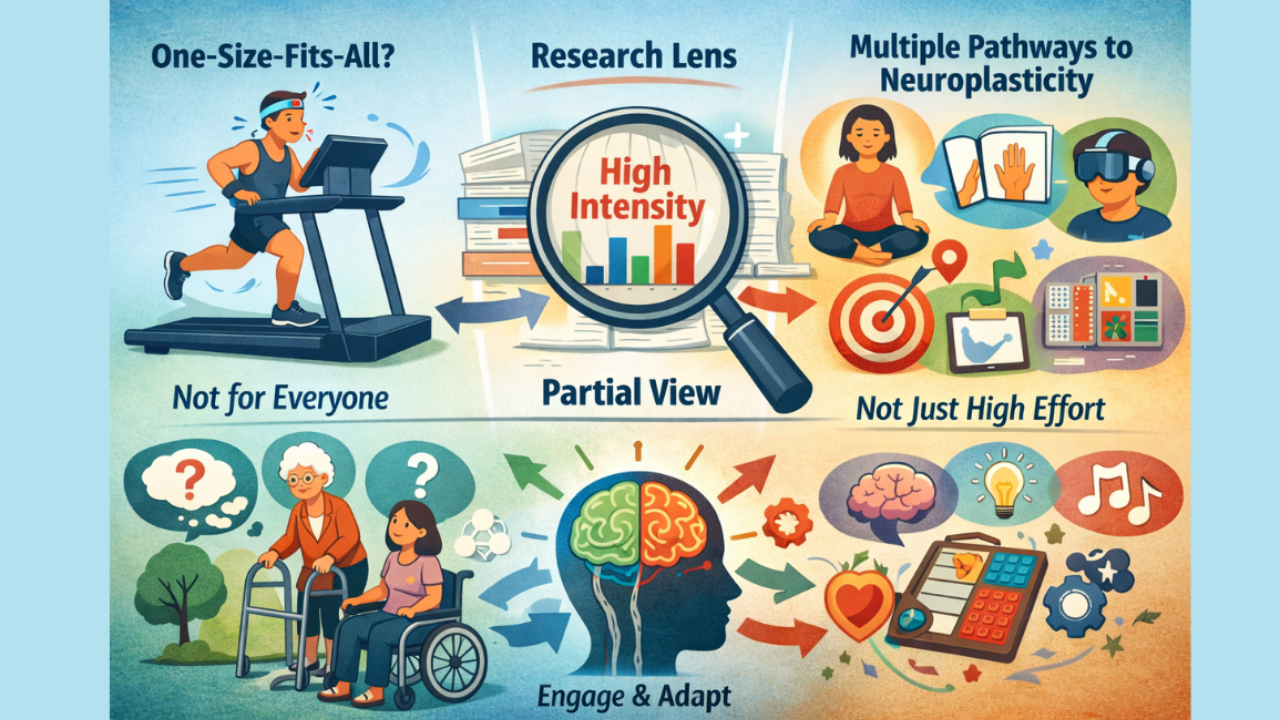
When Rehab Isn’t “High Intensity,” Is It Still Enough?
There is a quiet fear many rehabilitation clinicians and patients share: If we are not pushing high intensity, are we doing enough to change the brain?
We have all seen the messaging.
High repetitions. High load. Forced use. Bootcamp-style recovery. “More is better” gets repeated so often that it begins to sound like a rule.
Don't misunderstand me, high-intensity rehabilitation can be extremely valuable. It may improve cardiovascular capacity, strength, endurance, movement repetitions, and opportunities for motor learning.
However, and this is a big however, neurorehabilitation is not a gym competition.
The truth is more nuanced.
What Do We Mean by Intensity?
One reason this conversation becomes confusing is that intensity does not only mean heart rate, resistance, speed, or physical exhaustion.
Rehabilitation intensity may also involve:
- Repetition
- Duration
- Attention
- Task complexity
- Cognitive effort
- Sensory demand
- Emotional engagement
- Frequency of practice
- Personal meaning
- The amount of feedback and error correction required
An intervention can look physically quiet while still requiring a significant amount of nervous system involvement.
A patient practicing motor imagery may not appear physically active, but they may be working hard to create and maintain an accurate internal representation of movement.
A patient completing sensory discrimination training may not elevate their heart rate, but the nervous system is still being asked to attend, compare, process, and adapt.
A person completing a meaningful daily task may engage more deeply than they would during a physically harder exercise with little personal relevance.
Physical intensity matters, but it is not the only kind of therapeutic intensity. These ideas are all part of functional cognition.
The Fear Behind Lower-Intensity Work
The concern is understandable. If neuroplasticity is experience-dependent and repetition helps drive change, it feels logical to assume that lower physical intensity equals weaker results.
Clinicians worry they are underdosing treatment while patients may worry they are wasting valuable recovery time. However, recovery is not a simple volume equation.
The nervous system does not respond only to force and fatigue. Learning and adaptation may also be influenced by:
- Attention
- Repetition
- Salience
- Novelty
- Feedback
- Error
- Motivation
- Meaning
- Timing
- Emotional state
- Sleep
- Fatigue
- The ability to retain what was practiced
High physical intensity is one pathway through which rehabilitation may promote change.
It is not the only pathway.
Not Every Approach Works for Every Nervous System
There is no universal rehabilitation protocol that works equally well for everyone. Two people with the same diagnosis may respond very differently to the same intervention.
Their response may be influenced by:
- Lesion location
- Disease severity
- Cognitive capacity
- Emotional regulation
- Fatigue tolerance
- Sensory processing
- Motivation
- Prior experiences
- Sleep and stress
- Pain
- Medication effects
- Cardiovascular tolerance
- Learning style
- Environmental support
A patient who shuts down under high physical demand may learn more effectively through shorter, distributed, lower-load practice with strong cognitive engagement.
Another patient may thrive when the treatment is physically demanding and fast-paced.
Neither response makes the patient weak, unmotivated, or resistant to recovery.
Rehabilitation is about matching the dose, style, timing, and challenge to the nervous system in front of us.
Research Shows a Slice of Reality
Research studies are designed to answer focused questions. Investigators usually select a specific population, intervention, dosage, comparison, and outcome. They may exclude people with certain medical conditions, cognitive impairments, fatigue levels, medication profiles, or complex presentations. This is not necessarily a flaw. Controlling variables helps researchers determine whether an intervention is related to an outcome. However, it also means that no single study captures the full complexity of neurological recovery.
Clinical practice includes:
- Fluctuating symptoms
- Multiple diagnoses
- Emotional responses
- Family and caregiver factors
- Environmental barriers
- Different levels of motivation
- Different meanings attached to activities
- Good days and bad days
- Limited time, transportation, or financial resources
A study showing benefits from high-intensity training does not automatically prove that lower-load interventions are ineffective. It shows that a particular approach produced measurable results in a particular group under particular conditions. That information matters, but evidence guides clinical reasoning. It does not replace it.
Can Lower-Load Interventions Still Support Neurological Recovery?
Lower physical intensity does not mean the nervous system is inactive.Depending on the person, diagnosis, and treatment goal, lower-load or nontraditional interventions may still engage motor, sensory, cognitive, emotional, and attentional systems involved in rehabilitation.
Examples may include:
- Motor imagery
- Action observation
- Mirror therapy
- Sensory discrimination
- Goal-directed task practice
- Virtual or simulated environments
- Distributed practice
- Cognitive-motor activities
- Visual feedback
- Error-based learning
- Mindfulness and autonomic regulation
- Task-specific cognitive training
- Meaningful occupation-based practice
These approaches do not all have identical evidence, and they should not be treated as interchangeable. However, they demonstrate that the nervous system can be challenged through more than muscular exhaustion. One way to think about this is to view treatment as multimodal cognitive conditioning, where movement, attention, sensory processing, decision-making, and emotional regulation may all be working together.
A patient may improve by learning to detect sensory differences, imagine movement, recognize errors, organize a task, regulate symptoms, or practice a meaningful activity repeatedly and attentively.
The brain changes when it is challenged meaningfully, not only when it is exhausted.
Clinicians looking for a deeper clinical framework can explore the Dual Tasking in Neurorehabilitation course.
Productive Challenge Is Not the Same as Overload
High effort is not automatically harmful. Fatigue is not automatically evidence that treatment was poorly dosed. A patient may need to work hard, make errors, and experience temporary fatigue to improve. The challenge is that therapists must distinguish between productive challenge and overload.
Productive challenge may include:
- Increased effort with maintained safety
- Errors followed by correction
- Fatigue that improves with reasonable recovery
- Gradual improvement across trials
- Retention of the strategy
- Transfer into a functional activity
Possible overload may include:
- Complete loss of movement quality
- Inability to understand or retain instructions
- Increasing physical assistance
- Significant symptom escalation
- Repeated unsafe errors
- Withdrawal or shutdown
- Failure to recover adequately
- No clear connection between the activity and the treatment goal
A treatment may be beneficial over time while temporarily increasing fatigue during the session.
Both can be true.
The clinician must decide whether the fatigue represents a tolerable training response or whether it is interfering with safety, learning, and functional carryover.
What This Means for Clinicians
Using lower-load intervention does not mean you are failing the patient.
It may mean you are:
- Respecting fatigue
- Building attention
- Improving sensory awareness
- Increasing task salience
- Supporting emotional regulation
- Distributing practice
- Protecting movement quality
- Preparing the patient for greater intensity later
- Matching the intervention to the person’s current capacity
At other times, the patient may need more repetitions, faster movement, greater resistance, fewer rest periods, or higher cardiovascular demand. The point is to stop treating high physical intensity as the only legitimate sign of skilled rehabilitation.
What This Means for Patients
Recovery does not require constant maximal effort to be valid. A therapy session may look quiet and still require tremendous concentration, problem-solving, motor planning, sensory processing, and emotional regulation.This is especially important when movement and cognition happen together. Read more in Your Patient Is Working Hard. Their Brain Is Working Harder.
Progress may come from:
- Practicing consistently
- Focusing on movement quality
- Learning a useful strategy
- Repeating a meaningful activity
- Improving awareness
- Building tolerance gradually
- Managing symptoms well enough to stay engaged
- Applying therapy skills outside the clinic
Your treatment does not need to resemble a bootcamp to be meaningful. It needs to challenge the right system at the right level.
The next part of this conversation is understanding what happens when physical intensity and cognitive demand are increased at the same time. You can read more in Exercise Intensity and Cognitive Load in Neurorehabilitation.
Continue Learning With Us
Did you find this information helpful? Please share this article with another occupational therapy practitioner, student, educator, or rehabilitation professional who may benefit from it.
Would you like access to the clinical resources discussed throughout this article? Explore our membership options to find the level of support that works best for you.
Looking for a more formal learning and mentorship experience? Learn more about the Functional Cognition Lab Mentorship Program.
You can also explore our AOTA-approved courses and clinical resource packages for additional education, treatment resources, and practical tools you can use in rehabilitation practice.
Interested in receiving free functional cognition education each week? Subscribe to the Functional Cognition Lab Newsletter.