
Functional Cognition Pattern
Problem: Gets Lost Easily
They have trouble figuring out where to go—even in places that should feel familiar.
What this really is...
A breakdown in the brain’s ability to process space, orientation, and navigation in real time.
→ Spatial Cognition & Topographic Orientation Impairment
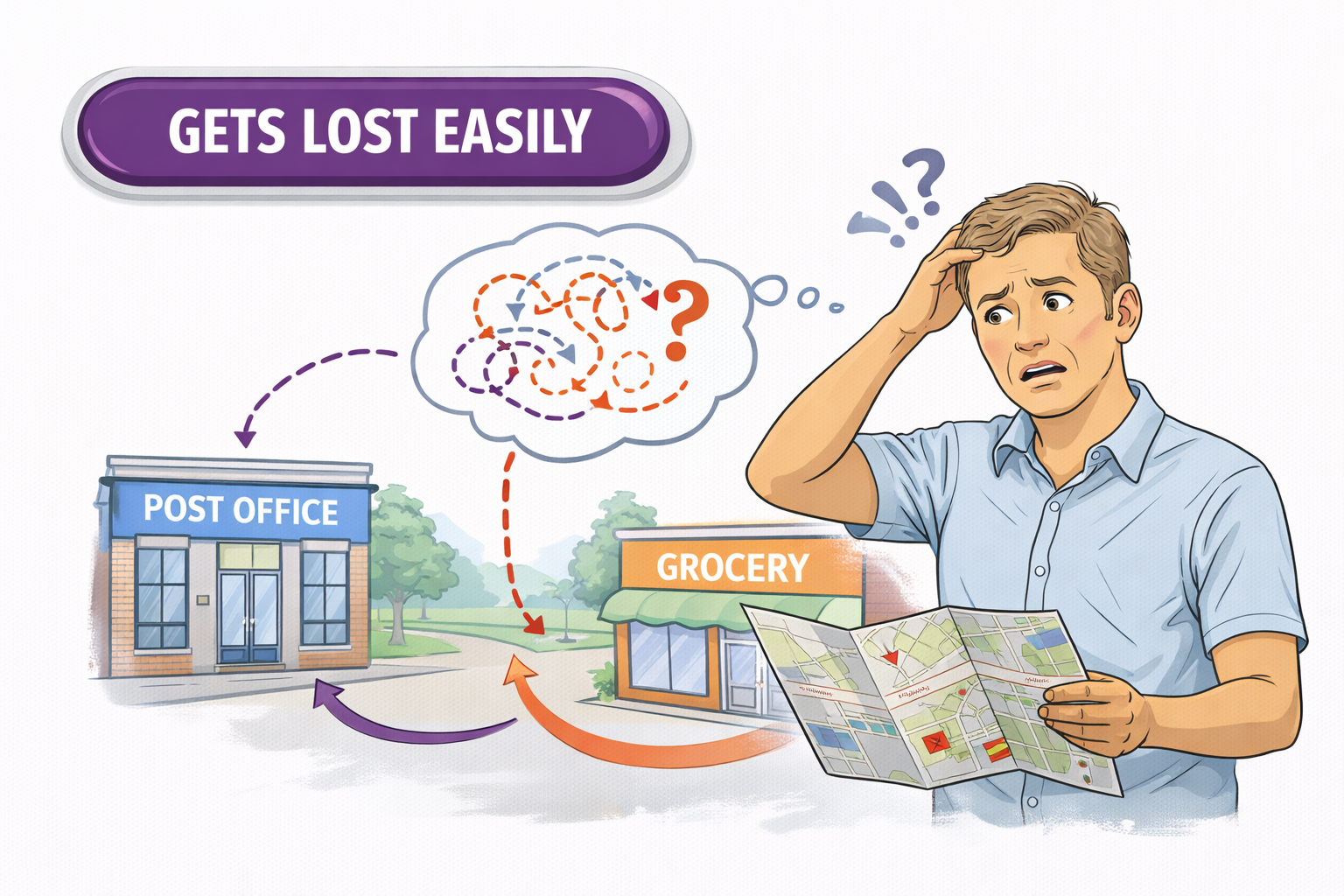
🧠 What You Are Seeing
- They get lost in familiar places
- They:
- hesitate at turns
- second-guess directions
- rely heavily on others
- appear unsure or anxious when navigating
They don’t trust where they are—or where they’re going.
⚙️ What Is Actually Happening
Navigation is not just memory—it’s a network process.
It requires:
- spatial awareness (where am I?)
- topographic orientation (how do I get there?)
- attention and scanning
- motor planning and movement through space
The brain must continuously:
- process the environment
- update position
- make directional decisions
👉 When this system is disrupted, navigation breaks down.
They are not just forgetting—
they are losing spatial organization.
🔎 Real Clinical Example
Patient walks independently with normal strength.
But when navigating:
- hesitates at intersections
- chooses incorrect directions
- becomes disoriented in new or busy environments
- relies on others for guidance
→ Movement is intact
→ Navigation and spatial processing are impaired
⛓️💥 Skills Breakdown
- Can walk → can’t navigate
- Recognizes places → can’t connect them
- Follows paths → struggles with decision points
- Moves safely → becomes unsafe when direction is required
⚠️ Why This Gets Missed
- Strength and mobility appear normal
- Testing may not assess real-world navigation
- Difficulties only appear in dynamic environments
We assume:
“They just need to pay more attention.”
But the brain is struggling to process space and direction.
🛠️ What To Do About It
- Simplify environments during training
- Practice navigation in controlled settings
- Use visual landmarks and structured routes
- Gradually increase environmental complexity
At the same time:
- train spatial awareness
- train through mental practice & rehearsal
- challenge directional decision-making
- integrate movement with navigation tasks
The goal is not just movement—
it’s safe and accurate navigation.
These are starting points - not full interventions.
Treating this effectively requires structured progression, environmental exposure, and targeted training of spatial processing and navigation skills.
This is where most clinicians get stuck.
How This Fits Into Clinical Practice
Standardized tests may not fully capture spatial navigation in real environments.
- Tests assess components of cognition
- Functional tasks reveal real-world navigation ability
Performance can be tracked through:
- accuracy of direction
- hesitation or delay
- need for cues
- safety during navigation
This is critical for independence and community mobility.
If they can’t navigate, they can’t move safely in the real world.
Want to Go Deeper
This is a key—but often overlooked—area of functional cognition.
Learn how to:
- assess spatial and navigation deficits
- train topographic orientation
- improve safety and independence