
Functional Cognition Pattern
Problem:
Can Function, But Memory Scores Low
They seem okay day-to-day—but testing tells a different story.
What this really is...
A gap between measured memory ability
…and real-world performance supported by compensation.
→ Compensated Function with Underlying Memory Impairment
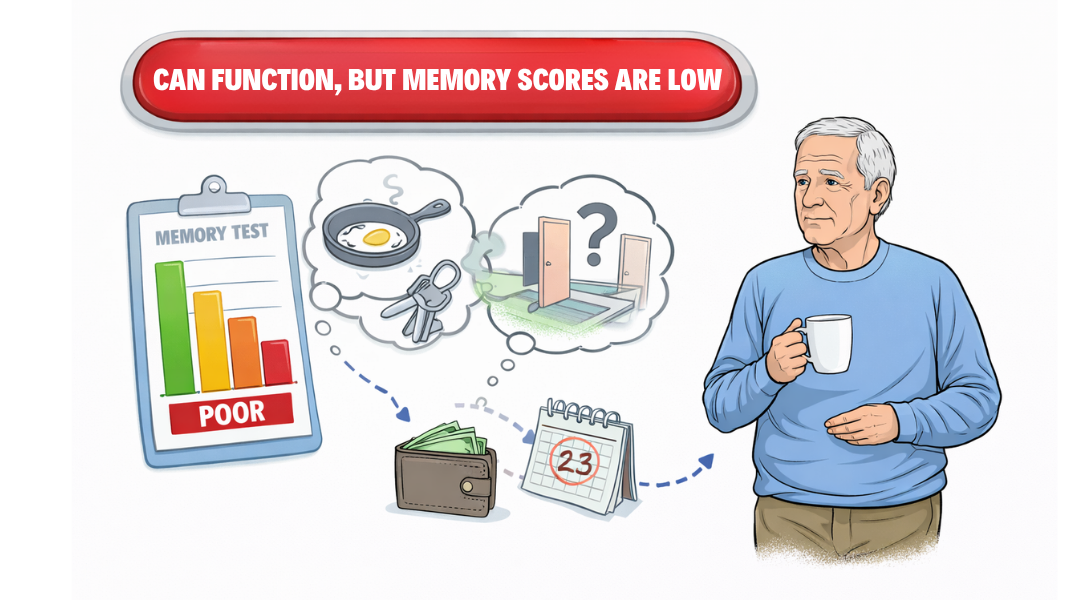
What You Are Seeing
- Memory scores are low on testing
- But in daily life, they:
- appear independent
- complete familiar tasks
- “get by” without obvious errors
It can look like memory isn’t a real problem.
What Is Actually Happening
The brain is using compensatory strategies to maintain function.
- habits and routines
- environmental cues
- repetition and familiarity
- over-reliance on structure
These supports allow performance to look intact…
but the underlying memory system is still impaired.
🔎 Real Clinical Example
Patient demonstrates low memory scores on standardized testing.
But in daily routines:
- follows the same morning sequence
- prepares familiar meals
- completes habitual tasks independently
When something changes:
- misses steps
- forgets new information
- becomes confused or stuck
→ Function is supported—not fully independent
→ Breakdown occurs when routine is disrupted
⛓️💥 Skills Breakdown
- Familiar tasks mask memory impairment
- Routine creates the appearance of independence
- Testing shows impairment—but function looks intact
We assume:
“If they’re functioning, memory must be fine.”
But function may be supported—not restored.
Why This Gets Missed
- Familiar tasks mask memory impairment
- Routine creates the appearance of independence
- Testing shows impairment—but function looks intact
We assume:
“If they’re functioning, memory must be fine.”
But function may be supported—not restored.
What To Do About It
- Introduce controlled variability into tasks
- Gradually reduce reliance on routine
- Practice learning new information in context
- Use external supports intentionally (not passively)
The goal is not just maintaining function—
it’s improving adaptability and learning.
How This Fits Into Clinical Practice
Standardized tests identify memory impairment.
But functional performance may appear intact due to compensation.
- Tests reveal underlying deficits
- Functional tasks reveal how those deficits are managed
Both are critical for understanding risk, safety, and progression.
These patterns can be:
- observed
- measured
- and tracked when task demands change
Want to Go Deeper
This pattern is often misunderstood—and often missed.
Learn how to:
- identify compensation vs true independence
- assess breakdown under change
- treat memory within real-world function
👉 Explore Courses, Tools, and Training