
Occupational Therapy for Arthritis
Aug 04, 2026
Occupational Therapy for Arthritis:
Evaluation, Joint Protection, and Everyday Activities
Helpful BOT Portal Page: Arthritis in Occupational Therapy
Membership Resources: This article and its companion audio are free to read and listen to. Links throughout the article connect members of the Functional Cognition Lab to related printables, treatment tools, courses, and clinical resources that align with the topic being discussed. Membership also includes access to the full resource library and direct clinical support. Find out more about membership on the Membership Options Page
Just want the resources mentioned in this article? Download the Arthritis Resource Bundle:
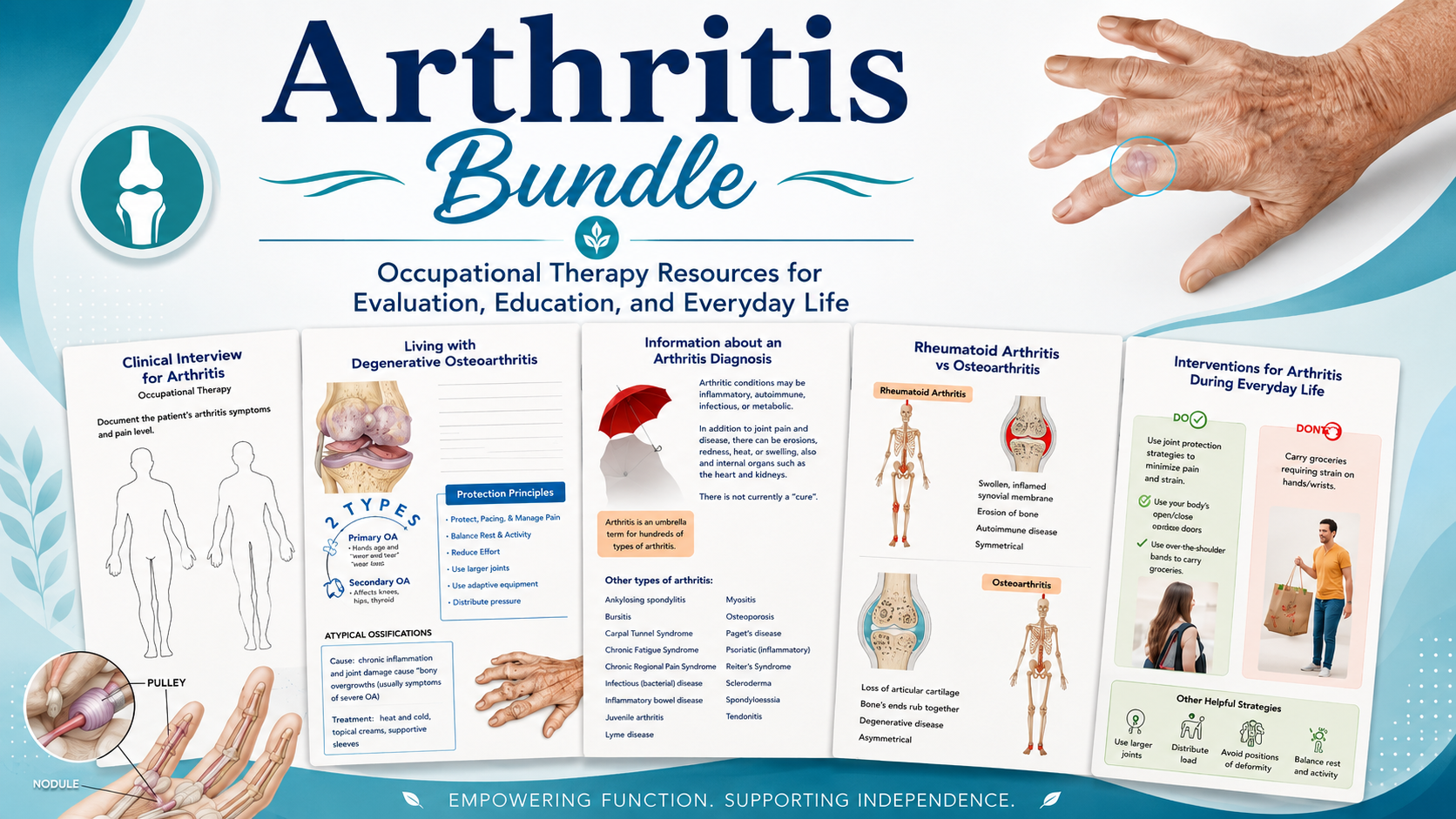
Arthritis is often discussed as though it is one diagnosis, but it is actually an umbrella term that includes many conditions affecting the joints and surrounding tissues. Some forms are primarily degenerative, while others involve autoimmune, inflammatory, infectious, or metabolic processes. This distinction matters because osteoarthritis, rheumatoid arthritis, gout, and other arthritic conditions do not affect the body in exactly the same way. Occupational therapy practitioners must understand both the diagnosis and the way symptoms are interfering with the person’s everyday life.
Arthritis may cause joint pain, stiffness, swelling, weakness, fatigue, reduced range of motion, and changes in joint shape or stability. These symptoms can make it harder to walk, climb stairs, get out of a chair, dress, bathe, prepare meals, open containers, write, carry groceries, and participate in work or leisure. The problem is rarely limited to one joint. Over time, people may change how they move, avoid certain activities, rely excessively on other joints, or stop participating in occupations that are important to them.
The AOTA arthritis fact sheet provides a helpful overview of occupational therapy’s role in arthritis management. Occupational therapy may address joint protection, pain management, exercise, adaptive equipment, splinting, environmental modification, energy conservation, self-management, and participation in meaningful activities. The goal is not simply to reduce a symptom during treatment. The goal is to help the person continue living as safely, comfortably, and independently as possible.
Osteoarthritis and Rheumatoid Arthritis Are Not the Same
Osteoarthritis and rheumatoid arthritis are two common conditions, but they involve different underlying processes. Osteoarthritis involves changes across the entire joint, including cartilage, bone, synovium, muscles, and surrounding tissues. Rheumatoid arthritis is an autoimmune inflammatory disease that can affect several joints symmetrically and may also cause fatigue and other whole-body symptoms.
This difference affects occupational therapy planning. A person with osteoarthritis may primarily report pain, stiffness, reduced movement, and difficulty tolerating repeated joint loading. A person with rheumatoid arthritis may experience changing levels of inflammation, fatigue, joint instability, and systemic symptoms. The therapist must consider disease activity, current inflammation, medications, joint integrity, and the person’s response to activity before deciding how aggressively to strengthen or progress a task.
ClinicianTip: A simple visual comparison can help patients and students understand these differences.
Member Resource: The Rheumatoid Arthritis Versus Osteoarthritis resource contrasts the autoimmune and inflammatory features of rheumatoid arthritis with the joint changes associated with osteoarthritis.
How Arthritis Affects Occupational Performance
Arthritis becomes an occupational therapy concern when joint symptoms interfere with daily activities, roles, routines, or health management. Hand arthritis may make it difficult to manage buttons, medication bottles, utensils, keys, phones, or food containers. Hip and knee arthritis may affect dressing, bathing, toileting, transfers, vehicle access, household mobility, and community participation.
Pain and fatigue may also change how a person organizes the day. Someone may complete several demanding activities in the morning and then have little energy left for meal preparation, social participation, or exercise. Another person may avoid movement because of fear that pain means additional damage. Occupational therapy examines these patterns and determines whether the person needs remediation, adaptation, education, environmental changes, or a combination of approaches.
Psychosocial factors also matter. Confidence, coping, self-efficacy, resilience, social support, and the person’s sense of control may influence how successfully they manage a chronic condition. The Salutogenesis: Assets for Health and Wellbeing resource provides useful language for recognizing and documenting strengths such as coping, empowerment, resilience, connectedness, and quality of life.
What Should an Occupational Therapy Evaluation Include?
An arthritis evaluation should go beyond a pain score and range-of-motion measurement. The therapist needs to understand when symptoms began, which joints are affected, how symptoms change throughout the day, how long morning stiffness lasts, whether fatigue or whole-body symptoms are present, and which activities are becoming difficult.
The evaluation may include:
- Pain location, intensity, and symptom pattern
- Joint stiffness, swelling, instability, or visible changes
- Strength, endurance, range of motion, and movement quality
- Grip, pinch, fine motor coordination, and hand use
- Fatigue and activity tolerance
- ADL and IADL performance
- Home, work, and community demands
- Current medications, splints, equipment, and self-management strategies
- The person’s priorities, confidence, and perceived barriers
The Clinical Interview for Arthritis provides a structured way to document pain location, disease onset, medication use, morning stiffness, joint patterns, visible deformities, muscle weakness, and difficulty with everyday tasks. A separate Pain and Trigger Point Tracker can help the patient identify where symptoms occur and whether the location changes over time.
Occupational Therapy Interventions for Arthritis
Occupational therapy treatment should be based on the specific mechanism interfering with function. Pain alone is not a precise treatment target. One person may need help reducing sustained grip, while another needs to improve lower-extremity strength, manage fatigue, modify a kitchen setup, or develop a safer way to carry objects.
Joint Protection
Joint-protection strategies reduce unnecessary stress while allowing the person to continue participating in daily activities. These strategies may include using larger and stronger joints, distributing weight across several joints, avoiding prolonged gripping, enlarging handles, changing position regularly, and reducing repetitive twisting or pinching.
For example, a person may hold a mug with two hands instead of gripping one small handle. They may push a grocery cart instead of carrying a basket, slide a heavy object across the counter instead of lifting it, or carry a flat object on the forearms instead of gripping its edges. The Interventions for Arthritis During Everyday Life guide provides practical examples for carrying, opening doors, handling kitchen items, reading, typing, and reducing repetitive strain.
Activity Grading and Energy Conservation
Activity grading involves changing the demands of a task so the person can participate successfully without causing an unnecessary flare. The therapist may adjust duration, resistance, repetitions, position, grip demand, environmental setup, or the number of steps involved. Rest may be planned before the person reaches complete exhaustion rather than only after symptoms become severe.
Energy conservation does not mean avoiding all activity. It means using energy intentionally so the person can complete the occupations that matter most. This may include alternating heavy and light tasks, sitting for part of meal preparation, organizing supplies before beginning, using a rolling cart, or dividing housework across several days.
Adaptive Equipment and Environmental Modification
Adaptive equipment can reduce joint stress and make activities easier to complete. Examples include large-handled utensils, electric can openers, jar-opening devices, button hooks, long-handled equipment, lightweight cookware, raised seating, and lever-style door handles.
Environmental changes may be equally important. Frequently used items can be moved within easy reach, heavy containers can be replaced with smaller ones, and work surfaces can be adjusted to reduce awkward positioning. These changes are not failures or shortcuts. They are treatment ingredients that improve the fit between the person, the task, and the environment.
Therapeutic Activity and Exercise
People with arthritis may still benefit from strengthening, mobility, balance, and endurance training. The program may simply require modification according to current pain, inflammation, fatigue, joint integrity, and disease activity. The goal is to support joint stability, maintain movement, reduce deconditioning, and improve the person’s ability to complete meaningful tasks.
Exercises become more relevant when connected to function. Repeated sit-to-stand practice may support toileting and community mobility. Reaching activities may prepare the person to access cabinets or clothing. Carrying graded household objects may improve tolerance for groceries, laundry, or work materials.
Main Takeaways
Arthritis management is not limited to treating painful joints. Occupational therapy examines how pain, stiffness, weakness, fatigue, environmental demands, habits, and emotional responses affect the person’s ability to live independently. Intervention may include joint protection, activity grading, adaptive equipment, movement training, environmental modification, and self-management education.
The strongest treatment plans connect each strategy to a real occupational problem. The question is not only whether grip strength improved or pain decreased during a session. The more important question is whether the person can now prepare a meal, manage medication, dress, move through the home, participate in work, or return to a valued activity with greater comfort and control.
Helpful Arthritis Resources
- Clinical Interview for Arthritis: Organizes symptom history, joint patterns, morning stiffness, visible changes, pain location, and occupational concerns.
- Rheumatoid Arthritis Versus Osteoarthritis: Provides a visual comparison of two common arthritis diagnoses.
- Living With Degenerative Osteoarthritis: Explains joint changes and basic joint-protection principles.
- Interventions for Arthritis During Everyday Life: Gives practical examples of reducing joint strain during ADLs and IADLs.
- Rheumatoid Arthritis Information: Reviews inflammation, systemic effects, bone health, physical activity, and health management.
- Arthritis Resources