I Almost Failed Neuro in OT School — And Now I Study the Brain
Jun 26, 2026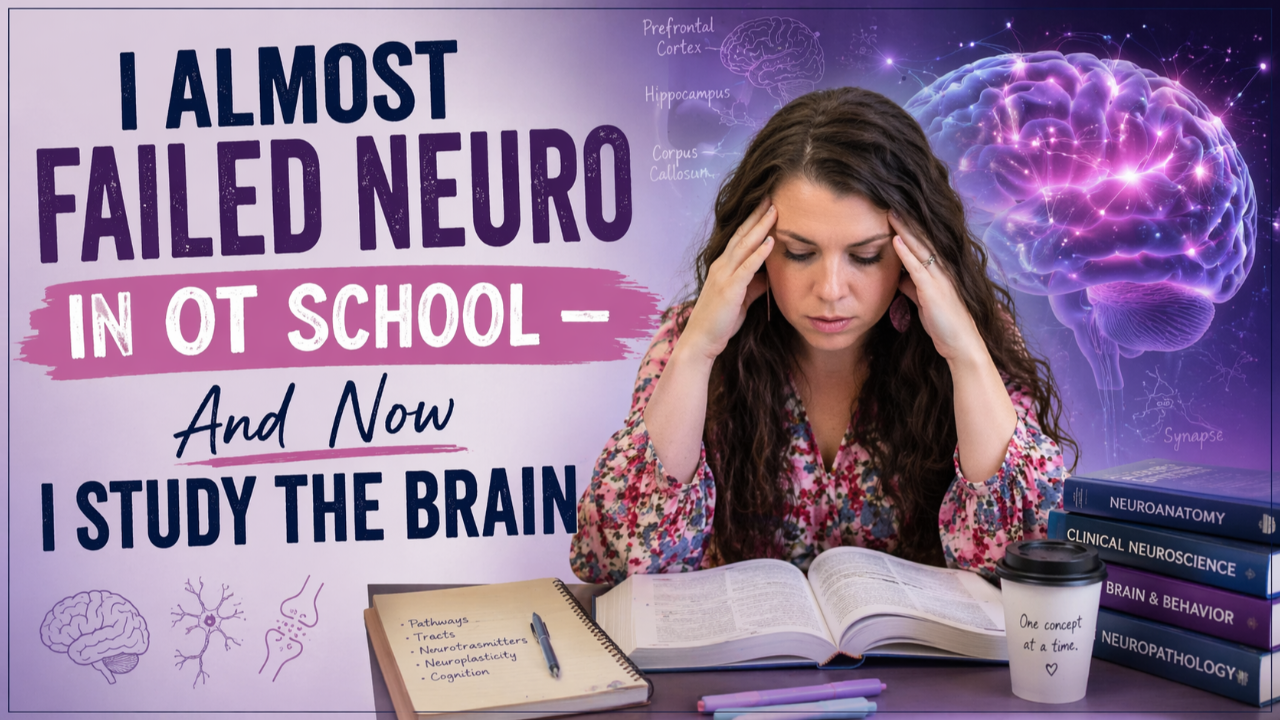
I Almost Failed Neuro. Here's What Happened Over the Next 10 Years.
Welcome to the companion audio for the Beyond Occupation article, “I almost failed neuro - heres what happened over the next 10 years.” I’m your host, Michelle Eliason.
If you’re interested in learning more about neuro and functional cognition (the connection bretween neuroscience and everyday activity, check out the links in the show notes. BOT Portal is home to the Functional Cognition Lab and I know you will love the content. As a reminder, Every Beyond Occupation article connects you with real-world examples, clinical resources, downloadable handouts, and more to help you bring the information directly into practice.
Now for the main topic......
There's something we don't say enough in rehab:
Not everyone gets neuroscience right away.
I didn't.
I almost failed my neuro courses in OT school. The pathways didn't make sense. The terminology felt like another language. I could memorize things, but I couldn't actually understand them. And that's a hard place to be when you're training for a profession built on understanding how the brain works.
The thing we quietly tell ourselves
Somewhere along the way, a lot of clinicians make a private decision: "I'm just not a neuro person."
So they lean toward what feels more manageable, avoid the deeper concepts, and rely on surface-level explanations. Not because they don't care. Because it never fully clicked.
I understand that. I lived it.
What the next 10+ years actually looked like
I didn't suddenly figure it out. There was no moment where everything snapped into place.
It looked like this instead: working in neuro rehab every day, hearing the same clinical problems over and over, looking things up again and again, taking courses and not fully understanding them the first time, learning terms and forgetting them and relearning them. Slowly connecting anatomy to function to behavior.
It was messy. It was slow. It was honestly clunky for a long time.
The paper that was part of that process
In 2024, I wrote a paper exploring white matter integrity, information processing speed, and the intersection of aging and traumatic brain injury.
At the time, I was trying to put language to something I kept seeing clinically. Patients who weren't weak, weren't confused, could do the task but couldn't keep up with the task. I didn't have the full model yet. I didn't have the vocabulary for it.
But I was starting to ask the right question.
That's what this paper represents to me.
Looking back honestly
If I read that paper now, I can see where the thinking is incomplete. Where the connections aren't fully developed. Where I was still trying to force concepts together.
But I don't read it and think "this isn't good enough."
I read it and think: this is where it started to come together.
What actually changed
The shift wasn't about learning more facts.
It was about learning how to connect structure to function to performance. Brain to behavior to real life. Impairment to timing to breakdown under cognitive load.
That's when neuroscience stopped feeling abstract and started feeling clinical.
If you feel behind, read this
If you're a clinician thinking "I don't get neuroscience," "this just isn't my strength," or "other people understand this better than I do" — I want you to hear this clearly:
You are not behind. You are not incapable. You are early in the process.
This does not develop overnight. Not from one course or one textbook.
It develops one concept at a time, one patient at a time, one "oh, that's what that means" moment at a time. Over years.
What your growth will not come from
Trying to understand everything at once. Comparing yourself to clinicians further along. Deciding too early what you're not good at.
Your growth will come from staying with the question. Being willing to sit in not fully understanding yet. And continuing anyway.
Where you are is not where you'll end up
Ten years ago, I couldn't make sense of neuro. In 2024, I was actively trying to make sense of it. Now I build my work around it.
That didn't happen because I was naturally good at it. It happened because I didn't walk away from it.
Stay with it. You don't need to get it today. You just need to keep going.