
Functional Cognition Pattern
Problem: Starts Tasks But Can't Finish
They can get started—but something breaks down along the way.
What this really is...
A breakdown in the brain’s ability to sustain, organize, and complete goal-directed activity.
→ Executive Function / Task Completion Impairment
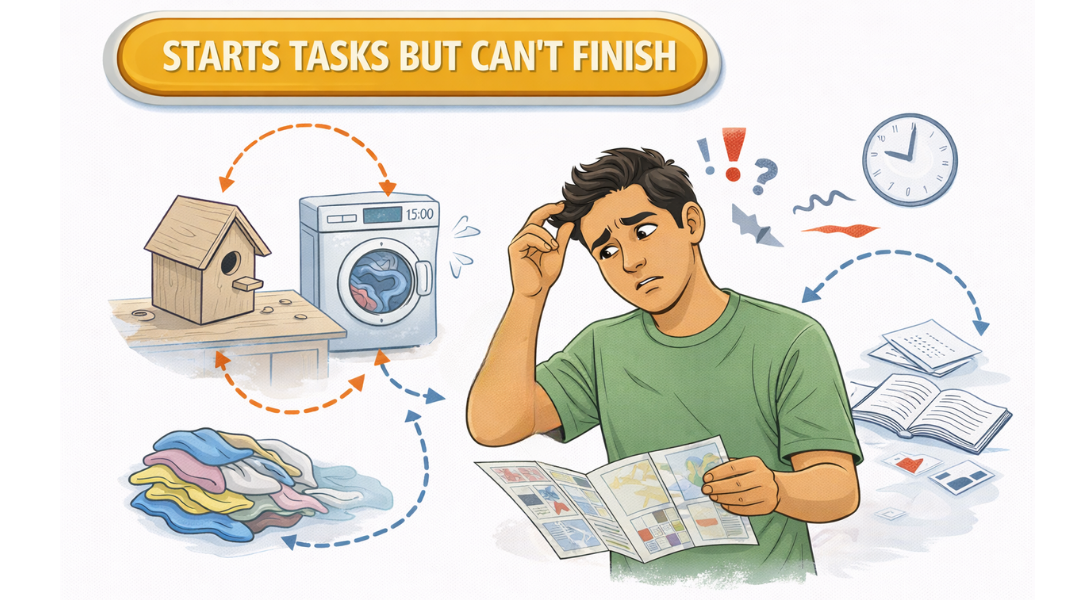
🧠 What You Are Seeing
- They start tasks independently
- But during the task, they:
- lose track of steps
- get distracted
- stop midway
- don’t know how to finish
The problem is not starting—it’s finishing.
⚙️ What Is Actually Happening
Completing a task requires continuous executive control.
The brain must:
- hold the goal in mind
- track progress
- sequence steps
- stay focused over time
- adjust when something changes
👉 When this system breaks down:
- attention drifts
- steps are lost
- the task becomes disorganized
They lose the thread of the activity.
🔎 Real Clinical Example
Patient begins a task like:
- doing laundry
- preparing a meal
- organizing items
They:
- start correctly
- move between steps inconsistently
- leave tasks incomplete
- require cues to finish
→ Initiation is intact
→ Completion and organization are impaired
⛓️💥 Skills Breakdown
- Starts tasks → can’t sustain them
- Knows steps → loses sequence
- Engages initially → drifts off task
- Attempts completion → becomes disorganized
⚠️ Why This Gets Missed
- Starting ability gives the impression of independence
- Partial completion is mistaken for success
- Behavior may be labeled as:
- distracted
- unmotivated
- careless
We assume:
“They just need to try harder.”
But the brain is struggling to maintain goal-directed action.
🛠️ What To Do About It
- Break tasks into clearly defined steps
- Provide visual or written sequencing
- Reduce competing distractions
- Cue progression through the task
At the same time:
- train sustained attention
- support task organization
- gradually increase independence in completion
The goal is not just starting—
it’s completing tasks successfully.
These are starting points - not full interventions.
Treating this effectively requires structured task progression, sequencing support, and training of sustained attention and executive control.
This is where most clinicians get stuck.
How This Fits Into Clinical Practice
Standardized tests may capture components of executive function…
…but may not reflect performance across an entire task.
- Tests measure discrete skills
- Functional tasks reveal sustained performance and completion
Performance can be tracked through:
- task completion rate
- need for cues
- sequence accuracy
- time to completion
This is critical for independence in daily activities.
If they can’t finish the task, they can’t function independently.
Want to Go Deeper
This is one of the most common executive function problems in practice.
Learn how to:
- assess task completion breakdown
- structure sequencing and support
- train follow-through in real-world tasks